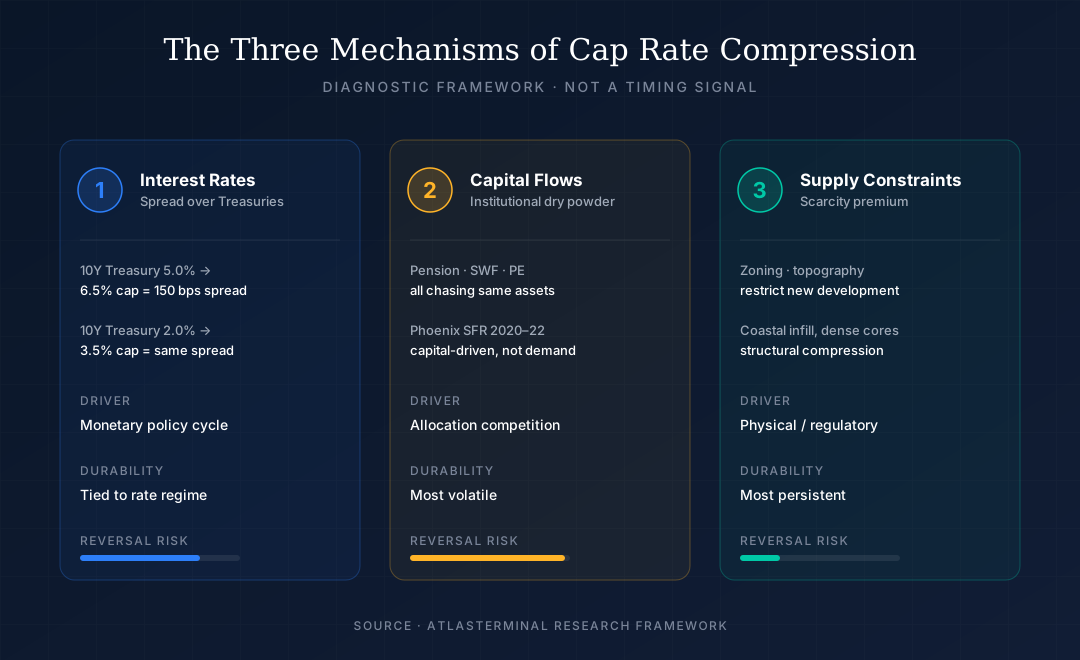
Most real estate investors treat cap rate compression as a market timing signal — a flashing indicator that a market is “hot” or “overpriced.” That framing is imprecise, and imprecision in underwriting compounds. Cap rate compression is better understood as a diagnostic: a symptom of identifiable forces operating on asset prices. Knowing which forces are at work, and whether they are durable, is what separates analytical underwriting from pattern-matching.
What a Cap Rate Actually Measures
A capitalization rate — net operating income divided by asset value — is a snapshot of the income yield embedded in a transaction price at a point in time. A property generating $72,000 in annual net operating income purchased for $1,200,000 carries a 6.0% cap rate. If that same income stream is repriced to $1,500,000 a year later, the cap rate falls to 4.8%. The property’s income did not change. The market’s required yield on that income did.
This distinction is the foundation of rigorous cap rate analysis. Compression does not necessarily mean income growth is slowing or that fundamentals are deteriorating. It means the price an investor must pay per dollar of income has increased. The mechanism behind that price increase determines everything about its durability.
The Three Mechanisms of Compression
Cap rate compression is driven by a relatively small set of identifiable forces, and they operate largely independently of one another.
1. Interest Rate Levels and the Risk-Free Rate
Real estate is priced in relation to alternatives. When the 10-year Treasury yield — the conventional risk-free benchmark — falls, investors seeking income-producing assets accept lower absolute yields while maintaining comparable spreads over the risk-free rate. In a 5.0% rate environment, a 6.5% cap rate represents a 150 basis point spread over Treasuries. In a 2.0% environment, the same spread logic could price the same asset at 3.5%. The income did not change. The discount rate did.
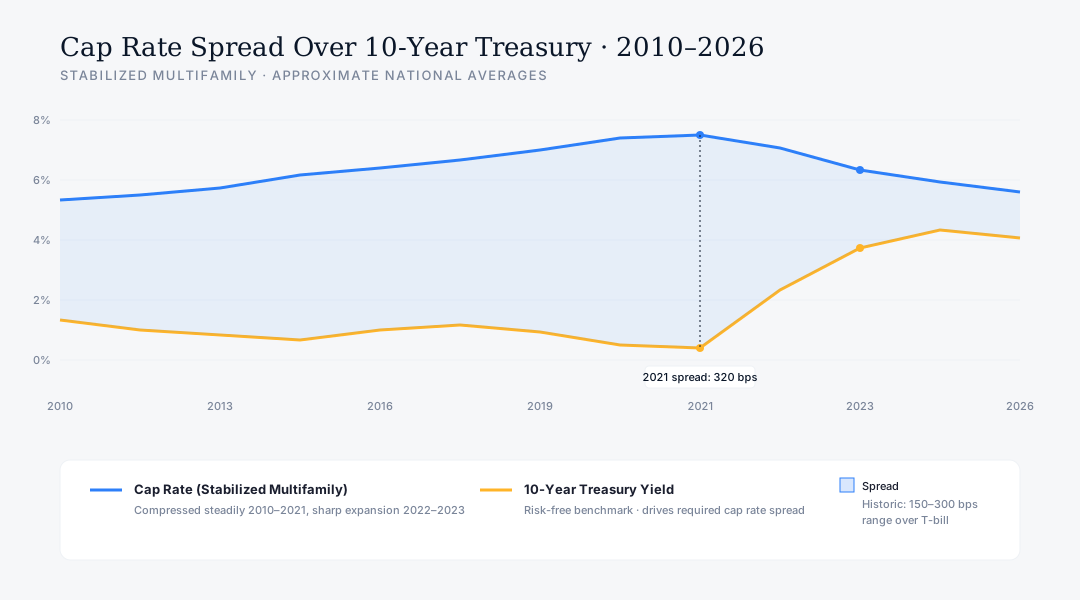
This mechanism explains why cap rates in primary US markets compressed steadily from 2010 through 2021 alongside declining interest rates — and why 2022–2023 saw rapid expansion as the 10-year Treasury moved from approximately 1.5% to over 4.5%. The compression cycle was, in significant part, a monetary policy cycle.
2. Capital Flows and Institutional Dry Powder
Institutional capital — pension funds, sovereign wealth vehicles, private equity real estate funds — competes intensively for the same assets in the same liquid markets. When large pools of capital seek stable income-producing properties simultaneously, competition for those assets compresses yields independent of income fundamentals. The surge in institutional single-family rental investment between 2020 and 2022 drove meaningful cap rate compression in markets like Phoenix, Atlanta, and Charlotte, largely through capital velocity rather than genuine demand-side rental growth.
This type of compression is more volatile than rate-driven compression. Institutional capital can exit quickly when return targets are no longer achievable or when capital is redirected toward other asset classes.
3. Supply Constraints and Scarcity Premium
In markets where new supply faces significant regulatory, topographic, or entitlement barriers, a scarcity premium accretes into pricing over time, independent of income dynamics. Coastal infill markets, dense urban cores, and jurisdictions with restrictive zoning histories exhibit structural cap rate compression because the supply mechanism that would normally expand to equalize returns is constrained. This form of compression is more durable, but also more difficult to unwind.
The Spread Framework
The most analytically useful lens for evaluating cap rates is the spread over the 10-year Treasury — not the absolute cap rate level in isolation. Historically, stabilized US real estate has priced at roughly 150 to 300 basis points above the risk-free rate, varying by asset class, market tier, and economic cycle.
When spreads narrow below 150 basis points, markets are either pricing in significant forward income growth or have become detached from underlying risk fundamentals. When spreads widen above 400 basis points, capital is either scarce, risk aversion is elevated, or the market is pricing in income deterioration or asset quality concerns.
Tracking the cap rate spread over time gives investors a more durable signal than the absolute cap rate. A 5.5% cap rate with a 10-year at 4.0% (150 bps spread) represents a very different risk environment than a 5.5% cap rate with a 10-year at 2.0% (350 bps spread), even though the nominal cap rate is identical.
Geographic Dispersion and Rotation
Compression does not move uniformly across markets. Secondary and tertiary markets frequently lag primary market compression by 12 to 24 months, creating a pattern where capital rotates toward higher-yielding markets as gateway market spreads narrow. Investors who tracked this rotation pattern during the 2012–2020 cycle — monitoring cap rate trends in Sun Belt metros as coastal cap rates reached cycle lows — captured a meaningful informational advantage.
The relevant analytical exercise is cross-market relative value: comparing cap rate levels and trends across comparable asset classes in different geographies, not evaluating a single market in isolation. A 5.0% cap rate in a high-growth secondary market may represent more attractive risk-adjusted pricing than a 4.5% cap rate in a supply-constrained coastal gateway — or vice versa, depending on income growth assumptions and exit dynamics.
Compression in Exit Underwriting
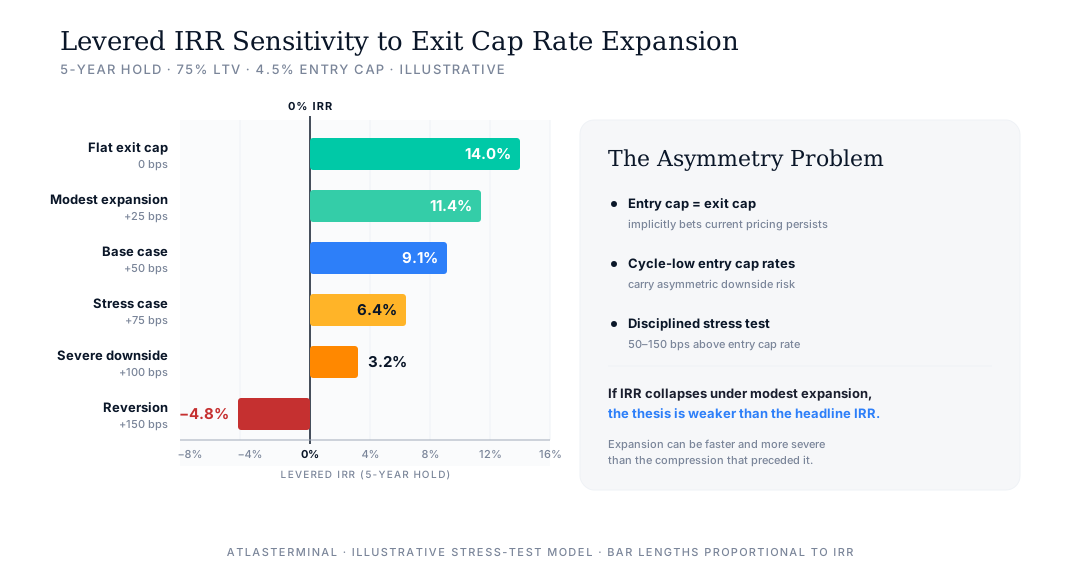
The most consequential place cap rate dynamics appear is in underwriting exit assumptions. When an investor underwrites a five-year hold at an exit cap rate equal to the entry cap rate, they are implicitly betting that current pricing — whatever forces are driving it — will persist through their hold period. When entry cap rates are at cycle lows and spreads are historically tight, this assumption carries asymmetric downside.
Disciplined underwriting stress-tests exit cap rates by 50 to 150 basis points above entry. If the projected return collapses under modest expansion — a partial reversion to historical spread norms — the investment thesis is weaker than the base-case IRR suggests. An asset that pencils to a 14% levered IRR at a flat exit cap rate but falls to 6% under 75 bps of expansion is carrying more risk than its headline return implies.
The Compression Trap
A common analytical error is extrapolating compression forward. Investors who entered assets at 4.0–4.5% cap rates in 2021, expecting continued compression toward 3.5%, experienced significant mark-to-market losses as rates normalized in 2022–2023. Cap rate expansion — the reversal of compression — tends to be faster and more severe than the compression that preceded it, because institutional capital can exit quickly and because the repricing mechanism operates through transaction prices rather than income.
Compression is not inherently a reason to avoid a market. It is a reason to be precise about what is driving it, whether the underlying forces are durable, and what the return profile looks like if compression partially reverses. The analysis, not the cap rate level itself, is what determines whether a price is rational.
Contextualizing Cap Rate Data
For individual property analysis, the most useful comparison is a distribution of cap rates across asset quality tiers, sub-markets, and vintage years — not a single market average. A Class A stabilized multifamily asset in a primary market and a Class C value-add property in a secondary market carry fundamentally different risk profiles that a nominal cap rate comparison cannot capture.
Secondary metrics that belong alongside cap rate in any rigorous underwriting:
- Debt yield (NOI / loan balance) — particularly relevant in higher-rate environments where debt service coverage ratios may constrain leverage
- Price per unit or per square foot — normalizes across asset sizes and enables cleaner comp analysis
- Rent-to-income ratios — measures the durability of tenant demand at current rental rates
- Vacancy rates and absorption — leading indicators of forward income stability
Cap rate is the entry point of real estate analysis, not the conclusion.
Frequently Asked Questions
What is a cap rate in real estate?
A cap rate (capitalization rate) is the ratio of a property’s net operating income to its current market value, expressed as a percentage. A property generating $60,000 in NOI valued at $1,000,000 carries a 6.0% cap rate. It represents the unlevered income yield embedded in the transaction price.
What does cap rate compression mean?
Cap rate compression occurs when property values rise faster than net operating income, causing the cap rate to decline. It indicates that investors are accepting lower income yields per dollar of value — typically driven by falling interest rates, increased capital competition, or supply constraints in a specific market.
Is a lower cap rate always bad for buyers?
Not necessarily. If compression reflects genuine income growth expectations and the spread over risk-free rates remains appropriate for the risk being assumed, compressed cap rates can still represent rational pricing. The key question is what mechanism is driving the compression and whether it is durable.
How do rising interest rates affect cap rates?
Rising rates typically put upward pressure on cap rates (expansion) because the spread over the risk-free rate must remain attractive for capital to stay allocated to real estate. However, markets with strong income growth can absorb rate increases without significant cap rate expansion, particularly when vacancy is low and rent growth is running ahead of debt costs.
What is a normal cap rate spread over Treasuries?
Historically, stabilized US real estate has priced at 150–300 basis points above the 10-year Treasury, varying by asset class and market. Spreads below 150 bps typically signal elevated pricing risk; spreads above 400 bps often indicate capital scarcity, elevated risk aversion, or asset quality concerns in the market being evaluated.
For a broader reference on cap rate — including the underlying formula, how to read one in context, and how it relates to debt yield and cash-on-cash — see the complete cap rate guide.
AtlasTerminal tracks cap rate trends, spread dynamics, and market benchmarks at the zip code level — giving investors the same analytical framework that institutional buyers use to evaluate markets and stress-test acquisition assumptions. Access the platform to run your next market comparison.