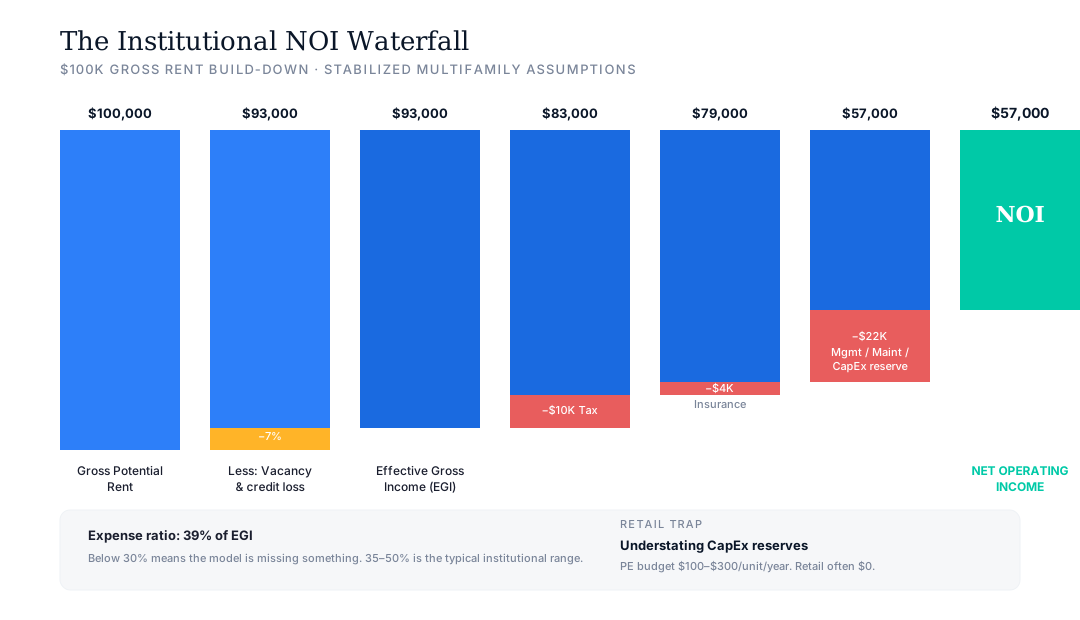
Part of our complete framework for underwriting a rental property.
Private equity firms acquire billions of dollars of residential and commercial rental property annually. Their advantage is not simply access to capital — it is analytical discipline applied consistently across every stage of the investment process. The framework they use is not proprietary. Most of it is replicable by any investor willing to be rigorous.
Understanding how institutional buyers underwrite rental properties reveals the gaps in how most retail investors evaluate deals — and provides a practical template for closing them.
Starting with the Right Question
Retail investors typically begin underwriting with a question about cash flow: “What will this property net me each month?” Institutional buyers begin with a different question: “What is the risk-adjusted return on this capital, and how does it compare to alternatives?”
That framing shift drives every subsequent step. Cash flow is an output of a model. The inputs — income assumptions, expense assumptions, financing terms, exit pricing — are what actually determine whether a deal creates or destroys value. Institutional underwriting is primarily a discipline of being honest about inputs.
Building the NOI Model
Net operating income is the foundation of every valuation. NOI is gross income minus operating expenses — before debt service, depreciation, and taxes. The precision with which an investor builds this model is the primary differentiator between rigorous and superficial underwriting.
Gross Potential Rent
The starting point is market rent — what the property would generate if fully occupied at current market rates. This is not necessarily the current in-place rent, which may be below or above market depending on lease vintage. Institutional buyers model the spread between in-place and market rents explicitly, as it determines both the near-term income trajectory and the repositioning opportunity (or risk) embedded in the acquisition.
Rent comparables should be granular: same asset class, same sub-market, similar vintage and amenity profile. City-level or ZIP-level averages are starting points, not conclusions.
Vacancy and Credit Loss
Institutional underwriting does not assume full occupancy. A standard assumption is 5–8% vacancy and credit loss for stabilized assets, higher for value-add or lease-up plays. This line item represents both physical vacancy — units temporarily unrented — and credit loss, representing non-payment from occupied units.
Retail investors frequently underestimate this. Projecting 2–3% vacancy on a single-family rental in a tight market may seem conservative, but it ignores the lumpy nature of vacancy in small portfolios: one turnover month in a 12-month hold represents 8.3% vacancy. Institutional buyers solve this through portfolio diversification and market selection for low-vacancy sub-markets.
Operating Expenses
The most common underwriting error by retail investors is understating operating expenses. Institutional buyers model the following categories explicitly:
- Property taxes — at assessed value post-acquisition, not pre-acquisition assessed value
- Insurance — full replacement cost coverage, not minimums
- Property management — typically 8–12% of effective gross income for third-party management
- Maintenance and repairs — recurring, budgeted line item, not zero
- Capital expenditure reserves — typically $100–$300 per unit per year for stabilized multifamily, higher for older vintage assets and single-family homes
- Utilities (if landlord-paid) — actual utility costs, not estimated
- Administrative and legal — lease renewals, evictions, compliance
A well-underwritten rental property typically carries an expense ratio of 35–50% of effective gross income, varying by asset class and management structure. If a pro forma shows operating expenses below 30% of gross revenue, the model is almost certainly missing something.
The Debt Coverage Ratio
Institutional lenders and buyers both focus on the debt service coverage ratio (DSCR): NOI divided by annual debt service. A DSCR of 1.0x means NOI exactly covers debt service; anything below is cash-flow negative before reserves and taxes. Most institutional buyers target a minimum DSCR of 1.20x–1.25x at acquisition, with stress-testing to confirm the deal remains above 1.0x under a scenario of higher vacancy, lower rents, or rising rates.
DSCR discipline also informs maximum leverage. If a deal requires more than 70–75% LTV to generate acceptable returns, institutional buyers typically re-examine whether the entry price is right rather than accepting more leverage to make the math work. Leverage amplifies both upside and downside; the institutional preference is to be selective on entry price rather than aggressive on debt.
Exit Cap Rate Assumptions
Every multi-year hold underwrites an eventual disposition. The exit cap rate assumption — the cap rate at which the property is assumed to transact at the end of the hold period — is the most sensitive variable in a return model, and the one retail investors most frequently get wrong.
The common error is assuming the exit cap rate equals the entry cap rate. This is optimistic in any environment and dangerously optimistic when entry cap rates are at cycle lows. Private equity underwriting stress-tests exit assumptions across a range: base case (flat or modest expansion), downside (75–150 bps expansion), and severe downside (200+ bps expansion).
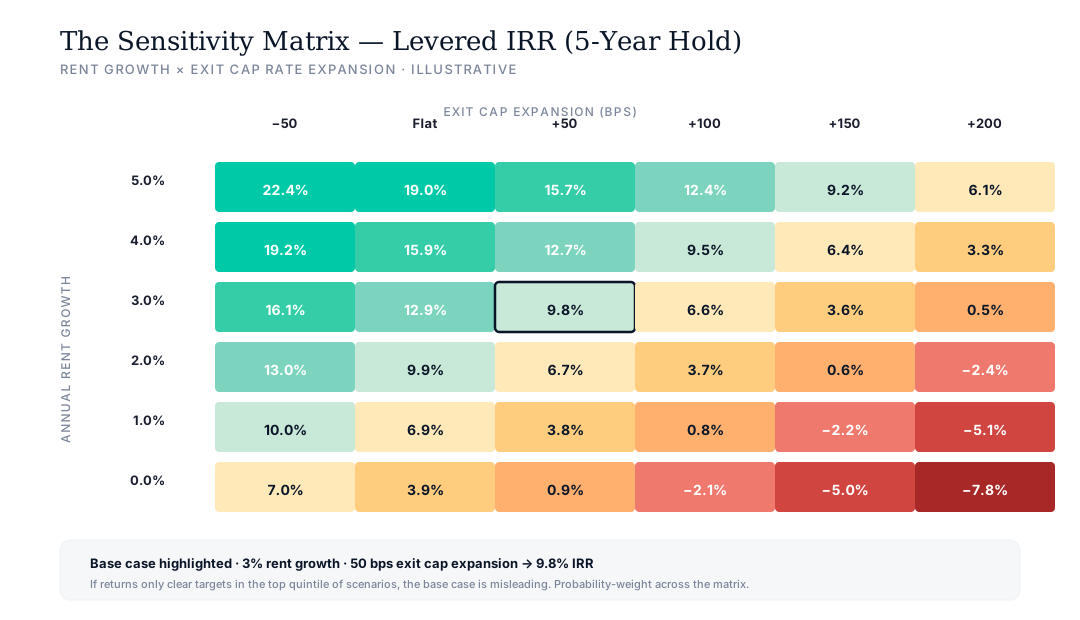
A deal that delivers a 16% levered IRR at a flat cap rate exit but 7% under 100 bps of expansion is a different risk profile than one that delivers 13% base case and 9% downside. The second deal is typically the better risk-adjusted investment.
Market Selection Criteria
Before modeling a specific property, institutional buyers apply a market selection filter. The criteria are quantitative and explicit:
- Population and household growth — positive trend over 5- and 10-year horizons
- Employment base diversification — no single employer representing more than 20–25% of local employment
- Rent growth trajectory — measured relative to both inflation and income growth
- Absorption and vacancy trends — demand absorbing new supply without sustained vacancy increases
- Regulatory environment — rent control exposure, eviction policy, permitting difficulty for competing supply
This pre-filter eliminates markets regardless of how attractive any individual property may appear. An excellent property in a deteriorating market will underperform a good property in a strong market over a 5–7 year hold.
The Sensitivity Table
Institutional underwriting always includes a sensitivity analysis: a matrix showing how returns change across combinations of rent growth assumptions and exit cap rates. This table is more informative than any single projected return. It answers the question: “How wrong do I need to be, and on which variables, before this investment fails to meet my return threshold?”
The sensitivity table forces honest engagement with uncertainty. If an investment only meets return targets in the top 20% of scenarios in the sensitivity matrix, the base case return is misleading — the expected return, probability-weighted across scenarios, is materially lower.
Due Diligence Beyond the Model
Financial modeling is necessary but not sufficient. Institutional due diligence also covers:
- Physical inspection and condition assessment — a third-party property condition report identifying deferred maintenance and near-term CapEx requirements
- Rent roll review — lease terms, lease expirations, concessions, any guaranteed or below-market rents
- Title and encumbrance review — liens, easements, restrictions, and access rights
- Zoning and permitting — permitted uses, any non-conforming conditions, development rights
- Environmental assessment — Phase I at minimum for any commercial or mixed-use asset
Each of these can materially alter acquisition economics. Skipping or abbreviating any of them is not analytical conservatism — it is accepting unknown risk that should have been quantified before closing.
What Retail Investors Most Commonly Miss
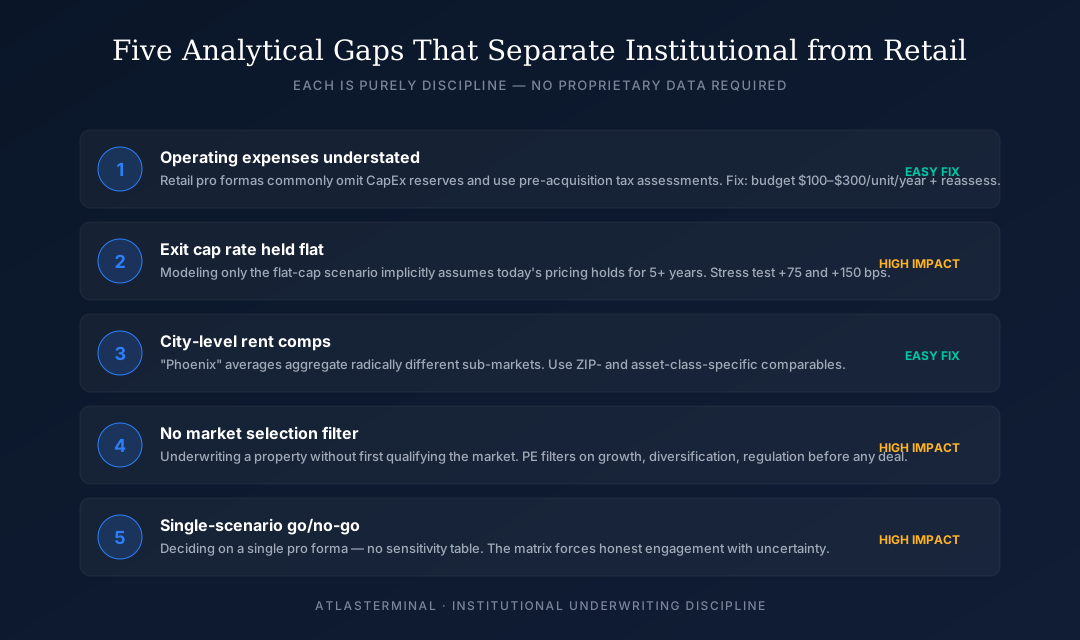
Synthesizing the above, the analytical gaps that most consistently separate institutional from retail underwriting are:
- Understating operating expenses, particularly CapEx reserves and post-acquisition property tax
- Ignoring exit cap rate sensitivity — modeling only the flat-cap-rate scenario
- Using city-level rent comps rather than sub-market and asset-class-specific comparables
- Omitting market selection filters — underwriting a property without first qualifying the market
- No sensitivity analysis — making go/no-go decisions on a single-scenario pro forma
None of these require institutional resources to fix. They require analytical discipline applied systematically.
Frequently Asked Questions
What is NOI in real estate?
Net operating income (NOI) is a property’s gross revenue minus all operating expenses, before debt service, depreciation, and income taxes. It is the primary measure of a property’s income-generating capacity and the basis for cap rate valuations.
What is a DSCR and why does it matter?
Debt service coverage ratio (DSCR) is NOI divided by annual debt service (principal and interest). It measures how comfortably a property’s income covers its debt obligations. Lenders typically require a minimum of 1.20x–1.25x; below 1.0x means the property is cash-flow negative before taxes and reserves.
How do institutional investors select rental property markets?
Institutional buyers filter markets on quantitative criteria: population growth, employment diversification, rent growth relative to income growth, absorption rates, and regulatory environment. Properties in markets that fail these filters are typically excluded regardless of individual asset attractiveness.
What exit cap rate should I use in my underwriting?
A rigorous approach models multiple scenarios: flat cap rate (optimistic), 75 bps expansion (base case in a normalizing rate environment), and 150+ bps expansion (downside). If returns collapse under the base case expansion, the deal carries more risk than headline returns suggest.
What expense ratio is realistic for a rental property?
For single-family rentals, operating expense ratios of 35–45% of gross potential rent are typical when all expenses are properly captured, including management, maintenance, CapEx reserves, taxes, and insurance. Multifamily assets with scale economics can run lower; older assets or those with landlord-paid utilities typically run higher.
AtlasTerminal brings institutional underwriting discipline to individual investors — with property-level NOI modeling, market comp databases, exit cap rate sensitivity tools, and sub-market analytics in a single platform. Start your next underwriting with the same framework institutional buyers use.