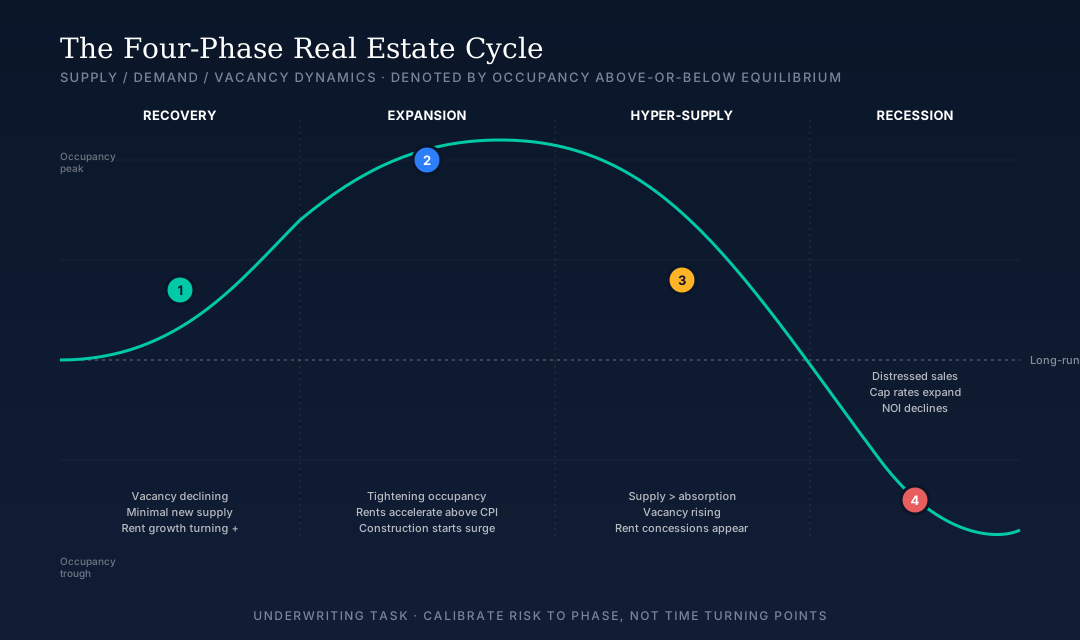
The real estate market cycle is not a theoretical construct. It is a pattern of supply, demand, and pricing behavior that repeats across markets, asset classes, and time horizons with sufficient regularity to be analytically useful. Investors who can identify where a market sits in the cycle — and adjust their assumptions accordingly — make materially different decisions than those who treat every market as being at the same point.
Understanding the cycle is not about predicting turning points. That is market timing, and it is notoriously unreliable. It is about calibrating risk: being honest about whether you are underwriting into a market that is absorbing supply, adding supply, or declining — and whether your assumptions reflect that reality.
The Four Phases
The most widely used framework for real estate market cycles identifies four phases, each with distinct characteristics in terms of vacancy, absorption, new supply, and pricing.
Phase 1: Recovery
Recovery follows a trough. Vacancy rates are elevated but declining. Absorption — the net change in occupied space — is positive but modest. New supply is minimal, as construction begins during downturns are rare given financing constraints and weak demand signals. Rental growth is flat or slightly positive as markets begin to tighten.
Investors operating in recovery phase markets face limited competition, distressed acquisition opportunities, and the prospect of significant appreciation as the market moves toward expansion. The risk is timing: early recovery can be difficult to distinguish from continued decline, and markets can move sideways for extended periods before genuinely turning.
Key metrics for recovery identification: - Declining vacancy rate over 2–4 consecutive quarters - Positive net absorption with minimal new supply entering the pipeline - Rent growth turning positive after a period of flat or negative growth - Stabilizing or improving employment in the local economy
Phase 2: Expansion
Expansion is characterized by tightening supply and accelerating demand. Vacancy rates move below long-run equilibrium levels, rent growth accelerates, and — critically — new construction begins in earnest as developers respond to improving economics and financing becomes available.
This is typically the most favorable acquisition environment: fundamentals are improving, rent growth supports underwriting, and new supply has not yet arrived in volume to constrain income growth. Returns are improving in real time, and leverage is accessible on reasonable terms.
The risk in late expansion is acquiring into conditions that are the most favorable they will be during the cycle, at the prices that reflect that optimism. Late-expansion acquisitions require careful exit underwriting; the entry environment will not persist through a full hold period.
Key metrics for expansion identification: - Vacancy approaching or below long-run equilibrium (typically 5–7% for residential, asset-class-dependent for commercial) - Accelerating rent growth, often running above CPI inflation - Rising construction starts and growing development pipeline - Rising transaction volume and declining days on market
Phase 3: Hyper-Supply
Hyper-supply occurs when the new construction pipeline — which was rational when initiated during expansion — delivers into a market that is no longer absorbing at the same pace. Vacancy begins to rise as new supply exceeds net new demand. Rental growth slows, stabilizes, or begins to decline.
This phase is often misidentified as late expansion by investors focused on trailing data. Because rent growth and income metrics reflect recent conditions, the forward-looking indicators — construction pipeline, absorption trends, population growth deceleration — are the more relevant signals. A market with rising vacancy and a large construction pipeline is likely in hyper-supply even if trailing-twelve-month rent growth appears positive.
Key metrics for hyper-supply identification: - Rising vacancy despite positive absorption — supply exceeding demand - Slowing rent growth or rent concessions becoming common - Large construction pipeline relative to market inventory - Cap rate stability or modest expansion despite strong recent income growth
Phase 4: Recession
The real estate recession phase is characterized by declining income, rising vacancy, and falling prices. Absorption turns negative (occupied stock is decreasing), new construction slows sharply as development economics deteriorate, and distressed sales begin to appear. Cap rates expand as buyers require higher yields to compensate for income risk.
The severity of the recession phase varies significantly by market. Markets with diversified employment bases, constrained supply, and moderate leverage tend to experience shorter and shallower downturns. Markets dependent on a single industry or employer, or those that accumulated excessive supply during expansion, tend to see sharper corrections.
Key metrics for recession identification: - Declining vacancy — but note this is a lagging indicator; new supply has stopped, reducing additions to inventory even as demand falls - Negative net absorption over multiple quarters - Declining nominal rents or effective rents (inclusive of concessions) - Distressed sales and motivated sellers entering the market
Measuring Cycle Position: The Data Inputs
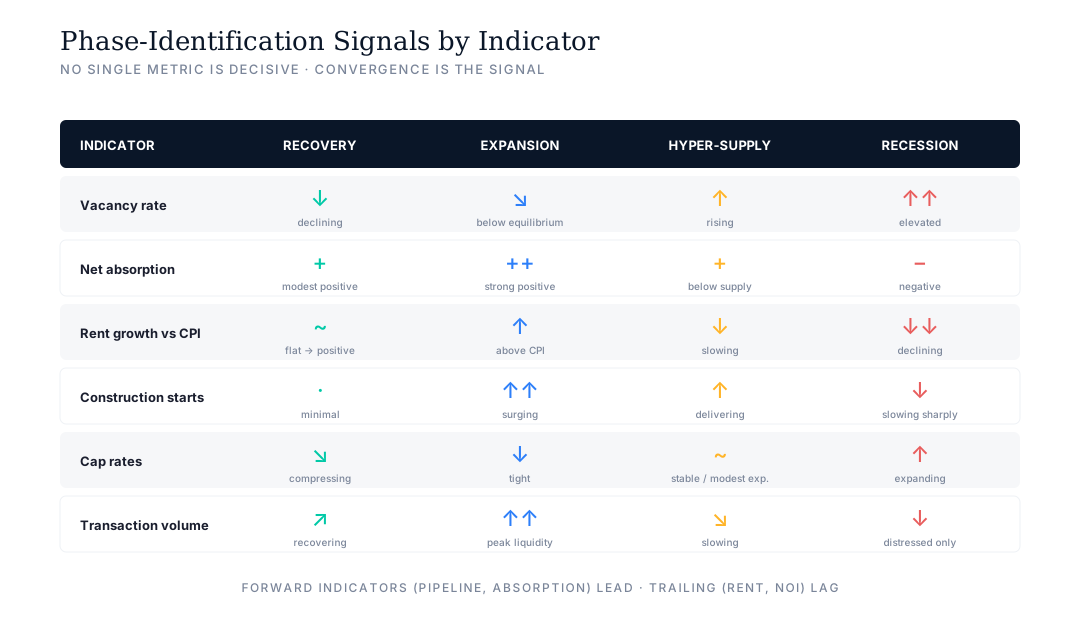
Identifying cycle position requires tracking a set of quantitative indicators across time. No single metric is sufficient; the signal comes from the combination and direction of movement across indicators.
Vacancy rate is the most fundamental indicator of supply-demand balance. Long-run equilibrium vacancy varies by asset class and market, but sustained moves above or below that equilibrium signal cycle phase transitions.
Net absorption measures the change in occupied inventory over a period. Positive absorption with low vacancy indicates expansion; positive absorption with rising vacancy indicates hyper-supply (supply exceeding demand); negative absorption signals recession.
Construction permits and starts are the leading indicator for future supply. A surge in permitted residential units or commercial square footage today predicts supply delivery 12–24 months forward. Markets with large construction pipelines relative to current demand levels are accumulating future hyper-supply risk regardless of current conditions.
Rent growth relative to inflation measures the real purchasing power dynamics of the rental market. Rent growth consistently above CPI suggests tightening conditions; rent growth at or below CPI suggests equilibrium or softening.
Capitalization rates and transaction volume reflect how capital is pricing market conditions. Rising transaction volume and tightening cap rates signal capital optimism; declining volume and expanding cap rates signal capital caution.
Employment and demographic data are the fundamental demand drivers. Population growth, household formation rates, employment base composition, and income growth determine the long-run demand trajectory that short-term supply fluctuations play out against.
Adjusting Underwriting for Cycle Position
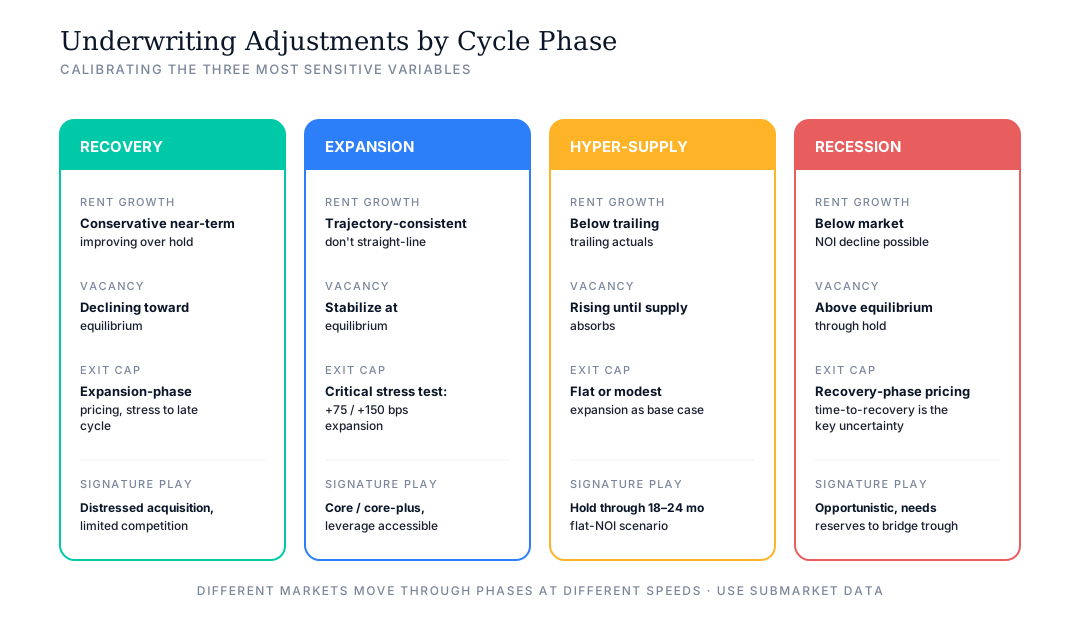
Cycle analysis informs underwriting primarily through three variables: rent growth assumptions, vacancy assumptions, and exit cap rate assumptions.
In early recovery: Use conservative near-term rent growth assumptions with improving trajectory over the hold period. Underwrite vacancy declining from current elevated levels toward equilibrium. Exit at a cap rate consistent with expansion-phase pricing, but stress-test against later-cycle expansion scenarios.
In expansion: Model rent growth consistent with recent trajectory but avoid straight-lining near-term rates across the full hold period. Model vacancy stabilizing at or near equilibrium. Critical to stress-test exit cap rates — expansion phase entries that assume continued expansion pricing at exit carry significant downside risk.
In hyper-supply: Reduce near-term rent growth assumptions below recent actuals. Underwrite rising vacancy until absorption catches up with supply. Use a flat or modestly expanding exit cap rate as base case. Only acquire at prices that survive a downside scenario of 18–24 months of flat or declining NOI.
In recession: Underwrite below-market rent growth, above-equilibrium vacancy, and the possibility of NOI decline over the hold period. Acquisitions in this phase are typically distressed or opportunistic, requiring sufficient capital reserves to hold through the trough. Exit underwriting should model recovery phase pricing, with time-to-recovery as the key uncertainty.
Multi-Market Cycle Dispersion
US real estate markets are not synchronized. Different metro areas — and different asset classes within the same metro — move through cycle phases at different times and at different speeds. A sub-market within a given MSA can be in expansion while an adjacent sub-market is experiencing hyper-supply, depending on localized supply additions and demand drivers.
This dispersion is both a risk and an opportunity. It is a risk for investors who apply macro-level cycle assessments to specific local markets without granular data. It is an opportunity for investors who track sub-market and ZIP-level indicators closely enough to identify markets that have not yet repriced to reflect their cycle position.
Building a Cycle Monitoring Dashboard
A practical cycle monitoring framework tracks the following indicators for each target market on a quarterly basis:
- Vacancy rate and trend (trailing 4 quarters)
- Net absorption relative to inventory
- Construction completions (trailing 12 months) versus units under construction (forward pipeline)
- Median rent growth year-over-year versus CPI
- Transaction cap rates by asset class
- Employment growth and unemployment rate
- Population growth and household formation rate
No individual data point is decisive. The signal is the direction and convergence of multiple indicators. A market where vacancy is declining, absorption is positive, rents are growing above inflation, and the construction pipeline is manageable is a strong expansion candidate. A market where two or three of those indicators are reversing — even if trailing metrics still look strong — may be approaching a phase transition.
Frequently Asked Questions
What are the four phases of the real estate market cycle?
The four phases are Recovery (elevated vacancy declining, minimal new supply), Expansion (tightening vacancy, accelerating rents, growing construction), Hyper-Supply (new supply exceeding absorption, rising vacancy), and Recession (declining absorption, falling rents, distressed sales).
How do I know which phase a real estate market is in?
No single metric determines cycle position. The most reliable approach tracks vacancy trends, net absorption, construction pipeline, rent growth relative to inflation, and transaction volume together over time. The convergence of these indicators — not any single data point — identifies phase.
How should I adjust my underwriting for cycle position?
Key variables to adjust are rent growth assumptions, vacancy trajectory, and exit cap rate. Early recovery should underwrite improving vacancy and modest near-term rent growth. Expansion requires careful exit cap rate stress-testing. Hyper-supply and recession phase underwriting should use conservative NOI assumptions and model extended hold scenarios.
Can you time the real estate market cycle?
Reliably timing cycle turning points is not achievable with consistency. The analytical value of cycle awareness is calibrating risk — being honest about what phase conditions imply for income trajectory and exit pricing — rather than predicting specific turns.
Why do different markets move through the cycle at different speeds?
Local supply and demand dynamics vary significantly. Employment base composition, migration trends, zoning constraints, and development costs determine how quickly markets respond to changing conditions. This is why national or regional cycle analysis needs to be supplemented with sub-market and ZIP-level data to be actionable.
AtlasTerminal tracks vacancy rates, absorption data, construction pipelines, and rent growth across US markets — providing the quantitative inputs you need to position any acquisition within its market cycle context. Access market cycle data for your target geographies.