Rental yield and cap rate appear frequently in the same sentence when investors discuss property returns. They are sometimes used interchangeably. They should not be. The two metrics measure different things, reflect different expense treatment, and are appropriate for different analytical purposes. Using the wrong one — or conflating them — produces systematic errors in how investors evaluate acquisitions and compare markets.
The Definitions
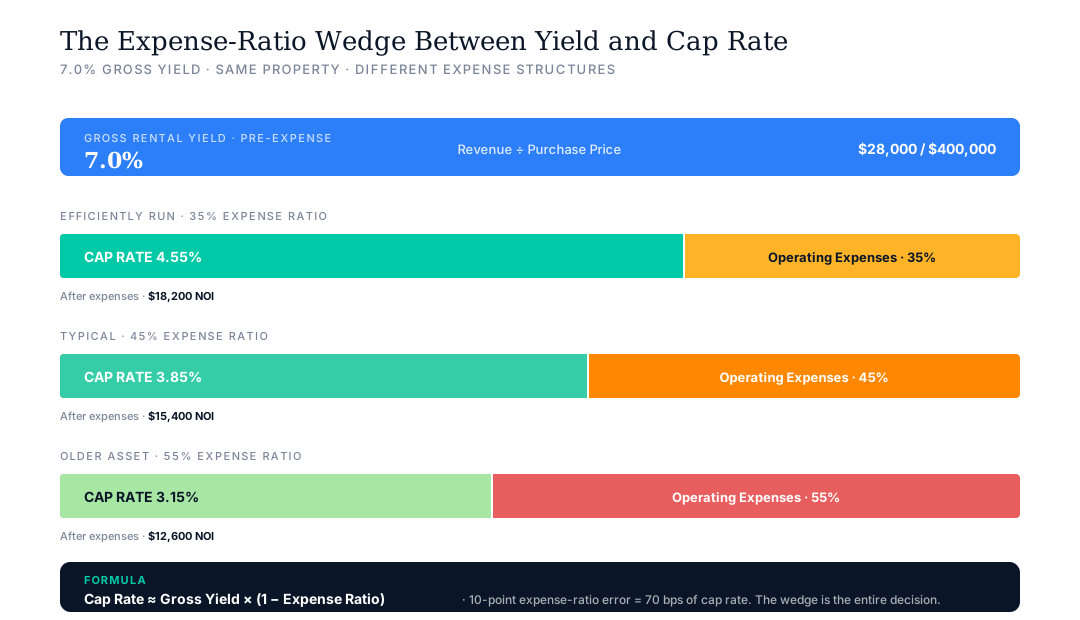
Gross rental yield is calculated as annual gross rent divided by purchase price, expressed as a percentage. A property purchased for $400,000 generating $28,000 in annual rent produces a gross rental yield of 7.0%. Expenses play no role in this calculation. It is a revenue metric, not an income metric.
Cap rate (capitalization rate) is calculated as net operating income divided by asset value or purchase price. For the same property, if annual operating expenses — taxes, insurance, maintenance, management, vacancy allowance — total $10,000, the NOI is $18,000 and the cap rate is 4.5%. Cap rate is an income metric. It accounts for the cost of generating revenue.
The difference between these two numbers — 7.0% yield versus 4.5% cap rate in this example — is the operating expense ratio embedded in the property. A high-yield property with high expenses may be less attractive than a lower-yield property run efficiently.
Why the Distinction Matters in Practice
The gap between gross yield and cap rate is not constant. It varies significantly by:
- Property type — commercial assets with net leases (tenant pays expenses) have narrower gaps; residential assets with landlord-paid utilities have wider gaps
- Asset quality and age — older assets carry higher maintenance and capital expenditure requirements
- Management structure — self-managed properties appear to have higher “returns” when management costs are excluded from the model
- Market — property tax rates, insurance costs, and utility structures vary dramatically by geography
An investor comparing a 7.5% gross yield property in a high-tax jurisdiction against a 6.5% gross yield property in a low-tax jurisdiction on yield alone may be misreading the relative value. The after-expense comparison could easily reverse the ranking.
When to Use Each Metric
The two metrics serve different purposes and are appropriate at different stages of analysis.
Gross Rental Yield: Screening and Market Comparison
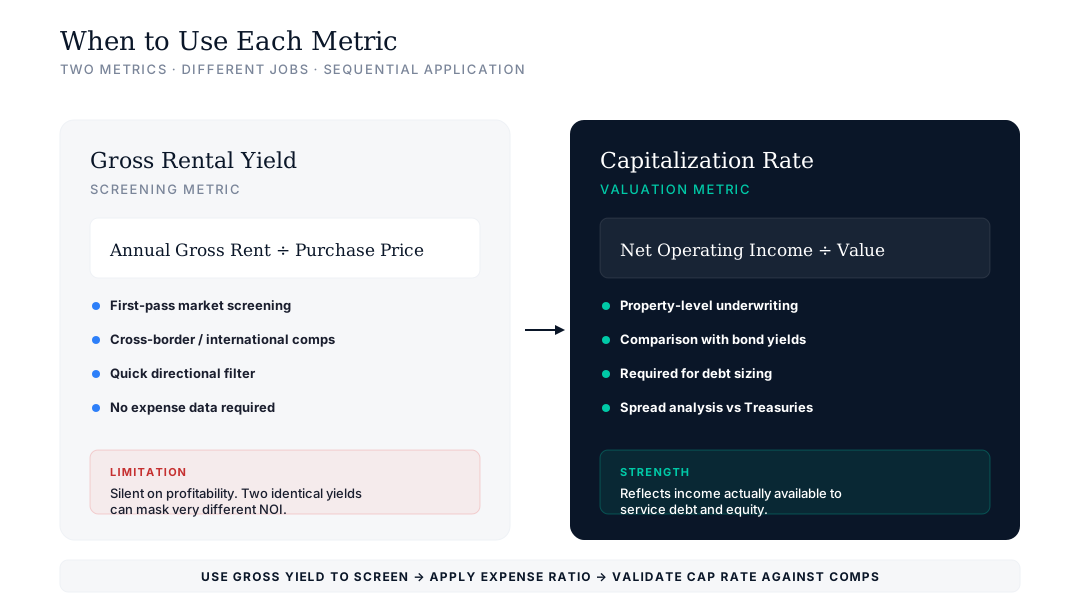
Gross rental yield is useful as a first-pass screening metric because it is quick to calculate and requires no expense assumptions. When comparing dozens of markets or properties to narrow a shortlist, yield provides a directional filter that does not require a full underwriting model.
It is also useful for cross-market comparisons at a high level — particularly for international comparisons where expense structures differ so much that cap rates are not directly comparable. A gross yield comparison across European real estate markets, for example, is more reliable than attempting to normalize expense structures across different tax and legal regimes.
The limitation is that gross yield is silent on profitability. Two properties with identical gross yields may have entirely different net income and return profiles depending on their operating expense structures.
Cap Rate: Valuation and Underwriting
Cap rate is the appropriate metric for property valuation and acquisition underwriting because it reflects the income actually available to service debt and generate equity returns. When evaluating whether a specific asset is fairly priced, the cap rate — compared against market cap rates for comparable assets — tells you whether you are paying market, above market, or below market for the income stream.
Cap rate also enables direct comparison between owning real estate and owning other income-producing assets. The spread between cap rates and bond yields, for example, is a meaningful indicator of relative value across asset classes — a comparison that gross yield cannot support because it is pre-expense.
The Expense Ratio Wedge
Understanding the expense ratio — operating expenses as a percentage of gross potential rent — is the bridge between the two metrics. For a given property, cap rate equals gross yield multiplied by one minus the expense ratio.
At a 35% expense ratio: a 7.0% gross yield produces approximately a 4.55% cap rate. At a 45% expense ratio: the same 7.0% gross yield produces approximately a 3.85% cap rate.
That gap — 4.55% versus 3.85% — is the difference between an asset priced in line with market and one that may be overpriced, depending on the market cap rate for comparable assets. Getting the expense ratio wrong by 10 percentage points changes the implied cap rate by 70 basis points.
This is why investors who use gross yield as a proxy for cap rate consistently overestimate returns. They are implicitly assuming a lower expense ratio than typically materializes, particularly once management fees, vacancy, and CapEx reserves are properly accounted for.
Common Benchmarks
While market averages vary by cycle, geography, and asset class, the following provide rough orientation:
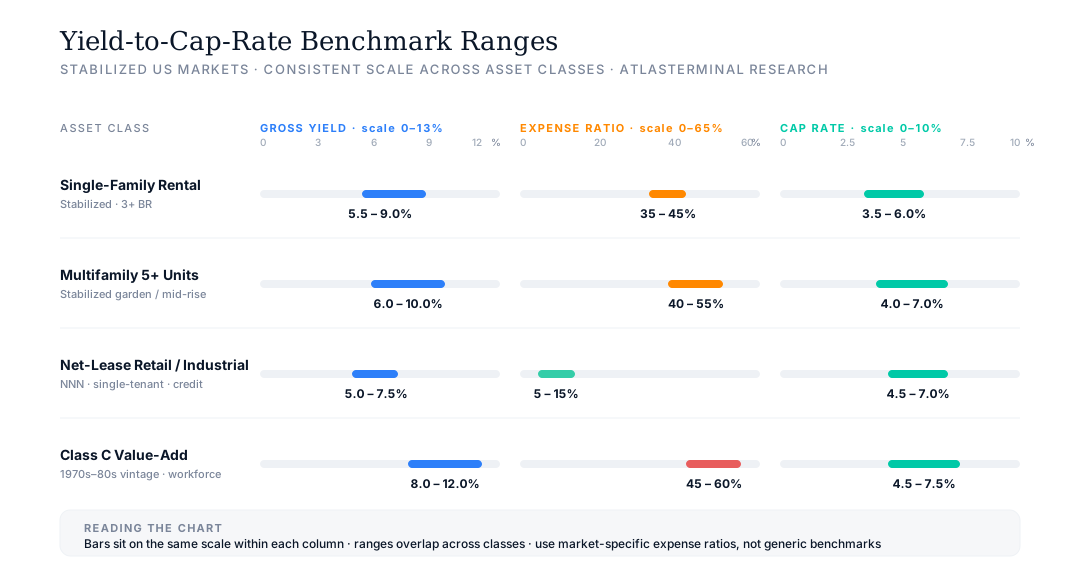
Single-family residential (stabilized): - Gross rental yield: 5.5–9.0% across US markets - Operating expense ratio: 35–45% - Cap rate: 3.5–6.0%, with meaningful spread between primary and secondary markets
Multifamily (stabilized, 5+ units): - Gross rental yield: 6.0–10.0% - Operating expense ratio: 40–55% (higher due to scale of common area maintenance and management) - Cap rate: 4.0–7.0%, varying significantly by market tier
These ranges overlap substantially. The point is not to identify a universal benchmark but to understand that a single-digit gross yield does not straightforwardly map to a net income yield that can be used for cap rate comparison — the expense wedge is too variable.
The Net Rental Yield
A third metric worth understanding is net rental yield: annual net income (after expenses, but before debt service) divided by total acquisition cost (purchase price plus transaction costs and initial CapEx). This is conceptually equivalent to cap rate but uses total investment cost rather than market value, and is more useful for modeling actual returns than for market comparison.
Net rental yield is particularly relevant when acquisition costs — transfer taxes, legal fees, renovation — are material relative to the purchase price, as is common in international markets or value-add acquisitions. A property purchased at a 5.5% cap rate may produce a 4.8% net rental yield once transaction and improvement costs are factored into the denominator.
The International Context
Gross rental yield is the dominant metric used in most international real estate analysis, partly because expense structures are too heterogeneous across markets to make cap rate comparison reliable. Investors comparing residential real estate yields across London, Tokyo, Dubai, and São Paulo will find gross yield to be the most consistent cross-market unit of analysis.
Within any individual market, however, the shift to cap rate analysis is essential for disciplined underwriting. The cross-market screening function of gross yield gives way to market-specific income modeling once an investor has identified a target market and is evaluating individual assets.
A Framework for Using Both
A practical approach combines both metrics in sequence:
- Screen markets and asset types using gross rental yield — filter for markets where yield levels are sufficient to support the return targets under reasonable expense assumptions
- Apply expense assumptions to convert gross yield to cap rate — use market-specific benchmarks for operating expense ratios, not generic defaults
- Validate cap rate against market comps — confirm the resulting cap rate is in line with market pricing for comparable assets
- Stress-test NOI assumptions — model vacancy, operating cost increases, and CapEx surprises to understand downside income scenarios
Neither metric alone is sufficient. Both, used in the right sequence, are.
Frequently Asked Questions
What is the difference between rental yield and cap rate?
Rental yield measures gross rent as a percentage of purchase price, before expenses. Cap rate measures net operating income (after expenses) as a percentage of value. The gap between them is determined by the operating expense ratio of the property.
Which is more accurate — rental yield or cap rate?
Cap rate is more informative for valuation and underwriting because it accounts for operating expenses. Rental yield is more useful as a screening metric for quick market comparisons where expense data is unavailable or inconsistent.
Can you convert rental yield to cap rate?
Yes, approximately: cap rate ≈ gross rental yield × (1 - operating expense ratio). At a 40% expense ratio, a 7.5% gross yield corresponds roughly to a 4.5% cap rate. The accuracy depends on how precise your expense ratio estimate is.
What is a good rental yield for a buy-to-let property?
There is no universal standard — it depends on local cap rates, financing costs, and return targets. As a rough heuristic, gross yields significantly below local financing rates typically indicate difficulty achieving positive leverage; gross yields well above financing rates may indicate higher risk, lower quality, or market mispricing.
Why do some markets have high yields but poor returns?
High gross yields can mask high expense ratios, high vacancy, poor rent growth prospects, or deteriorating market fundamentals. A 10% gross yield in a market with declining population, weak employment, and high physical vacancy may produce lower total returns than a 5.5% gross yield in a high-growth, low-vacancy market with strong rent escalation.
For a complete reference on cap rate as a standalone metric — including its formula, what it leaves out, and how it relates to other return measures — see the complete cap rate guide.
AtlasTerminal computes gross rental yield, cap rate, and net return metrics side-by-side at the property and ZIP code level — eliminating the manual conversion and benchmarking work that these calculations require. Analyze your target market with institutional-grade metrics.