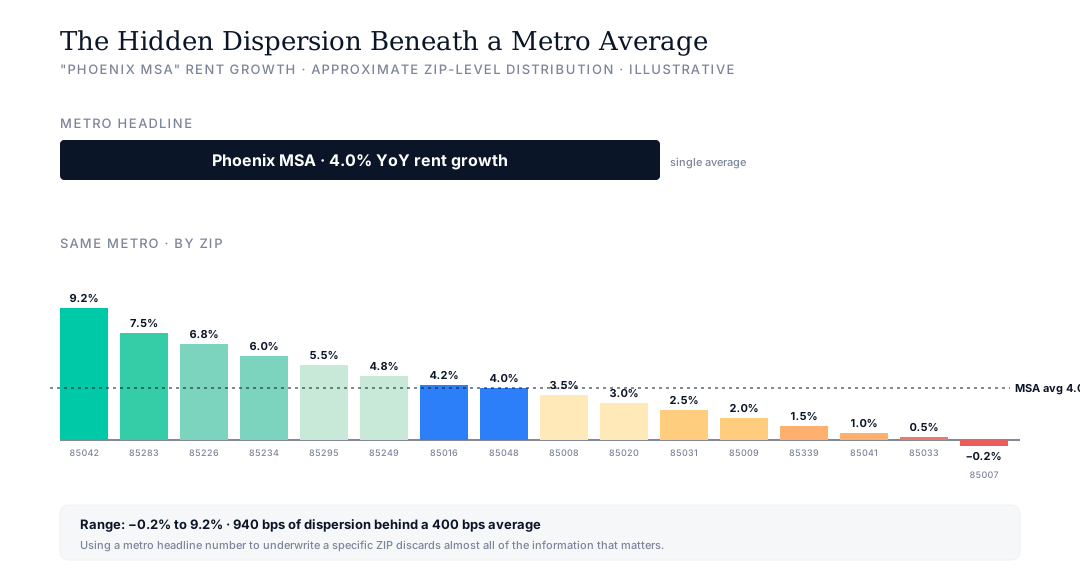
City-level real estate statistics are useful for one thing: conversation. Metro-wide average rent growth, median home prices, and vacancy rates aggregate out the variability that actually determines whether a specific investment succeeds or fails. A market with 4% average rent growth may contain ZIP codes with 9% growth and others with 1% growth. An investor using the metro average is making decisions with noise, not signal.
Institutional real estate investors do not start with metropolitan area data. They start with granular sub-market analytics — at the ZIP code level or smaller — because that is where the informational asymmetry lives. ZIP code analytics is not a niche technique. It is the standard of care for disciplined acquisition analysis.
Why City-Level Data Fails
Metropolitan statistical areas (MSAs) are administrative geographies designed for census and economic measurement, not for real estate decision-making. They contain vast internal heterogeneity: dense urban cores, inner-ring suburbs, outer-ring suburbs, industrial corridors, and exurban growth areas that behave as entirely separate markets.
A “Phoenix, AZ” market analysis aggregates conditions in Tempe, Scottsdale, Mesa, Gilbert, Goodyear, and South Phoenix — markets with meaningfully different price levels, rental demand profiles, tenant income ranges, vacancy rates, and supply pipelines. An investor relying on Phoenix-level metrics to evaluate a specific asset in any of these sub-markets is working with data that may be directionally correct but operationally useless.
The same logic applies at smaller scales. Within a single city like Austin or Denver, ZIP codes separated by two miles can have dramatically different cap rates, vacancy rates, rent-to-income ratios, and appreciation trajectories. These differences are not random — they are driven by employment access, school quality, walkability, crime, and demographic composition. They are measurable, trackable, and actionable.
The Data Layers That Matter
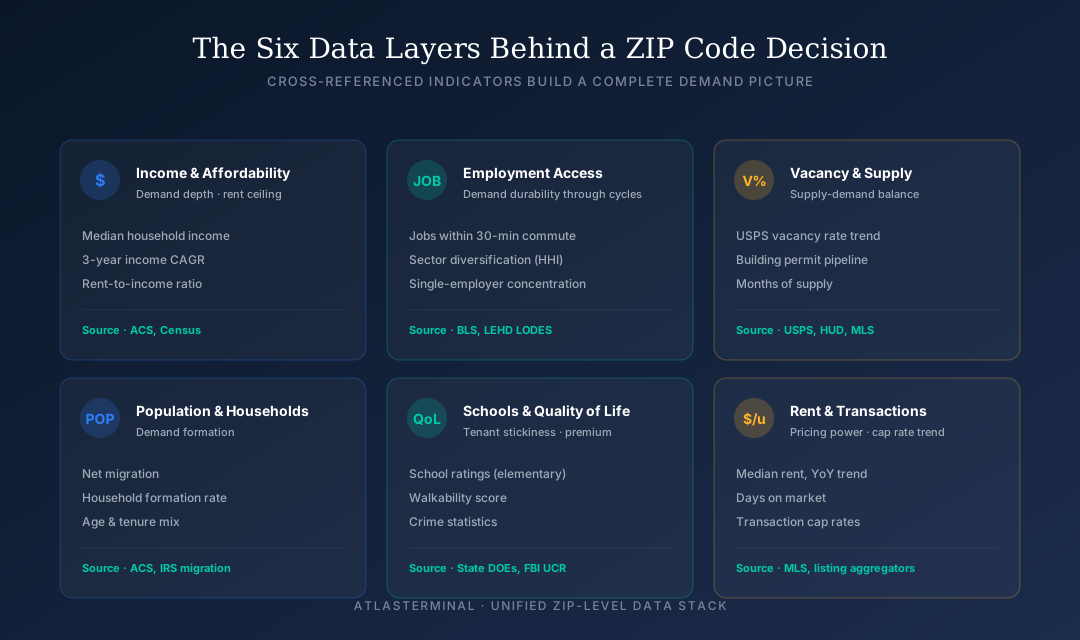
Effective ZIP code analysis layers multiple data types together. No single variable is sufficient; the analytical value comes from cross-referencing indicators to build a complete picture of demand quality, income stability, and forward trajectory.
Income and Affordability
Median household income and income growth rate at the ZIP code level determine the depth of the rental demand pool and the durability of rental rates. A ZIP code with median household income growing above the national average is experiencing demand-side appreciation that will support rent growth over time. A ZIP code with stagnant or declining median income is likely to see rent growth constrained by tenant affordability, regardless of what supply conditions look like.
Rent-to-income ratios — average rent divided by average income — indicate whether rental demand is sustainable at current price levels or stretched. Markets where rent-to-income exceeds 35–40% for the median renter are experiencing structural affordability stress, which is both a social concern and a leading indicator of demand elasticity: small rent increases may push marginal tenants to seek lower-cost alternatives or relocate.
Employment Access and Base Quality
Employment access — the number of jobs reachable within a reasonable commute from a given ZIP code — is a core driver of residential rental demand. ZIP codes with strong employment access hold demand through economic cycles more reliably than those dependent on a specific employer or industry cluster.
Employment base quality matters as much as quantity. A ZIP code adjacent to a major healthcare or technology employment hub, where incomes are above-median and employment stability is high, will support rental pricing power and low vacancy more reliably than one dependent on a single major employer in a cyclical sector. This distinction requires sector-level employment data, not just aggregate employment counts.
Vacancy Rate Trends
ZIP-level vacancy rates — tracked over time — are the most direct measure of supply-demand balance at the sub-market level. A ZIP code with vacancy consistently running below 4% has a structurally tight rental market that will support pricing power. One with vacancy trending above 8% is absorbing supply faster than demand is forming, or experiencing demand-side deterioration.
Vacancy trends are as important as levels. A ZIP code at 5% vacancy but declining (from 7% two years prior) is in a different trajectory than one at 5% vacancy and rising. The direction of movement is a stronger signal about forward conditions than the current reading in isolation.
Population and Household Formation
Net population change — not just growth rate — at the ZIP level captures whether people are moving in or moving out. In aggregate, population flows into growing metropolitan areas, but individual ZIP codes within those areas may be gaining or losing residents to adjacent sub-markets depending on development patterns, housing supply additions, and neighborhood dynamics.
Household formation rates are particularly relevant for residential rental analysis. Population growth translates to rental demand only when it converts to household formation. Student populations, for example, may inflate population counts without creating proportional rental demand if they live in shared housing or institutional dormitories.
School Ratings and Quality of Life Indicators
For long-term rental investment in residential markets — particularly single-family or small multifamily — school district and individual school ratings are strong predictors of tenant quality and holding period appreciation. Tenants with school-age children make location decisions significantly influenced by school quality, creating demand stickiness and pricing premiums that persist across economic cycles.
Quality-of-life indicators including walkability scores, access to parks and retail, and crime statistics at the ZIP or neighborhood level influence both the depth of the demand pool and the durability of pricing in that pool. These are not “soft” factors — they are the observable proxies for what drives tenant preferences and, therefore, rental demand.
Identifying Informational Asymmetry
The analytical opportunity in ZIP code analytics is not simply to find markets where all indicators look favorable — those markets are already priced efficiently because everyone can see the same positive signals. The opportunity is to identify markets where a specific combination of leading indicators suggests improving trajectory that is not yet reflected in transaction pricing.
Patterns worth tracking:
- Infrastructure investment signals — announced transit projects, road expansions, or major employer relocations have historically preceded demand increases in adjacent ZIP codes by 18–36 months, before the appreciation shows up in price data
- Income growth outpacing rent growth — improving affordability ratios suggest capacity for future rent growth without demand destruction
- Declining vacancy in a ZIP code adjacent to a high-vacancy market — may indicate demand rotation as renters seek value in lower-cost adjacencies
- Rising school ratings in a historically underperforming district — reflects improving neighborhood trajectory that typically leads pricing appreciation
These signals require granular, longitudinal data to identify. They are invisible in metro-level averages and in trailing transaction databases. They are visible in ZIP-level time-series analytics.
Building a ZIP Code Comparison Model
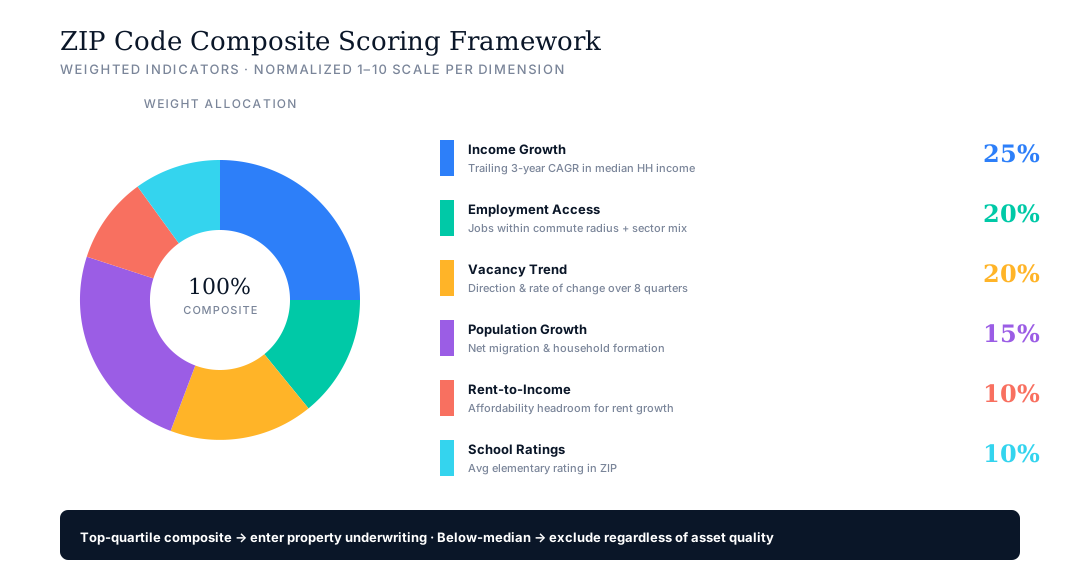
A practical ZIP code comparison model scores potential investment markets across a standardized set of indicators, allowing direct comparison between target geographies. A simple scoring framework might weight:
- Income growth (25%) — trailing 3-year CAGR in median household income
- Employment access (20%) — jobs within 30-minute commute radius, sector diversification
- Vacancy trend (20%) — direction and rate of change over trailing 8 quarters
- Population growth (15%) — net migration and household formation trend
- Rent-to-income ratio (10%) — affordability headroom for future rent growth
- School ratings (10%) — average elementary school rating in the ZIP code
Scoring on a normalized scale (1–10) across these dimensions produces a composite indicator that allows an investor to rank and compare potential markets before moving to property-level underwriting. Markets scoring in the top quartile on this framework are not guaranteed to outperform — but they start the underwriting process from a position of demonstrated demand quality rather than assumed demand quality.
From ZIP Code Screening to Property Underwriting
ZIP code analytics is a market selection tool, not a substitute for property underwriting. Once a ZIP code or sub-market qualifies through the screening framework, the next step is property-level due diligence: comparable rent analysis, physical inspection, expense modeling, financing analysis, and exit scenario stress testing.
The sequence matters. Identifying strong sub-markets before selecting properties — rather than falling in love with a property and then rationalizing the market — produces better risk-adjusted outcomes over time. The discipline is market-first, property-second.
Strong sub-market analytics also improve the accuracy of underwriting assumptions. When your vacancy assumption is grounded in ZIP-level vacancy data rather than metropolitan averages, when your rent growth assumption is derived from comparable ZIP code rent trends rather than a generic 3% inflation assumption, the pro forma reflects actual market conditions rather than analytical placeholders.
That precision is what institutional investors have and most retail investors lack. It is not a function of proprietary data. It is a function of knowing where to look.
Frequently Asked Questions
What is zip code analytics in real estate?
ZIP code analytics refers to the analysis of real estate market conditions — vacancy, rent trends, employment access, income levels, demographic composition — at the ZIP code level rather than at the city or metropolitan area level. It provides more granular and actionable market intelligence than aggregate statistics.
Why is city-level real estate data insufficient?
Metropolitan statistical areas contain enormous internal heterogeneity. ZIP codes within the same city can have dramatically different vacancy rates, rent trajectories, income levels, and demand drivers. Decisions made on city-level averages may be systematically misrepresenting conditions in the specific sub-market being evaluated.
What data sources are most important for ZIP code real estate analysis?
Key data sources include: Census Bureau income and household data, USPS vacancy data, local MLS and rental listing databases for rent comparables, building permit records, employment data from the Bureau of Labor Statistics at the county level, and school quality data from state departments of education.
How do institutional investors use zip code data?
Institutional investors use ZIP-level data to screen target markets before property-level underwriting, to calibrate vacancy and rent growth assumptions, to identify sub-markets with improving trajectories not yet reflected in transaction prices, and to benchmark individual properties against their sub-market peer set.
Can individual investors access the same zip code data as institutional investors?
Most of the data sources institutional investors use are publicly available — Census data, BLS employment data, public permit records, and MLS data are accessible with varying degrees of effort. The institutional advantage is primarily in the tooling and workflow that aggregates, normalizes, and analyzes this data systematically rather than in the data sources themselves.
AtlasTerminal aggregates ZIP-level income, vacancy, employment, and demographic data into a single analytical platform — enabling the market selection discipline that institutional investors apply before they ever underwrite a specific property. Explore ZIP code analytics for your target markets.