Part of our complete framework for underwriting a rental property.
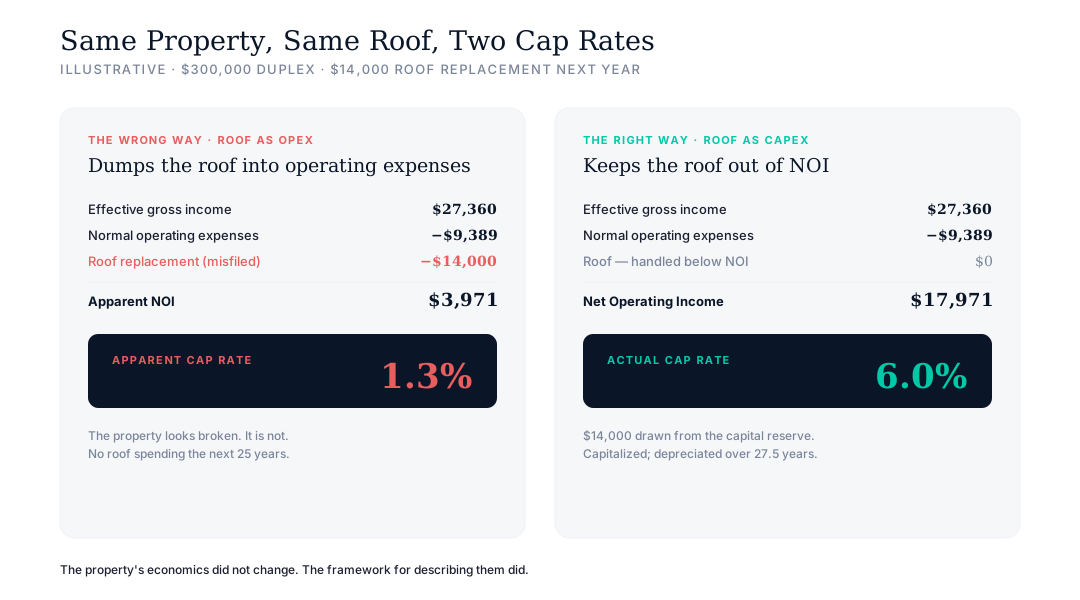
A first-time investor builds a pro forma on a $300,000 duplex. The seller’s package shows net operating income of $17,600. The inspection flags a roof at end of life — a $14,000 replacement next year. The investor subtracts the $14,000 from NOI, gets $3,600, and concludes the property earns a 1.2% cap rate. The deal looks dead. It is not — the math is wrong. A roof replacement does not belong in NOI. It belongs in a separate category called capital expenditures, and the distinction between that and operating expenses is the line every rental analysis is drawn against.
What Operating Expenses Are
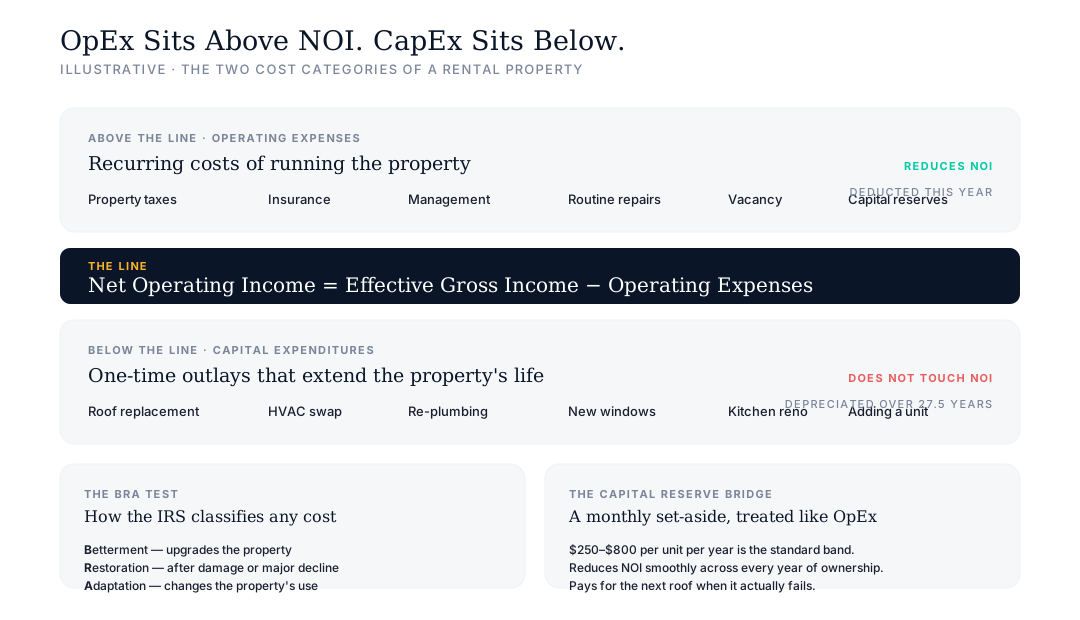
Operating expenses, often shortened to OpEx, are the recurring costs of running a rental property. They show up every year in roughly the same amount:
- Property taxes
- Insurance
- Property management fees
- Routine maintenance and repairs
- Utilities and HOA fees the landlord pays
- Vacancy and collection loss (a deduction from gross rent)
OpEx is subtracted from effective gross income to produce NOI, and it is fully deductible against rental income in the year paid — a $1,200 insurance premium is a $1,200 expense on this year’s tax return.
The defining feature of an operating expense is that it keeps the property in its current condition. Fixing a broken water heater, patching a leaky pipe, repainting between tenants — none of these change what the property is. They keep it running.
What Capital Expenditures Are
Capital expenditures, almost always shortened to CapEx, are major one-time outlays that extend the property’s useful life, restore it after damage, or change what it is:
- Roof replacement
- Full HVAC system replacement
- Major plumbing or electrical re-runs
- Window replacement across the building
- Kitchen or bathroom renovation
- Adding a unit, deck, or garage
CapEx is not deducted in the year you spend the money. It is capitalized — added to the property’s tax basis — and depreciated over its useful life. For residential rental, the IRS schedule is 27.5 years. A $14,000 roof produces a depreciation expense of roughly $509 a year, not a $14,000 expense this year.
The IRS classification test is called the BRA test, for Betterment, Restoration, or Adaptation. If a cost betters the property, restores it after a casualty, or adapts it to a new use, it is CapEx. If it keeps the property running as it already was, it is OpEx.

Why the Distinction Matters
Two reasons. First, NOI is meant to describe a normal year. A roof gets replaced once every 25 to 30 years. Dumping that single event into one year’s operating expenses collapses NOI, craters the cap rate, and makes a healthy property look broken. The whole purpose of NOI is to smooth out the cost of running the property; lumping CapEx into it defeats that.
Second, the tax treatments diverge. OpEx is deducted this year. CapEx is depreciated over 27.5 years. Misclassifying a $14,000 roof as OpEx overstates this year’s deduction by about $13,500 and invites an IRS adjustment.
The result is a two-line structure: OpEx sits above NOI and reduces it; CapEx sits below NOI and reduces cash flow only in the year it happens.
The Capital Reserve — The Bridge
If CapEx is not in NOI, how does a pro forma account for the fact that a roof eventually needs replacing? With a capital reserve — a monthly set-aside that approximates the long-run cost of future CapEx, smoothed across every year of ownership.
A reserve is treated like OpEx. It sits above NOI and reduces it. When the roof actually fails, the cash comes out of the reserve account, not that year’s operating budget.
A common benchmark is $250 to $800 per unit per year. Newer Class A or B properties sit at the low end ($250–$450); older Class C properties with aging systems sit at the high end ($600–$800). For a $300,000 single-family rental, $1,000 a year — about $83 a month — is a reasonable middle-of-the-road number.
A Worked Example
The duplex from the opening: $300,000 price, $2,400 a month in rent, $28,800 gross annual. Operating expenses, including a capital reserve:
| Line | Amount |
|---|---|
| Gross rent | $28,800 |
| Vacancy (5%) | −$1,440 |
| Effective Gross Income | $27,360 |
| Property taxes | −$3,600 |
| Insurance | −$1,400 |
| Management (8%) | −$2,189 |
| Maintenance and repairs | −$1,200 |
| Capital reserves ($83/month) | −$1,000 |
| Total operating expenses | −$9,389 |
| Net Operating Income | $17,971 |
| Cap rate (NOI ÷ Price) | 6.0% |
Next year the roof fails and costs $14,000. The wrong way drops $14,000 into operating expenses, producing an NOI of $3,971 and an implied cap rate of 1.3%. The right way leaves NOI at $17,971, draws the $14,000 from the capital reserve, and adds it to tax basis depreciated over 27.5 years.
The property’s economics did not change. The framework for describing them did.
What to Do on Your Next Listing
Run any cost through this short test:
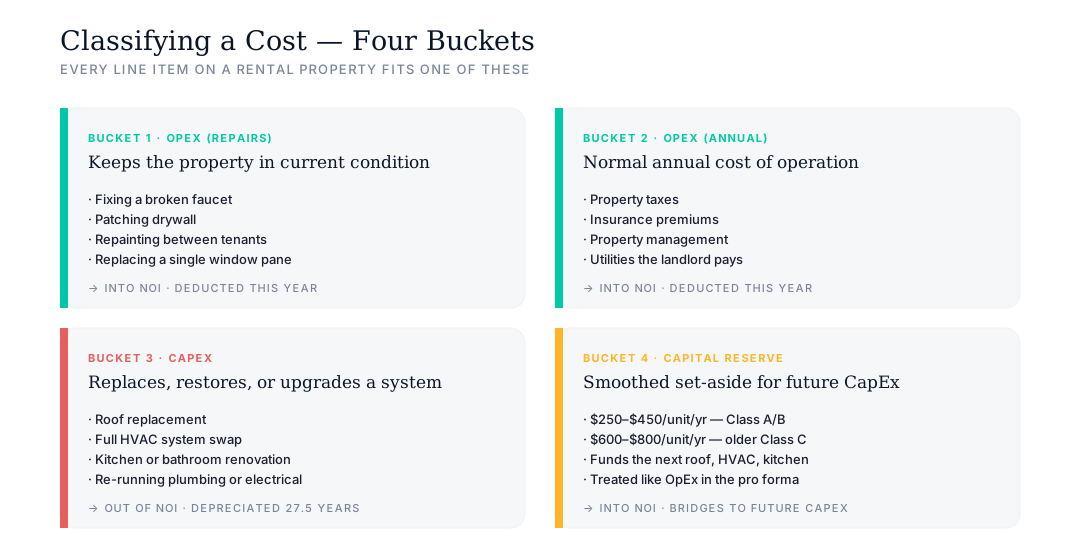
- Does the cost keep the property in its current condition? Routine repairs, painting between tenants. → OpEx. Into NOI.
- Does it replace, restore, or upgrade a major system? Roof, HVAC, kitchen renovation. → CapEx. Out of NOI. Capitalized and depreciated.
- Is it a normal annual expense? Taxes, insurance, management. → OpEx. Into NOI.
- Is it a set-aside for future major work? Capital reserves. → Treated as OpEx in the pro forma, funding future CapEx without distorting any single year.
- When in doubt, apply the BRA test. Betterment, Restoration, Adaptation → CapEx.
Get this right and the pro forma reflects long-run economics. Get it wrong and a single roof makes a normal deal look broken.
Frequently Asked Questions
Is repainting a unit OpEx or CapEx?
OpEx. Repainting between tenants keeps the unit rentable; it does not change what the property is. Same for replacing a broken faucet or patching drywall. The dollar amount does not determine the category — the nature of the work does.
What about a full kitchen renovation?
CapEx. A renovation upgrades the property — that is the betterment leg of the BRA test. The cost is capitalized and depreciated over 27.5 years. Same for a full bathroom remodel, replacing all the windows, or re-running the electrical system.
Why is the capital reserve treated as OpEx if CapEx is not?
The reserve is a smoothing mechanism, not a real CapEx outlay. It represents the expected long-run cost of future work, spread evenly across every year of ownership. Treating it as an annual operating expense puts that long-run cost into every year’s NOI — exactly the smoothing NOI is designed to do.
Do I need to track all this for a single property?
Yes. The IRS distinguishes deductible repairs from capitalized improvements; misclassifying a roof as a repair invites an audit adjustment. And mixing CapEx into OpEx makes one bad year mask the operating pattern.
AtlasTerminal builds operating expenses, capital reserves, and a discrete CapEx schedule on every rental — so the cap rate and cash-on-cash return reflect long-run economics, not a one-time event. Run the numbers on a property you are considering and see what the deal earns once the two cost categories sit where they belong.