Part of our complete framework for underwriting a rental property.
A property listing advertises $2,000 a month in rent. The asking price is $300,000. It is tempting to divide one by the other, get 8%, and conclude the deal pays an 8% yield. It does not. The number that tells you what the property actually earns — the number every other real estate metric is built on — is called Net Operating Income, or NOI. It is the first number any rental investor should learn to calculate.
This post walks through what NOI is, what goes into it, and a full worked example on a single-family rental. By the end, the reader should be able to take any listing and build NOI from scratch.
What NOI Actually Measures
Net Operating Income is the annual income a rental property produces after normal operating expenses but before the mortgage, income taxes, and depreciation. In one line:
NOI = Effective Gross Income − Operating Expenses
The word “operating” is the important one. NOI is meant to describe the property itself — how much money the bricks and the lease generate after running costs — independent of how the owner financed it or how their tax situation looks. Two investors who buy the exact same property at the exact same price will compute the same NOI, even if one pays cash and the other puts 25% down.
That is exactly why NOI is the starting point for almost every other metric in real estate. Cap rate (NOI divided by purchase price) uses it. Debt yield, cash-on-cash return, yield on cost — all of them either use NOI directly or build on top of it. Getting NOI right is the prerequisite for getting anything else right.
What NOI does not include:
- The mortgage payment (principal and interest)
- Federal or state income taxes
- Depreciation
- One-time capital improvements (a new roof, a full renovation)
Those belong to the owner, the lender, or the IRS — not the property.

The Five Lines From Rent to NOI
Every NOI calculation walks down the same five-line ladder.
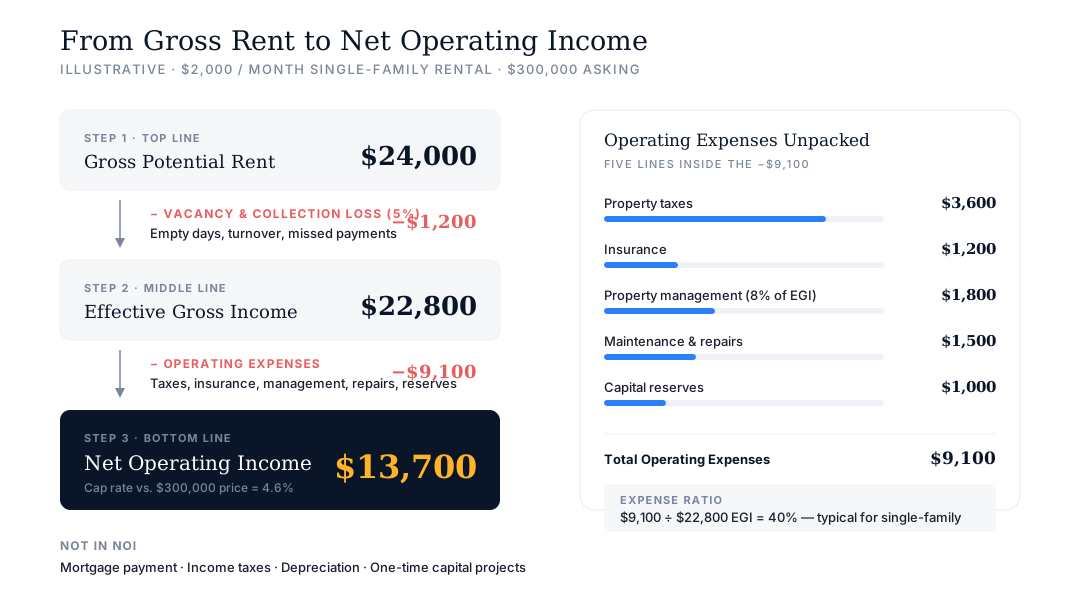
1. Gross Potential Rent. What the property would collect if it were rented every day of the year at the asking rent. For a single unit at $2,000 a month, that is $24,000 a year. This is the number on the listing, and it is the number a beginner reflex says to use. It is also the number that, on its own, tells you the least.
2. Vacancy and Collection Loss. No rental is occupied 100% of the time. Tenants move out, units sit empty between leases, and occasionally a tenant stops paying before they leave. A reasonable assumption for a stable single-family rental is 5% of gross rent; for a less stable market or property, 7–10% is more honest. Subtract this from gross rent.
3. Effective Gross Income (EGI). Gross rent minus vacancy. This is the income the property actually collects.
4. Operating Expenses. Everything required to keep the property running:
- Property taxes
- Insurance
- Property management fees (typically 8–10% of EGI for single-family rentals, even if you self-manage — count it, because your time has value)
- Maintenance and repairs
- Capital reserves (a monthly set-aside for big-ticket items like roofs and HVAC)
- Utilities and HOA fees, if the landlord pays them
5. Net Operating Income. EGI minus operating expenses. The final number.
A Worked Example
Consider a single-family rental priced at $300,000. The numbers are illustrative but realistic for a stable secondary market.
| Line | Amount |
|---|---|
| Gross Potential Rent ($2,000 × 12) | $24,000 |
| Vacancy and collection loss (5%) | −$1,200 |
| Effective Gross Income | $22,800 |
| Property taxes | −$3,600 |
| Insurance | −$1,200 |
| Property management (8% of EGI) | −$1,800 |
| Maintenance and repairs | −$1,500 |
| Capital reserves | −$1,000 |
| Total operating expenses | −$9,100 |
| Net Operating Income (NOI) | $13,700 |
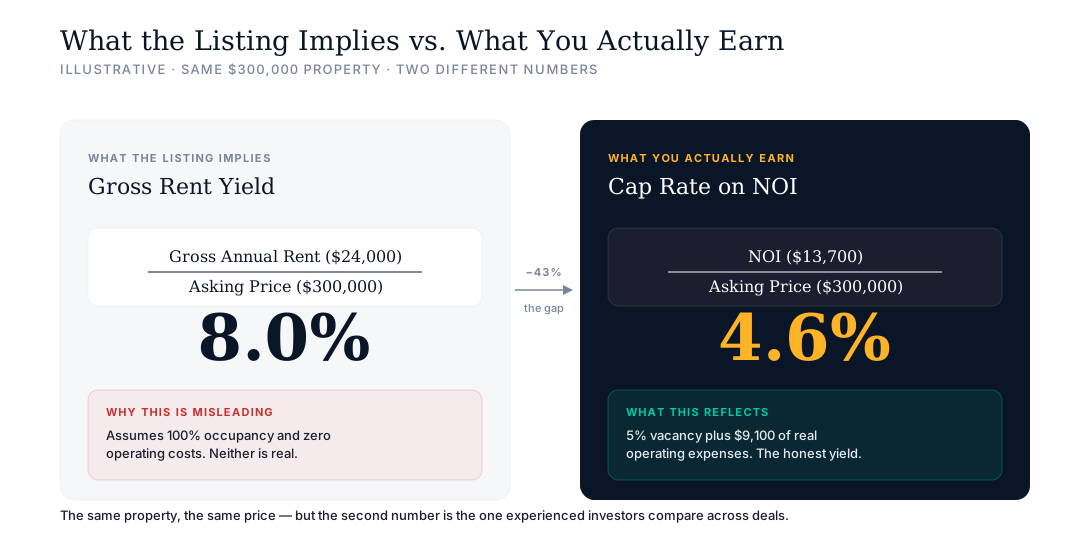
The cap rate — NOI divided by purchase price — is $13,700 ÷ $300,000 = 4.6%.
Compare that to the back-of-envelope 8% the beginner instinct produces from gross rent. Nearly half of the “yield” disappears the moment vacancy and operating costs are accounted for. That difference — between $24,000 of gross rent and $13,700 of NOI — is the entire reason this post exists. It is also the reason experienced investors look skeptically at listings that quote only gross rent.
Where Beginners Get It Wrong
The same handful of mistakes show up over and over.
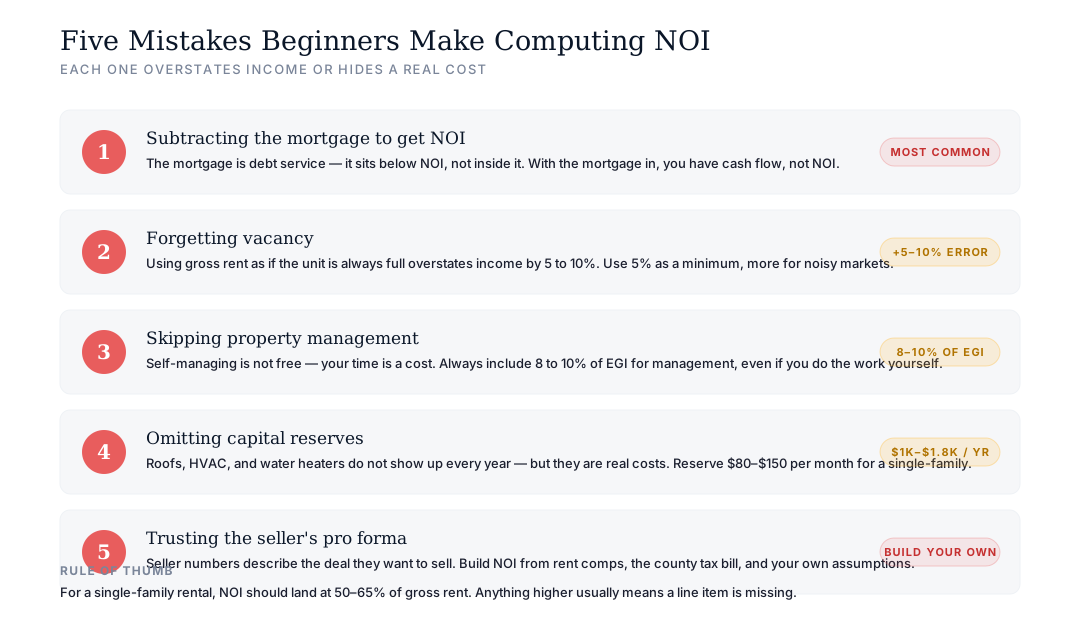
Subtracting the mortgage to get NOI. The mortgage is debt service — it sits below NOI, not inside it. Two investors with different loans will produce the same NOI on the same property. If the mortgage is in the calculation, the result is cash flow, not NOI.
Forgetting vacancy. Using gross rent as if the unit will be 100% occupied forever overstates income by 5–10%. That single line, by itself, can turn a marginal deal into a positive one on paper.
Skipping property management. Self-managing does not make management free. Your time is a real cost; pricing it in keeps the NOI comparable to a property you would buy and have professionally managed.
Omitting capital reserves. Roofs, HVAC systems, and water heaters are not annual expenses, but they are real. A monthly reserve — often $80–$150 for a single-family home — keeps NOI honest about long-term cost.
Trusting the seller’s pro forma. The numbers a seller provides describe the deal they want to sell, not the deal you will buy. Build NOI from rent comps, a tax bill, an insurance quote, and your own management and reserve assumptions.
What to Do on Your Next Listing
When the next property surfaces, take fifteen minutes and run this checklist:
- Pull the asking rent and multiply by 12 — that is gross rent.
- Subtract 5% (or more) for vacancy — that is EGI.
- Look up the property tax bill on the county website. Use the real number, not the seller’s number.
- Get an insurance quote, or use 0.4–0.6% of purchase price as a placeholder.
- Add 8% of EGI for management, plus realistic maintenance and reserves.
- Subtract total operating expenses from EGI — that is your NOI.
Then divide NOI by the asking price to get the cap rate, and compare it to other recent sales in the same market. If the cap rate is well below comparable properties, the price is too high — or your operating expenses are too low.
Frequently Asked Questions
Is NOI the same as cash flow?
No. NOI is the property’s operating income before the mortgage. Cash flow is what is left after the mortgage payment. A property can have a healthy NOI and still produce thin cash flow if the loan is large or the rate is high. Both numbers are useful — NOI tells you about the property; cash flow tells you about your specific deal.
Does NOI apply to short-term rentals?
Yes, with adjustments. For a short-term rental, gross rent becomes projected nightly revenue × occupancy, and operating expenses pick up new lines like cleaning, platform fees, and consumables. The structure is the same — gross revenue, vacancy or non-occupancy, operating expenses, NOI — but the inputs are noisier and the expense ratio is usually higher.
Why is property management included if I plan to self-manage?
Because your time is a cost and because the property should be valued as a transferable asset. If you priced the deal assuming you would manage it for free, and then sold it three years later, the next buyer would deduct management and pay less. Counting management in NOI keeps the property’s value honest from day one.
Is NOI calculated monthly or annually?
Annually, by convention. Real estate metrics like cap rate, debt yield, and yield on cost are all annual, so NOI is computed annually to match. Monthly NOI is sometimes used for cash-flow planning, but for valuation and comparison purposes always use the annual figure.
AtlasTerminal builds NOI line by line from real tax records, insurance quotes, and rent comps — no seller pro formas — and then layers cap rate, debt yield, and cash-on-cash on top. Run the numbers on a property you are considering and see what the deal actually earns.