A broker sends over a listing and says “it trades at a 7 cap.” A market report mentions that “cap rates in Phoenix have moved 80 basis points.” It is the most-cited number in real estate and one of the most commonly misread. Capitalization rate — almost always shortened to cap rate — is what this post unpacks: what it measures, how to compute it, and the four things it deliberately leaves out.
Cap rate is the third metric every beginner should learn, after net operating income and cash-on-cash return. NOI tells you what the property earns. Cash-on-cash tells you what the deal earns on your invested cash. Cap rate sits in the middle — it tells you what the property yields as a property, before any loan or any individual investor’s situation enters the picture.
What Cap Rate Measures
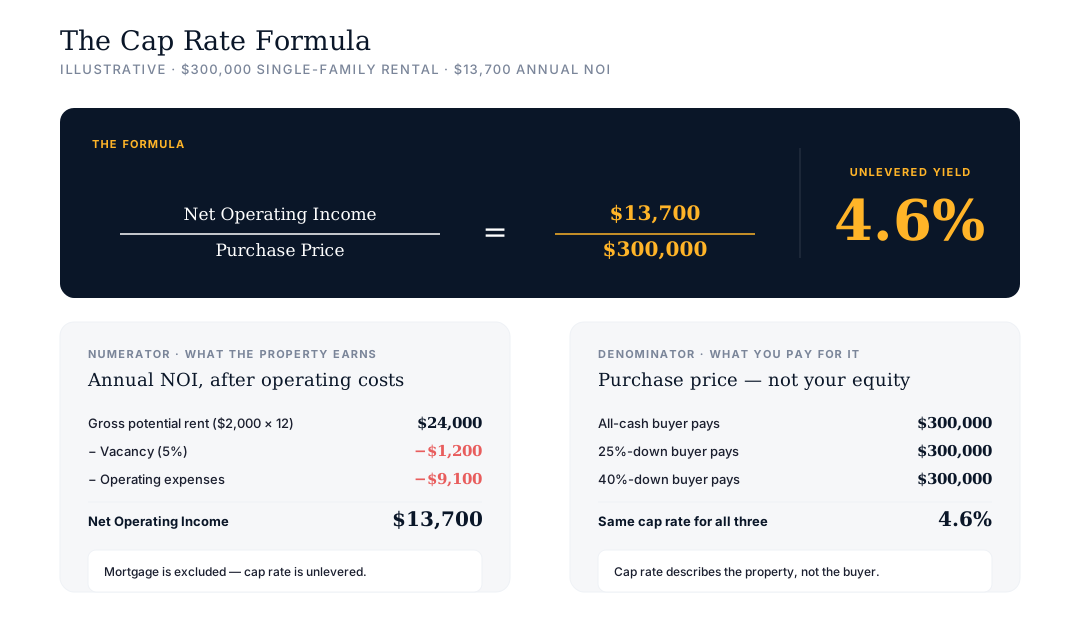
Cap rate is the annual net operating income a property produces, divided by its purchase price (or, for an already-owned property, its current market value). In one line:
Cap Rate = Net Operating Income ÷ Purchase Price
A property with $14,000 of NOI selling for $200,000 trades at a 7% cap rate. The math is mechanical. The interpretation is what matters: cap rate is the unlevered annual yield the property produces. “Unlevered” means as if the buyer paid cash — no mortgage in the picture. The same property at the same price will compute the same cap rate for an all-cash buyer, a buyer putting 20% down, and a buyer putting 40% down. Cap rate describes the bricks, not the borrower.
That is its great strength as a comparison tool. When a broker says one building trades at a 5.5 cap and another at a 7 cap, the comparison is apples-to-apples regardless of how either buyer plans to finance the deal. It is also why cap rate is the metric used in nearly every market report and every broker’s offering memorandum.

Why a Higher Cap Rate Is Not Automatically Better
The most common beginner reflex is to treat a higher cap rate as a better deal. It usually is not. Cap rates are set by the market, and they price in two things the formula does not show: risk and expected growth.
A stabilized, well-located apartment building in a major metro might trade at a 4.5% cap rate because rents grow reliably, vacancy is low, and the building is easy to finance. A similar-looking building in a secondary market with flat population growth and weaker tenant quality might trade at a 7.5% cap rate because the same cash flows are riskier and grow more slowly. The higher cap rate is the market’s way of demanding more current yield to compensate for less future growth and more downside risk.
This is why experienced investors say cap rates should be compared, not targeted. A 7% cap rate is excellent in Manhattan and unremarkable in a secondary Midwest market. The right benchmark is always recent comparable sales in the same submarket — not a national rule of thumb.
A Worked Example
Take the $300,000 single-family rental from the NOI walkthrough. The line-by-line NOI on that property was $13,700.
| Line | Amount |
|---|---|
| Purchase price | $300,000 |
| Net Operating Income | $13,700 |
| Cap rate ($13,700 ÷ $300,000) | 4.6% |
Now suppose the investor finds a similar property two zip codes away — same vintage, same condition, same rent. It is priced at $230,000 and underwrites to $14,200 of NOI.
| Line | Amount |
|---|---|
| Purchase price | $230,000 |
| Net Operating Income | $14,200 |
| Cap rate ($14,200 ÷ $230,000) | 6.2% |
The second property trades at a 6.2% cap rate versus 4.6% for the first. On paper, it is the higher-yielding deal. The next question — the one cap rate cannot answer — is why. Slower rent growth, higher vacancy, deferred maintenance, worse schools? Cap rate flags the gap; it does not explain it.
What Cap Rate Leaves Out
Cap rate is a clean and useful number, but it is silent on four things a complete return picture must include.
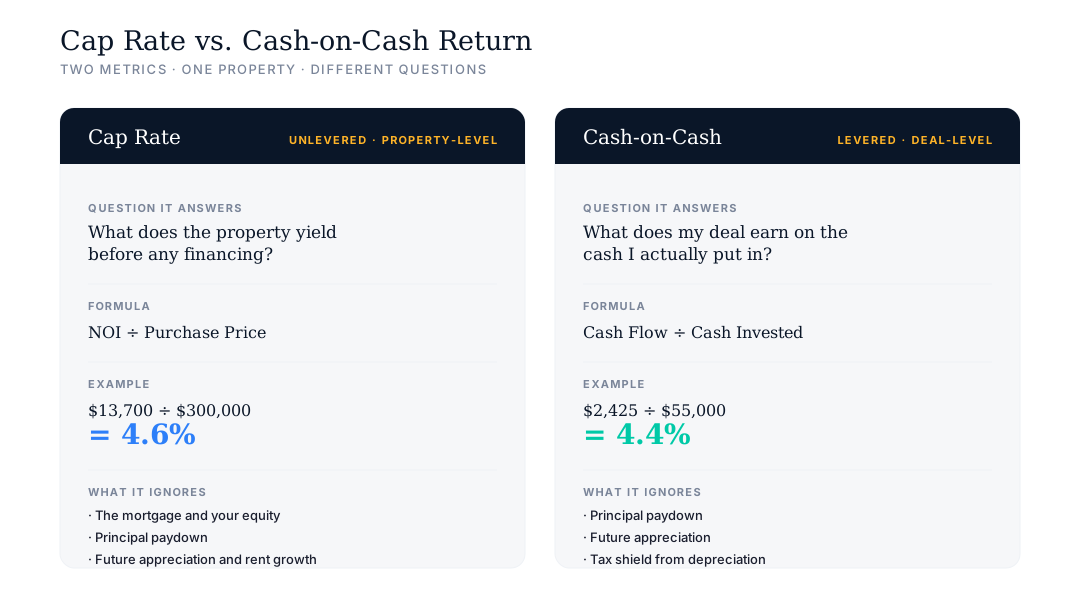
Leverage. Cap rate ignores the loan entirely. Two investors buying the same building with different down payments will have meaningfully different returns, and cap rate will not reflect that. The metric that bakes the loan in is cash-on-cash return.
Principal paydown. Every mortgage payment shifts a little equity from the lender to the investor — real return that cap rate ignores.
Appreciation. If the building’s value drifts up over time, that is also real return that cap rate ignores. Cap rate is a one-year snapshot of operating yield, not a forecast.
Tax effects. Depreciation, mortgage interest deductibility, and 1031 exchanges all change the after-tax picture. Cap rate is pre-tax and pre-depreciation.
The right way to think about cap rate is as a screen, not a verdict. It quickly tells you whether a listing is priced in line with the market. It does not tell you whether the deal works for you.
What to Do on Your Next Listing
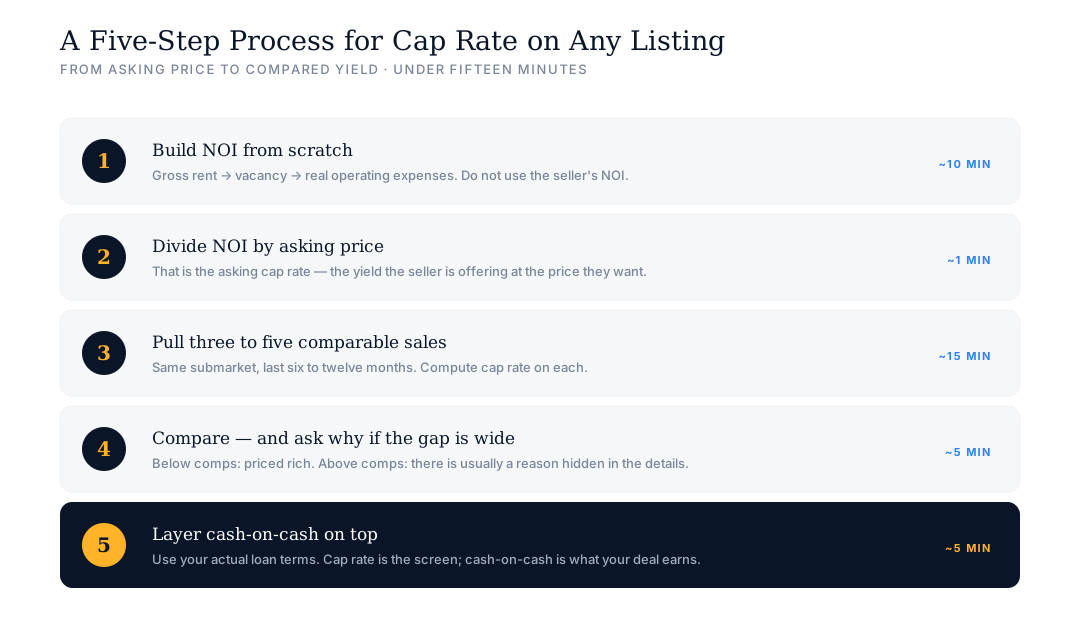
The next time a property surfaces, run this five-step process:
- Build NOI from scratch. Use the line-by-line approach — gross rent, vacancy, real operating expenses. Do not use the seller’s NOI.
- Divide NOI by the asking price. That is the asking cap rate.
- Pull three to five comparable sales in the same submarket from the last six to twelve months. Compute the cap rate on each.
- Compare. If the asking cap rate is well below comparables, the listing is priced rich. If it is well above, ask why — there is usually a reason.
- Layer the financing on top. Compute cash-on-cash return using your actual loan terms. That is what the deal earns for you, specifically.
Cap rate is the first screen. Cash-on-cash is the second. Neither is the whole story, but together they cover most of what a beginner needs to read a deal.
Frequently Asked Questions
Is cap rate the same as ROI?
No. ROI usually means total return — cash flow plus principal paydown plus appreciation over the full hold. Cap rate is only one year of unlevered operating yield. It is an input into a return picture, not the picture itself.
Why do brokers quote cap rate instead of cash-on-cash?
Because cap rate is the only metric that compares cleanly across buyers. Two investors with different loan terms will get different cash-on-cash returns on the same property, so cash-on-cash is not useful for market-wide comparison. Cap rate isolates the property from the buyer’s situation.
What is a “good” cap rate?
There is no universal answer — only a comparative one. A 5% cap rate is excellent in a tier-one urban submarket and underwhelming in a tier-three secondary market. The right benchmark is always recent comparable sales in the same submarket, not a national number.
Does cap rate apply to short-term rentals?
Yes, but with care. The NOI used in the numerator must reflect the higher operating costs of short-term rentals — cleaning, platform fees, consumables, marketing — and the more volatile occupancy. A short-term-rental cap rate built on long-term-rental assumptions will look attractive on paper and disappoint in operation.
For a complete reference on cap rate — including cap rate dynamics, exit-cap stress testing, and how it relates to debt yield and yield on cost — see the complete cap rate guide.
AtlasTerminal builds cap rate, cash-on-cash, and debt yield from the same line-by-line NOI — using real tax records, insurance quotes, and recent comparable sales rather than seller pro formas. Run the numbers on a listing you are considering and see how the asking cap rate compares to the market.