Part of our complete guide to DSCR and debt coverage.
A first-time investor walks into a rental loan expecting the usual questions — salary, pay stubs, tax returns. A growing share of rental lenders ask a different one instead: does the property earn enough to cover its own mortgage? The answer is a single ratio, the debt-service coverage ratio (DSCR), and it quietly decides how large a loan the deal can support. This post explains what that ratio is, how a lender uses it, and how to compute it on your next listing.
What DSCR Measures
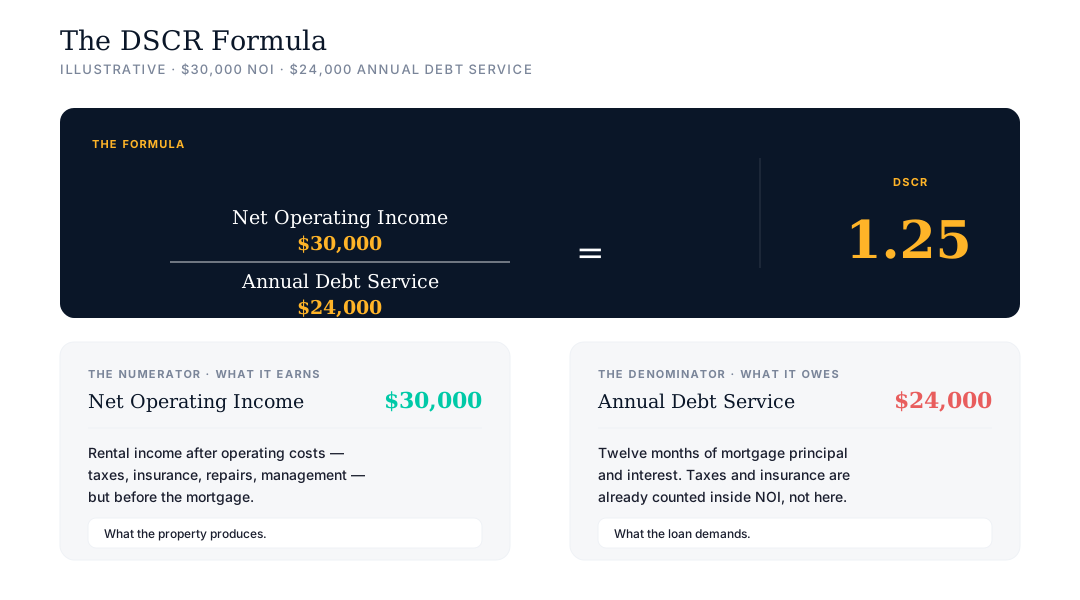
Debt-service coverage ratio compares the income a property produces to the loan payment that income has to cover. In one line:
DSCR = Net Operating Income ÷ Annual Debt Service
Two terms carry the formula. Net operating income — usually shortened to NOI — is the rental income left after operating costs like taxes, insurance, repairs, and management, but before the mortgage. (Its own walkthrough lives in the net operating income explainer.) Annual debt service is the twelve months of mortgage principal and interest the loan demands — the subject of the debt service post.
So DSCR is simply the property’s operating income divided by its yearly loan payment. A property that earns $30,000 of NOI and owes $24,000 a year on its mortgage has a DSCR of $30,000 ÷ $24,000 = 1.25.
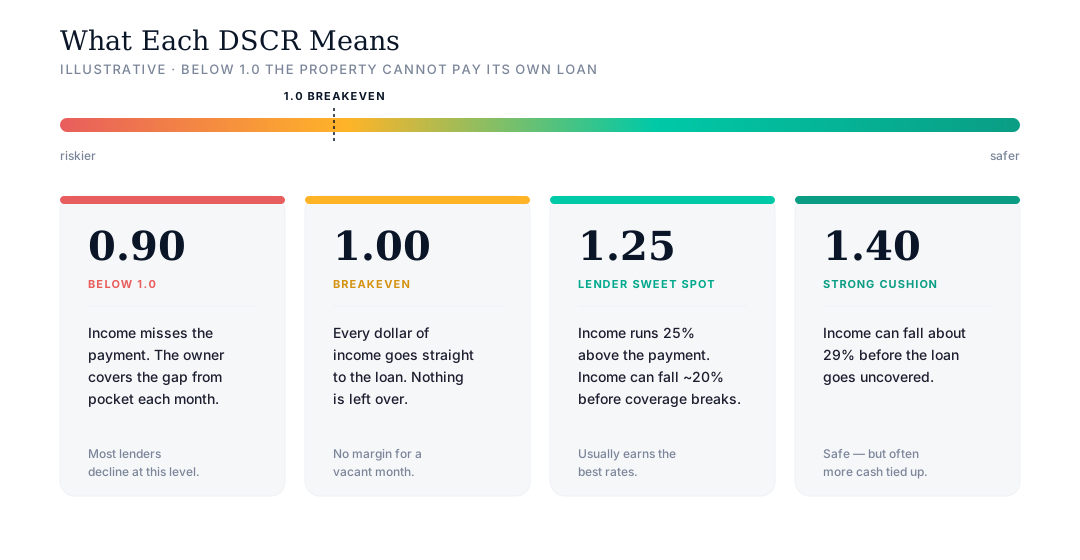
The intuition matters more than the arithmetic. A DSCR of 1.0 means the property earns exactly its loan payment — every dollar of income goes to the bank, with nothing left over. Below 1.0, the income does not cover the loan and the owner has to feed the property out of pocket. A DSCR of 1.25 means income runs 25% above the payment; read the other way, NOI could fall by about 20% before coverage drops to 1.0. Higher is safer.

How Lenders Use the Ratio
A lender sets a minimum DSCR the deal has to clear to qualify — for rental properties in 2026, most programs sit between 1.0 and 1.25, with 1.25 earning the best rates and a handful of programs reaching down toward 0.75 for borrowers who put more cash down. The minimum is the heart of a DSCR loan: a loan product that qualifies the property’s cash flow rather than the borrower’s personal income, which is why it has become a common first financing for new investors.
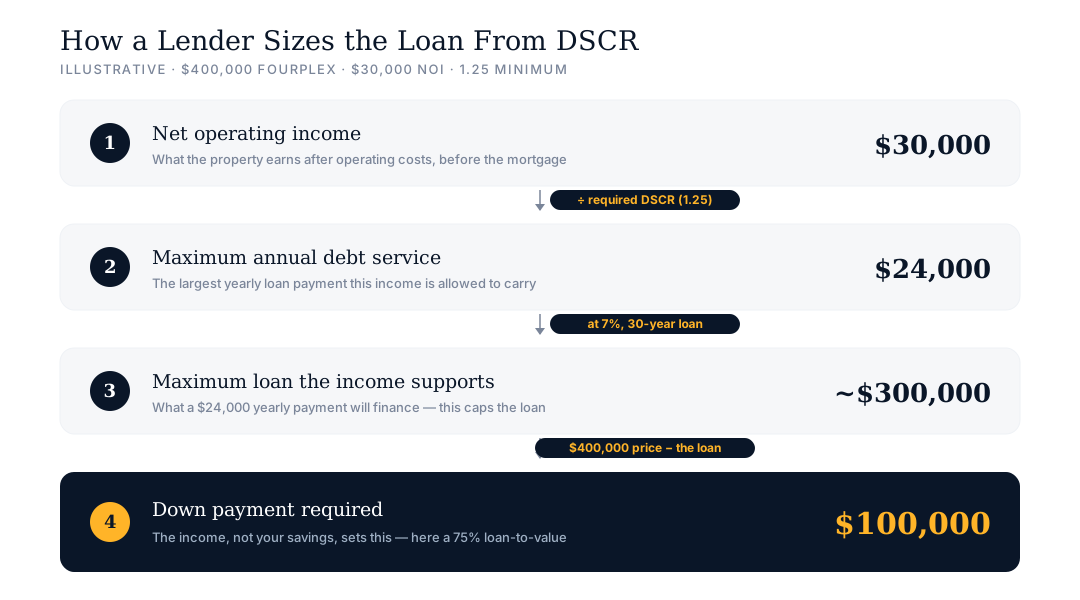
Here is the part beginners miss. The lender does not start from the price and check the ratio afterward. It works backward from the income. Take the required DSCR, divide it into NOI, and you get the largest annual payment the property is allowed to carry — and that payment caps the loan.
That backward step is the difference between thinking a lender will fund a price and understanding it will only fund an income. The next section runs the numbers.
A Worked Example
A fourplex is listed at $400,000. After building NOI line by line, you arrive at $30,000 of net operating income. The lender requires a minimum DSCR of 1.25.
Start with the question the lender actually asks — what is the largest yearly payment this income can support?
| Step | Calculation | Result |
|---|---|---|
| Net operating income | given | $30,000 |
| Required DSCR | lender minimum | 1.25 |
| Maximum annual debt service | $30,000 ÷ 1.25 | $24,000 |
A $24,000 annual payment is $2,000 a month. At a 7% rate on a 30-year amortizing loan, $2,000 a month supports a loan of roughly $300,000. On a $400,000 property, that leaves $100,000 — a 25% down payment, which sets the loan-to-value at 75%.
Now suppose you wanted to put less down — say $60,000, borrowing $340,000. The payment climbs to about $2,260 a month, or $27,150 a year. Re-run the ratio:
| Line | Amount |
|---|---|
| Net operating income | $30,000 |
| Annual debt service | $27,150 |
| DSCR | 1.10 |
At 1.10 the deal no longer clears the 1.25 minimum. The lender does not decline the investor — it declines the loan size. It caps the loan at the ~$300,000 the income supports and asks for the larger down payment. The property’s income, not your savings or your salary, set the ceiling.
What DSCR Leaves Out
DSCR is one ratio at one moment, and it is silent on several things that still decide the deal.
It is a snapshot. The DSCR at closing reflects one rate, one occupancy level, and one expense load. Raise the rate, add a vacancy spike, or absorb an insurance jump and the ratio moves. Pressure-testing it is the job of the DSCR stress test at the next tier up.
It says nothing about your return. A deal can clear 1.25 on a huge down payment and still earn a thin yield on the cash you put in. DSCR is a lender’s safety test; cash-on-cash return is the number that tells you what your money earns.
The lender’s NOI may not be yours. Loan programs underwrite to their own rent and vacancy assumptions, often with a standard haircut. The DSCR on the term sheet can differ from the one your real numbers produce.
What to Do on Your Next Listing
When the next property surfaces, run this in a few minutes:
- Build NOI honestly. Use the NOI walkthrough — real taxes, real insurance, vacancy, management, and reserves. Garbage in, garbage ratio.
- Find the lender’s minimum. Ask the loan officer for the required DSCR — usually 1.0 to 1.25 — before you fall in love with a price.
- Size the loan backward. Divide NOI by the required DSCR. That is the largest annual payment the property supports, and it caps the loan.
- Translate to a down payment. Subtract the supportable loan from the price. If the gap is more cash than you have, the deal is too expensive for that income — not impossible, but it needs a lower price or higher rent.
- Compute your own DSCR too. Run the ratio on the loan you would actually take, with your real numbers, and confirm it clears the minimum with room to spare.
Frequently Asked Questions
Is DSCR the same as a “DSCR loan”?
No — one is the ratio, the other is a loan product. DSCR is the math: income divided by the loan payment. A DSCR loan is a financing program that qualifies you on that ratio instead of your personal income, pay stubs, or tax returns. The loan is named after the test it relies on.
What DSCR do lenders usually require?
For rental properties in 2026, most programs want a minimum between 1.0 and 1.25. A ratio of 1.25 or higher generally earns the best rates; some specialty programs accept ratios below 1.0 in exchange for a larger down payment and stronger cash reserves.
Is a higher DSCR always better?
Safer, but not free. A high DSCR usually comes from a large down payment, which means less leverage and more of your own cash tied up. A property at 1.50 is unlikely to ever miss a payment, but the capital that bought that cushion might have earned more spread across two deals. DSCR is a safety floor; balance it against your return.
Does DSCR use my whole mortgage payment or just the interest?
It uses annual debt service — principal and interest together — as the denominator. Taxes and insurance are not in it, because those already sit inside NOI as operating expenses. Putting them in the loan line would count them twice.
AtlasTerminal builds NOI from real tax records and rent comps, then sizes the loan a property can actually support against current DSCR requirements — so the down payment is a number, not a surprise. Run the ratio on a listing you are weighing and see what the income will and will not finance.