A first-time investor finds a rental priced at $200,000 that rents for $2,000 a month. They run the numbers, calculate a 7.2% cap rate, and feel good about the deal. Then they get a loan quote, write a check for the down payment and closing costs, and a year later look at their bank account and ask: what did my money actually earn? The answer is almost never the cap rate. The metric that answers the question — cash-on-cash return — is the focus of this post.
Cash-on-cash return is the second metric every beginner should learn, right after net operating income. NOI tells you what the property earns. Cash-on-cash tells you what your specific deal earns on the cash you actually put in.
What Cash-on-Cash Return Measures
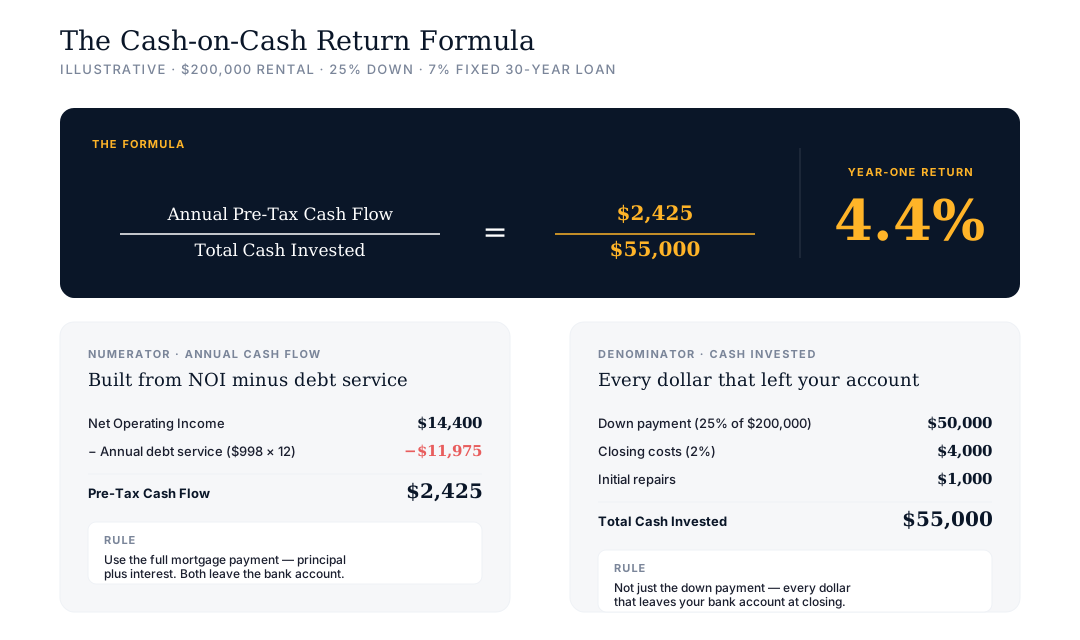
Cash-on-cash return is the annual pre-tax cash flow a rental property produces, divided by the total cash the investor put into the deal. In one line:
Cash-on-Cash Return = Annual Pre-Tax Cash Flow ÷ Total Cash Invested
The word “cash” appears twice, and both are doing work. The numerator is pre-tax cash flow — what is left after operating expenses and the mortgage payment. The denominator is the cash you actually wrote checks for — not the purchase price.
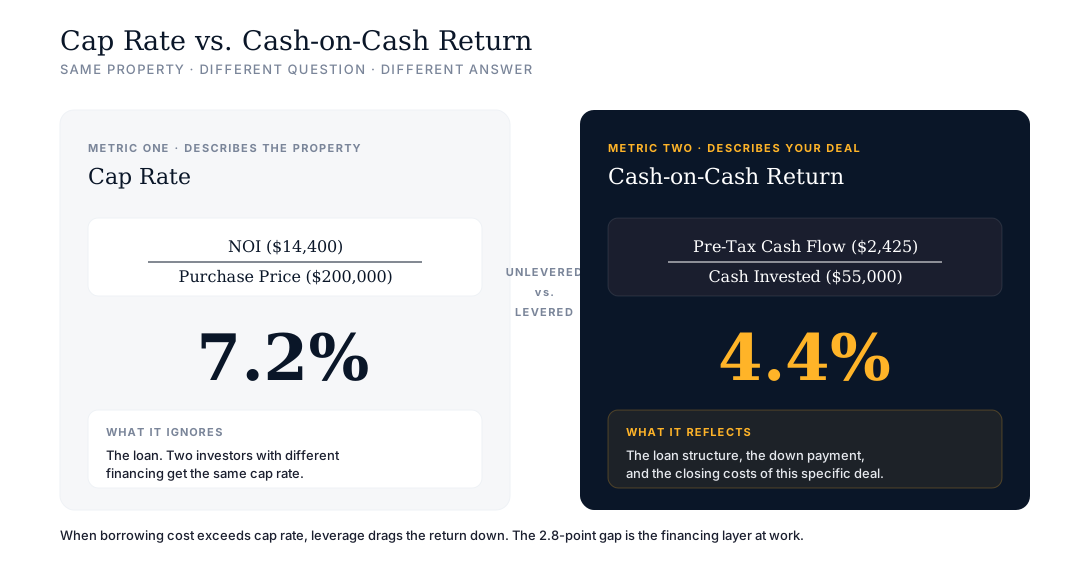
That second point is what makes the metric different from cap rate. Cap rate divides NOI by the purchase price and treats every deal as if it were bought in cash. Cash-on-cash divides cash flow by the investor’s own money and reflects how the loan is structured. Two investors buying the same property with different down payments will compute different cash-on-cash returns. Cash-on-cash is a property of the deal, not of the building.
What Counts as “Cash Invested”
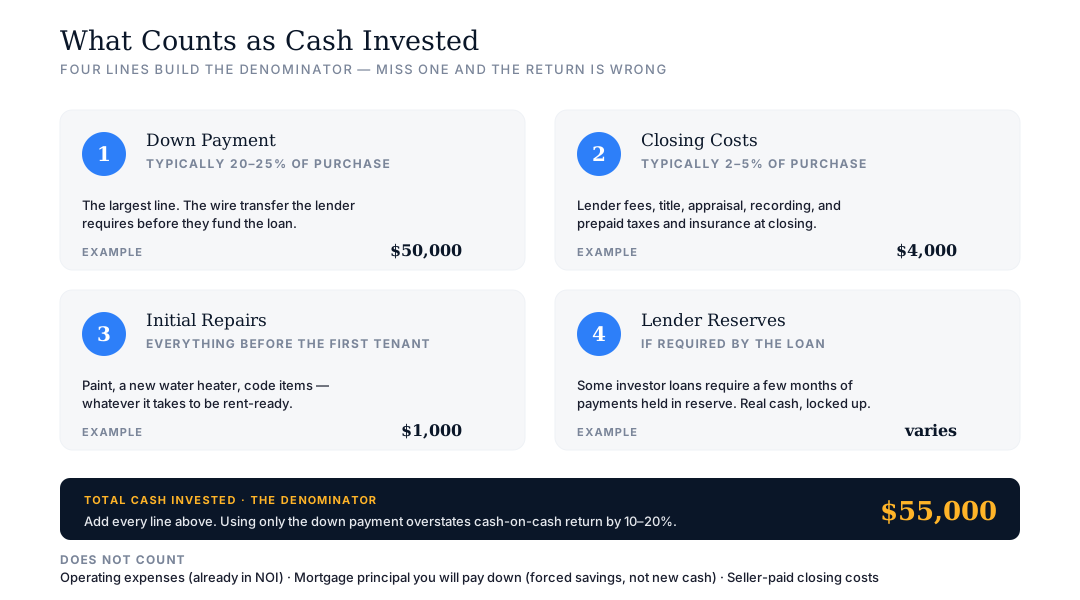
The denominator is where beginners most often slip. Cash invested is everything the investor pays out of pocket to take ownership and get the property rentable:
- Down payment. The largest line. For a conventional investment property loan, typically 20–25% of purchase price.
- Closing costs. Lender fees, title insurance, recording, appraisal, prepaid taxes and insurance — usually 2–5% of purchase price.
- Initial repairs. Anything the property needs before a tenant moves in — a new water heater, fresh paint, a few code items.
- Lender reserves. Some loans require a few months of mortgage payments held in a reserve account at closing.
What does not count as cash invested:
- Ongoing operating expenses (those are already deducted inside NOI).
- The mortgage principal you pay down each month (that is “forced savings,” not new cash invested).
- Closing costs the seller agrees to pay on your behalf.
The total of all out-of-pocket items is the denominator. Using only the down payment — the most common beginner error — overstates cash-on-cash return by 10–20%.
The Numerator — From NOI to Cash Flow
The numerator starts where the NOI walkthrough ended. Take NOI and subtract the annual debt service (the mortgage payment, principal plus interest, multiplied by twelve). What is left is annual pre-tax cash flow — the cash the investor can actually spend, before any income taxes.
| Line | Source |
|---|---|
| Net Operating Income | from the NOI calculation |
| − Annual debt service | loan amount, rate, term |
| = Annual pre-tax cash flow | the numerator |
Two things are easy to get wrong here. First, use the full mortgage payment, not just interest. Tax accountants split it because interest is deductible and principal is not, but for cash-on-cash the full payment is the right number — both leave the bank account. Second, do not include the tax shield from depreciation. Cash-on-cash is pre-tax by convention; mixing in tax effects turns it into a different metric.
A Worked Example
Continuing the $200,000 rental from earlier:
| Line | Amount |
|---|---|
| Purchase price | $200,000 |
| Gross potential rent ($2,000 × 12) | $24,000 |
| − Vacancy (5%) | −$1,200 |
| − Operating expenses | −$8,400 |
| Net Operating Income | $14,400 |
| Cap rate ($14,400 ÷ $200,000) | 7.2% |
Now the financing layer:
| Line | Amount |
|---|---|
| Down payment (25%) | $50,000 |
| Closing costs (2%) | $4,000 |
| Initial repairs | $1,000 |
| Total cash invested | $55,000 |
| Loan amount | $150,000 |
| Loan terms | 7% fixed, 30-year |
| Annual debt service ($998 × 12) | $11,975 |
The cash flow and cash-on-cash:
| Line | Amount |
|---|---|
| NOI | $14,400 |
| − Annual debt service | −$11,975 |
| Annual pre-tax cash flow | $2,425 |
| Cash-on-cash return ($2,425 ÷ $55,000) | 4.4% |
The same property that produces a 7.2% cap rate produces a 4.4% cash-on-cash return after financing. That gap — between the property yield and the investor yield — is the single most important number in the example. It exists because the borrowing cost (roughly 8% as a loan constant) is higher than the cap rate, so the loan is pulling the return down rather than levering it up. In a lower-rate environment the gap would close or invert.
Where Beginners Get It Wrong
Confusing cash-on-cash with total return. Cash-on-cash captures only one stream — current cash flow. It deliberately ignores principal paydown (the loan balance shrinking each month), appreciation (the building’s market value drifting), and tax benefits (depreciation, write-offs). All three are real components of long-term return. A 4% cash-on-cash deal that also produces 4% annual principal paydown and 3% appreciation is meaningfully different from a 4% bond.
Using only the down payment as cash invested. Closing costs and initial repairs are real cash leaving the bank account. Forgetting them inflates cash-on-cash by 10–20% and makes the deal look cleaner than it is.
Comparing cash-on-cash to cap rate as if they were the same thing. They are not. Cap rate is unlevered — it ignores the loan. Cash-on-cash is levered — it bakes the loan in. When rates are low, leverage usually lifts cash-on-cash above cap rate. When rates are high, it can pull cash-on-cash below cap rate, as in this example.
Treating year-one cash-on-cash as the lifetime number. Rent grows over time; the mortgage payment on a fixed-rate loan does not. Year-five cash-on-cash on the same deal is usually meaningfully higher than year-one. The headline cash-on-cash on day one is a starting point, not a forecast.
What to Do on Your Next Deal
When the next property surfaces, layer cash-on-cash on top of the NOI checklist:
- Build NOI using the line-by-line approach — gross rent, vacancy, real operating expenses.
- Get a real loan quote. Use the actual rate, down payment, and closing costs your lender quotes — not a generic 7%.
- Compute annual debt service. Monthly principal-and-interest times twelve. Online amortization calculators are fine; the math itself is mechanical.
- Add up every dollar of cash leaving your account at closing. Down payment, closing costs, initial repairs, lender reserves. That total is the denominator.
- Divide. Pre-tax cash flow over total cash in. That is your cash-on-cash return.
- Compare it to your real alternatives. Treasury yields, dividend stocks, the S&P 500 — whatever else the same $55,000 could be invested in. The point of cash-on-cash is not whether it is “good in real estate” but whether it beats what the cash would earn elsewhere, on a risk-adjusted basis.
Frequently Asked Questions
Is cash-on-cash return the same as ROI?
No. ROI usually means total return — cash flow plus principal paydown plus appreciation, often over the full holding period. Cash-on-cash is only the first piece: one year of cash flow over the cash you invested. It is one input into ROI, not the whole picture.
Does cash-on-cash include appreciation?
No. Cash-on-cash is strictly cash flow over cash invested. It deliberately ignores the building going up in value, because that gain is unrealized until sale. Appreciation belongs in a separate calculation — typically internal rate of return (IRR) over the full hold.
What is a “good” cash-on-cash return?
There is no universal number. Historically, retail investors targeted 8–10% cash-on-cash in stable markets. At 2026 rates that benchmark is harder to hit — 4–6% is more common for a clean leveraged deal, with appreciation and principal paydown carrying more of the total return. The honest comparison is always against what the same cash would earn elsewhere.
How is cash-on-cash different from yield on cost?
Yield on cost divides stabilized NOI by total project cost (purchase plus all renovation spend) — it answers whether a value-add renovation creates value. Cash-on-cash divides cash flow by the investor’s cash equity — it answers what the investor earns per dollar they put up. Different denominators, different questions.
AtlasTerminal builds cash-on-cash, cap rate, and debt yield from the same line-by-line NOI — using real tax records, insurance quotes, and lender pricing rather than seller pro formas. See what your next deal actually returns on the cash you would invest.