Part of our complete guide to DSCR and debt coverage.
A property analysis ends with NOI of $13,700. The mortgage calculator says the monthly payment is $1,497. The seller’s pro forma claims “cash flow of $4,800 a year.” Three numbers, all attached to the same property, none of which agree — and the first-time investor is left unsure which to trust.
The bridge between net operating income and cash flow is a single line called debt service. It is the most concrete number in real estate analysis — the literal dollars the loan demands each year — and it is also the line most often conflated with the monthly mortgage payment, with PITI, or with “the mortgage.” This post unpacks what debt service actually is, how to compute it, and what it leaves out.
What Debt Service Measures
Debt service is the annual cost of the loan — principal plus interest — that the property owes the lender. In one line:
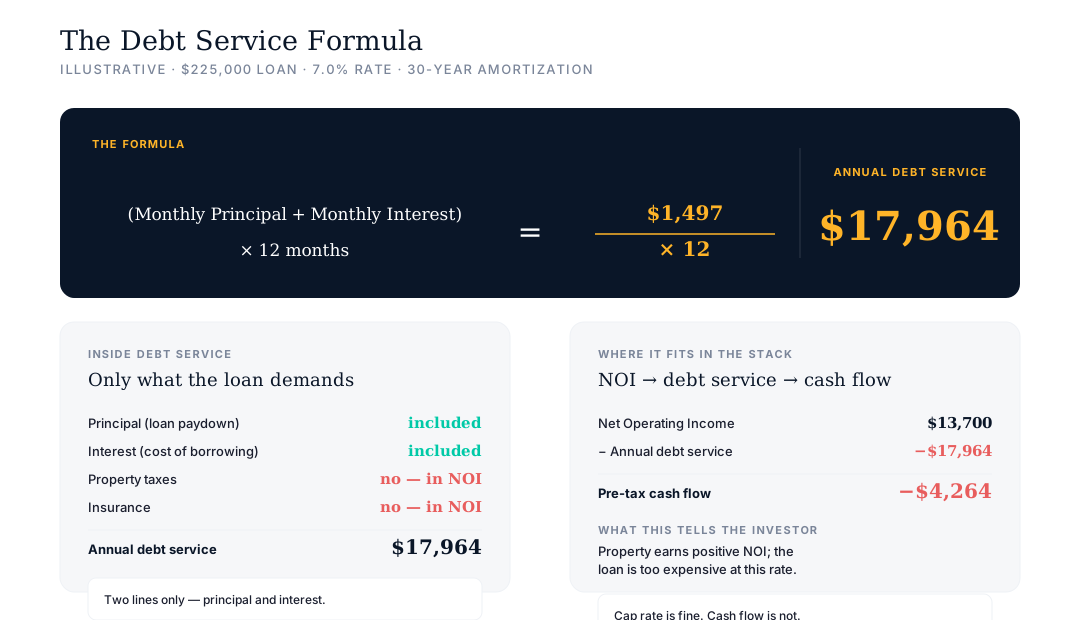
Annual Debt Service = (Monthly Principal + Monthly Interest) × 12
For a fully amortizing 30-year mortgage, debt service is just the monthly P&I payment times 12. A property bought with a $225,000 loan at 7% interest, fixed for 30 years, carries a monthly P&I of about $1,497 and annual debt service of about $17,964.
Two things sit outside of debt service that often get bundled with it on a mortgage statement:
- Property taxes (T)
- Homeowners or landlord insurance (I)
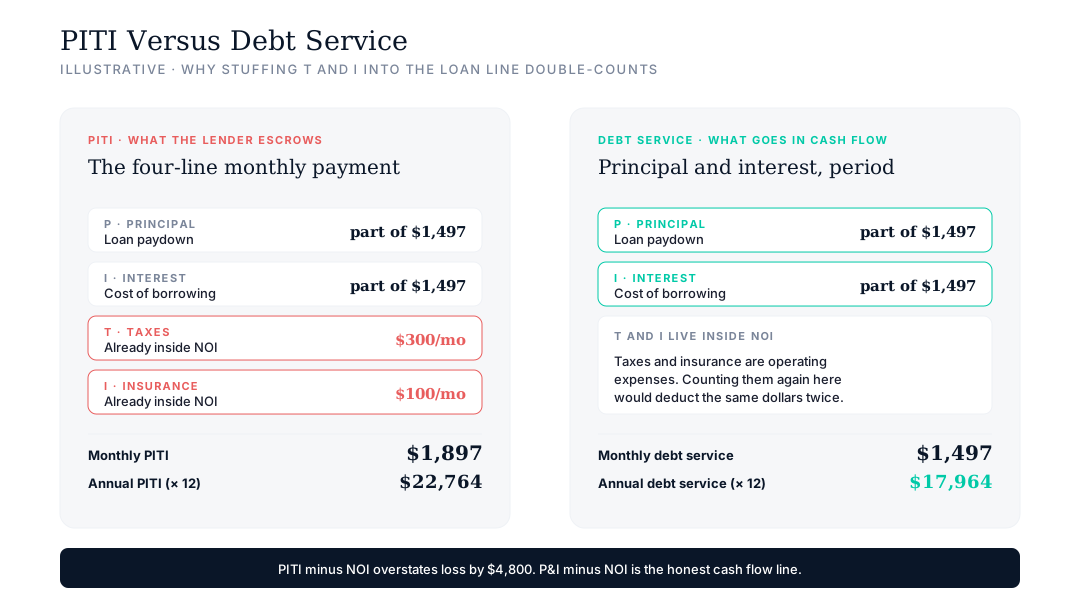
Add T and I to P&I and you get PITI — the four-letter shorthand for what most lenders escrow and what most first-time investors think of as “the mortgage.” Debt service is P&I only. Taxes and insurance are operating expenses; they live inside NOI, not inside debt service.

Why the PITI Confusion Matters
Real estate metrics stack. Each one builds on the next, and double-counting a single line cascades through everything downstream:
- NOI = effective gross income − operating expenses (taxes and insurance included)
- Cash flow = NOI − debt service
If T and I are counted twice — once inside NOI as operating expenses, and again inside a PITI-shaped debt service line — pre-tax cash flow is understated by 30–50%. The deal looks worse on paper than it actually is, and the rookie investor either passes on a workable property or distrusts the whole framework.
The two numbers serve different audiences. NOI describes the property: what the bricks and the lease produce regardless of who owns them. Debt service describes the loan: what the bank charges a specific investor for a specific borrowing arrangement. Cash flow is what is left over for the investor after both. Keeping each in its own box is the entire skill.
A Worked Example
Take the $300,000 single-family rental from the NOI walkthrough — NOI of $13,700. The investor puts 25% down and borrows $225,000 at 7%, fully amortizing over 30 years.
| Loan input | Value |
|---|---|
| Loan amount | $225,000 |
| Interest rate | 7.0% |
| Amortization | 30 years |
| Monthly P&I | $1,497 |
| Annual debt service (P&I × 12) | $17,964 |
Now the cash flow line:
| Line | Amount |
|---|---|
| Net Operating Income | $13,700 |
| − Annual debt service | −$17,964 |
| Pre-tax cash flow | −$4,264 |
The property loses $4,264 a year on a cash basis — even though the cap rate is 4.6% and the NOI is genuinely positive. That gap is the entire reason cap rate and cash flow are different numbers. The property is fine; the loan is too expensive for it at today’s rate. A larger down payment, a lower rate, or a lower price would each move the line back above zero.
Now suppose the same investor had stuffed T and I into the mortgage line — using PITI of $1,897 ($1,497 P&I + $300 taxes + $100 insurance) and treating that as debt service. PITI times 12 is $22,764. NOI minus that PITI would be −$9,064 — an extra $4,800 of phantom loss, every dollar of which is already counted inside NOI as operating expenses. PITI minus NOI is not cash flow. P&I minus NOI is.
What Debt Service Leaves Out
Like every metric, debt service is silent on several things that still affect the deal:
Principal paydown. Each year of debt service shifts more of the payment from interest to principal. Year-one principal on a 30-year amortizing loan at 7% is only about 15% of the payment; by year ten it is closer to 25%. Cash flow treats principal as a cost; total return treats it as forced savings.
Interest-only and balloon loans. Some commercial loans pay only interest for years, then balloon at the end. Debt service in those years is lower than an amortizing equivalent, but the principal still has to be repaid or refinanced. Lower debt service today is not the same as a cheaper loan.
Rate resets. Adjustable-rate and bridge loans reprice on a schedule. Debt service today is not necessarily debt service in year three.
Refinance economics. Pulling cash out at refinance changes debt service. The new payment may be larger even though the property is the same.
What to Do on Your Next Listing
The next time a property surfaces, run this:
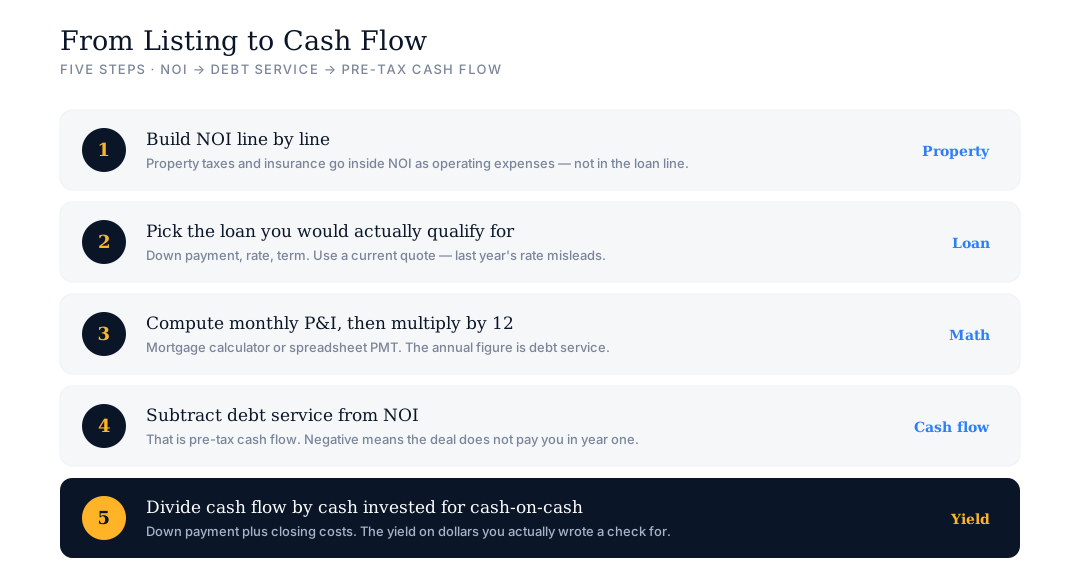
- Build NOI line by line. Use the NOI walkthrough. Make sure property taxes and insurance are inside NOI, not floating somewhere else.
- Pick the loan you would actually use. Down payment, rate, amortization term. Use a real quote, not a stale assumption from a year ago.
- Compute monthly P&I. A mortgage calculator, your lender’s term sheet, or a spreadsheet
PMTfunction all work. Multiply by 12 for annual debt service. - Subtract debt service from NOI. That is pre-tax cash flow. If it is negative, the deal does not pay you in year one — that may still be acceptable, but it has to be a deliberate decision.
- Pair with cash-on-cash. Divide cash flow by the cash invested (down payment plus closing costs) to get cash-on-cash return — the yield on the dollars you actually wrote a check for.
Frequently Asked Questions
Is debt service the same as my mortgage payment?
Not exactly. The monthly mortgage statement usually includes principal, interest, taxes, and insurance — PITI. Debt service is principal and interest only. Taxes and insurance show up in NOI as operating expenses, so including them inside debt service would double-count.
Does debt service include PMI?
By convention, no. Private mortgage insurance is treated like insurance — an operating cost above debt service. The split is conceptual: debt service describes what the loan costs the property; PMI describes what the loan costs you specifically because of your equity position.
Do interest-only loans have lower debt service?
Yes, in year one. Interest-only debt service is just the interest portion — no principal paydown. The trade-off is no equity build through amortization, and the full loan principal is due at the end of the interest-only period or at the balloon.
Does debt service change over the life of the loan?
For a standard fixed-rate amortizing loan, the total dollar payment is constant — debt service stays flat. The split between principal and interest shifts (more interest early, more principal late), but the total per year does not. Adjustable and balloon loans are different — debt service can step up at every reset.
AtlasTerminal computes debt service against the loan an investor would actually qualify for — current rates, current LTV constraints, current insurance quotes — and shows the resulting cash flow against the NOI line by line. Run the numbers on a listing you are considering and see what the deal earns after the loan.