Part of our complete framework for underwriting a rental property.
A duplex is listed at $300,000. The investor calls a lender. The lender quotes a rate, then says, “we can do 75% LTV on a property like this.” The investor agrees, hangs up, and is now $75,000 short before closing day — without quite knowing why. Loan-to-value, almost always shortened to LTV, is the single ratio that controls how much cash the investor brings to the table, how large the loan is, and how much margin the deal has if the property’s value falls.
This post walks through what LTV measures, how it sets the down payment, and a full worked example on a small rental at three common LTV levels. By the end, the reader should be able to call a lender, hear an LTV quote, and immediately know what it implies.
What LTV Actually Measures
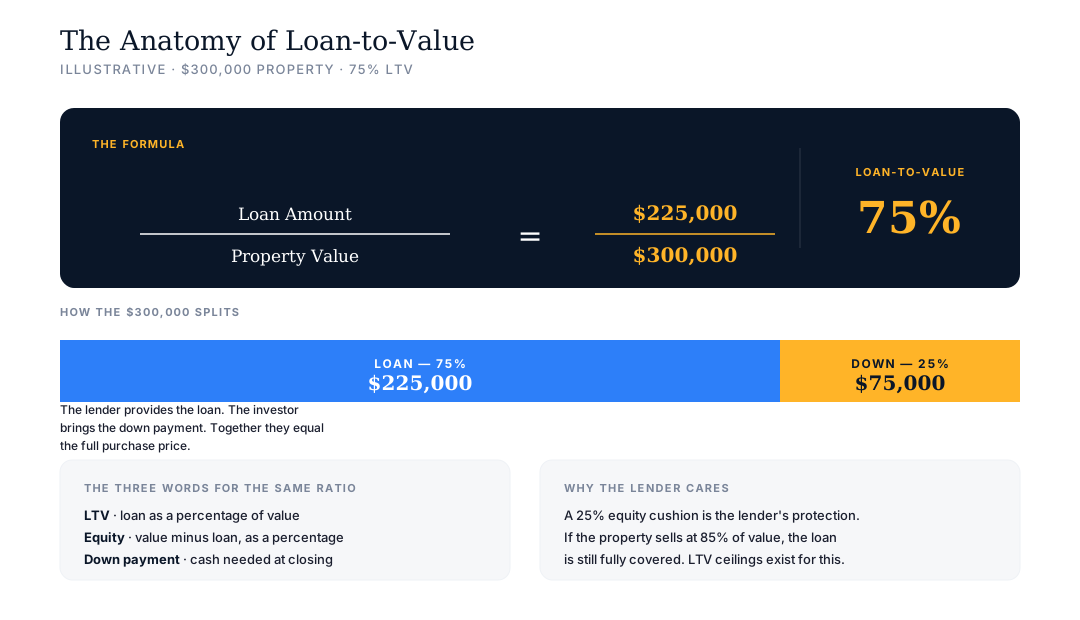
Loan-to-value is the loan amount divided by the property’s value, expressed as a percentage. In one line:
LTV = Loan Amount ÷ Property Value
On a $300,000 duplex with a $225,000 loan, the LTV is $225,000 ÷ $300,000 = 75%. Read aloud, the number means the lender is financing 75% of the value; the investor is bringing 25% in cash equity. Everything else flows from those two halves.
LTV is the number the lender cares about more than any other. It tells the lender how much cushion there is between the loan and the property’s value before they are exposed to a loss. If the property sells in foreclosure for 85% of its appraised value, a 75% LTV loan is still fully covered; a 90% LTV loan is not. That cushion — the gap between the loan and the value — is the lender’s protection, and the reason LTV ceilings exist on every loan program.
Two other terms describe the same idea from different angles. Equity is what is left when you subtract the loan from the value (a 75% LTV property is 25% equity). Down payment is the cash needed to create that equity at the moment of purchase. They are three windows onto the same ratio.

How LTV Sets the Down Payment
The arithmetic is mechanical. Whatever LTV the lender quotes, the down payment is the rest:
- 80% LTV → 20% down
- 75% LTV → 25% down
- 70% LTV → 30% down
- 65% LTV → 35% down
On the same $300,000 duplex, those numbers translate to $60,000, $75,000, $90,000, and $105,000 in cash, respectively. The choice of LTV is, in dollar terms, a choice about how much cash leaves the investor’s account at closing — and how much remains for reserves, repairs, and the next deal.
LTV ranges vary by loan type. Conventional investment property loans typically top out at 75–80% LTV for a single rental. DSCR loans — the most common product for rental investors today — usually quote 70–80%. Commercial loans on small multifamily run 65–75%. FHA loans, available only to owner-occupants of a 1–4 unit property, go as high as 96.5%. The investor’s job is to know the LTV before walking into a deal, because the LTV determines whether the deal is doable on the cash they have.
A Worked Example
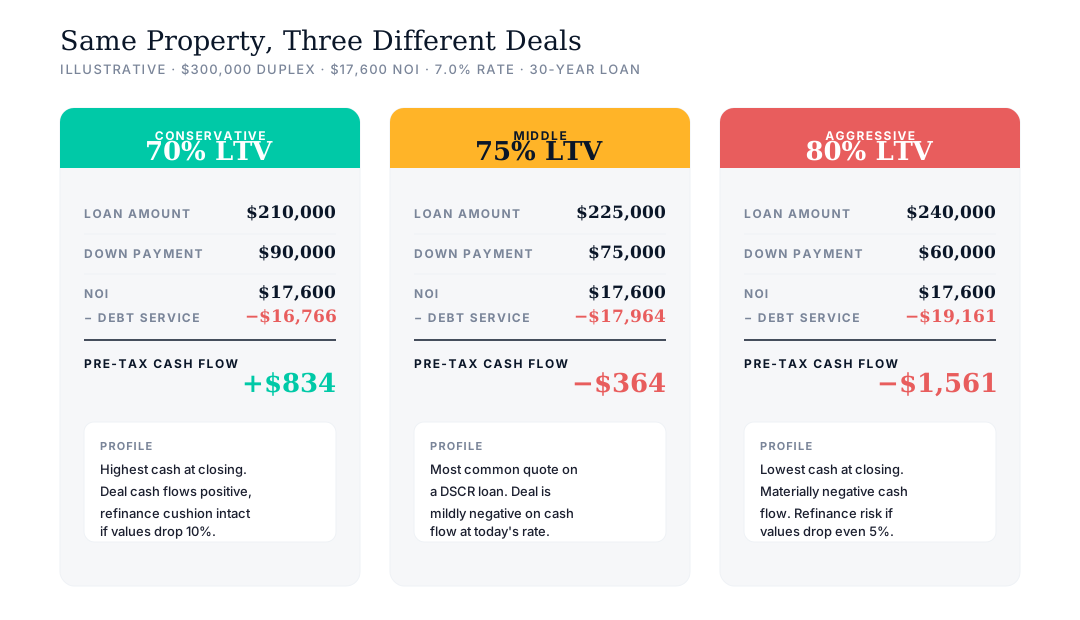
Consider the $300,000 duplex from the opening, with $2,400 a month in rent — $28,800 a year — and operating expenses of $11,200, producing an NOI of $17,600. Assume a 30-year amortizing rental loan at a 7% rate. The three LTV scenarios sit side by side.
| Line | 70% LTV | 75% LTV | 80% LTV |
|---|---|---|---|
| Purchase price | $300,000 | $300,000 | $300,000 |
| Loan amount | $210,000 | $225,000 | $240,000 |
| Down payment | $90,000 | $75,000 | $60,000 |
| Net Operating Income | $17,600 | $17,600 | $17,600 |
| Annual debt service | −$16,766 | −$17,964 | −$19,161 |
| Pre-tax cash flow | $834 | −$364 | −$1,561 |
The property earns the same NOI in all three columns — that is what NOI is supposed to do, describe the property independently of how it is financed. What changes with LTV is the loan, and what changes with the loan is the debt service and therefore the cash flow.
At 70% LTV the deal cash flows, barely. At 75% it is mildly negative. At 80% it is meaningfully negative — the property earns enough to pay the property, but not enough to pay the property and a larger loan. Same property. Same NOI. Three very different deals.
Higher LTV Is Cheaper Cash But More Risk
The temptation, especially on a first deal, is to push LTV as high as the lender allows. Lower down payment means more cash left over, more deals possible, more reach. The math also runs the other way.
A higher LTV means a larger loan, which means higher debt service, which means thinner cash flow. It also means less equity cushion if the property’s value drops. A property bought at 80% LTV that loses 10% of its value is suddenly at 89% LTV; at refinance time, the lender will require the investor to pay down the loan in cash or accept worse terms. A property bought at 70% LTV in the same scenario sits at 78% LTV — still comfortably inside refinance limits.
LTV is, in this sense, a dial between two costs the investor pays in different currencies. Low LTV costs cash today. High LTV costs flexibility tomorrow. The right setting depends on how much cash the investor has, how much margin the deal carries, and how much room they want if rents stall or rates reprice at refinance.
What to Do on Your Next Listing
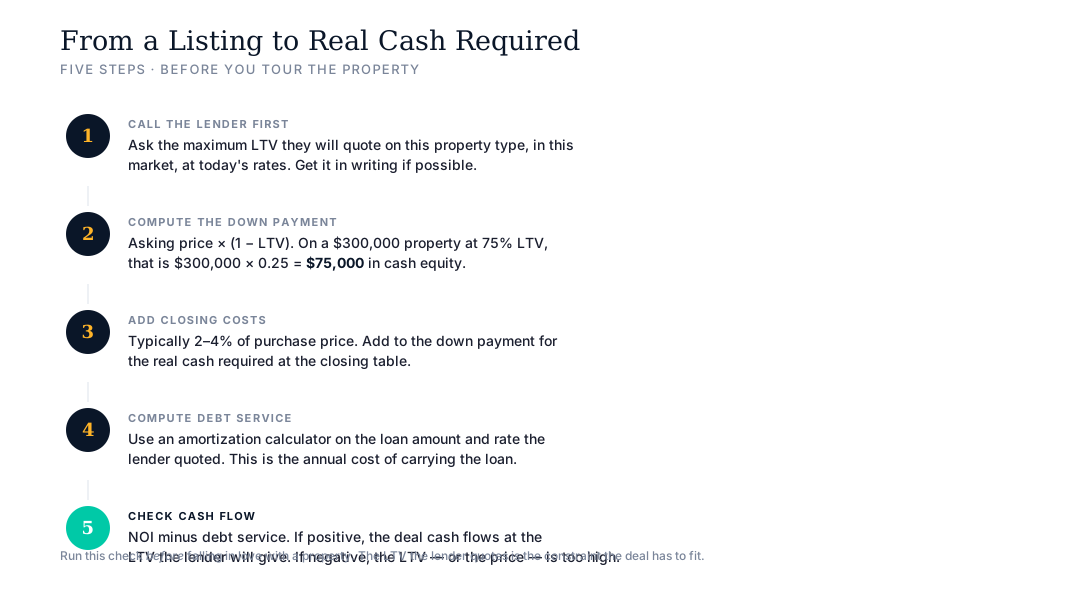
Before touring a property, run this five-step check:
- Call the lender first. Ask the maximum LTV they will quote on a property of this type, in this market, at today’s rates. Get a written quote if possible.
- Multiply the asking price by (1 − LTV) to get the down payment. On a $300,000 property at 75% LTV, that is $300,000 × 0.25 = $75,000 in cash.
- Add closing costs — typically 2–4% of purchase price — to the down payment. That is the real cash required at the closing table.
- Compute debt service at the loan amount and rate the lender quoted. A simple amortization calculator does this in seconds.
- Subtract debt service from NOI to see whether the deal cash flows at the LTV available. If it does not, the LTV is too high — or the price is.
Run this check before falling in love with a property. The LTV the lender will actually quote is the constraint the deal has to fit.
Frequently Asked Questions
Is LTV the same as down payment?
They are two sides of the same coin. LTV is the loan as a percentage of value; down payment is the cash that makes up the difference. A 75% LTV always implies a 25% down payment (before closing costs). Lenders quote LTV; buyers usually think in down payment. Both describe the same split.
What LTV will I get on my first rental?
For a single-family rental purchased with a conventional investment loan, 75–80% LTV is typical for a strong borrower. For DSCR loans, 75% is the most common quote; the strongest deals reach 80%. For a 2–4 unit property occupied by the buyer, FHA loans go as high as 96.5% LTV. Always confirm with the lender on the specific property — LTV ceilings tighten on properties in weaker condition or markets.
How is LTV different from LTC?
LTV uses the property’s value in the denominator. Loan-to-cost (LTC) uses the investor’s total project cost — purchase plus renovation. On a deal with significant rehab, LTC matters more because it tracks what the investor is actually putting into the deal. For a stabilized rental purchase with no rehab, LTV and LTC are usually the same number.
Does the appraisal affect LTV?
Yes — and this catches new investors off guard. The lender sets LTV against the appraised value, not the purchase price. If a property under contract for $300,000 appraises at $290,000, a 75% LTV loan is $217,500 (75% of $290,000), not $225,000. The investor has to make up the $7,500 difference in cash or renegotiate the price.
AtlasTerminal sizes the loan, computes the down payment, and runs the cash flow against the LTV a lender will actually quote — not the LTV a seller assumes. Run the numbers on a listing you are considering and see what the deal asks of the cash you have.