Part of our complete framework for underwriting a rental property.
When an investor evaluates a property that needs work — a small multifamily with deferred maintenance, a single-family rental in a turning neighborhood, a fourplex with under-market rents — they usually compute one of two numbers. They calculate the cap rate on the in-place income and find it disappointing. Or they project a stabilized cap rate on the post-renovation income and find it attractive. Both numbers are misleading. The first ignores the upside the renovation will create. The second ignores the cost of creating it.
The metric that actually answers the question — does this deal work — is yield on cost. It is the standard underwriting metric for developers and value-add operators, and it is largely absent from how retail investors talk about their deals. Understanding it changes how a value-add deal is evaluated and, in many cases, whether it gets done at all.
The Three Numbers, and Which One Misleads
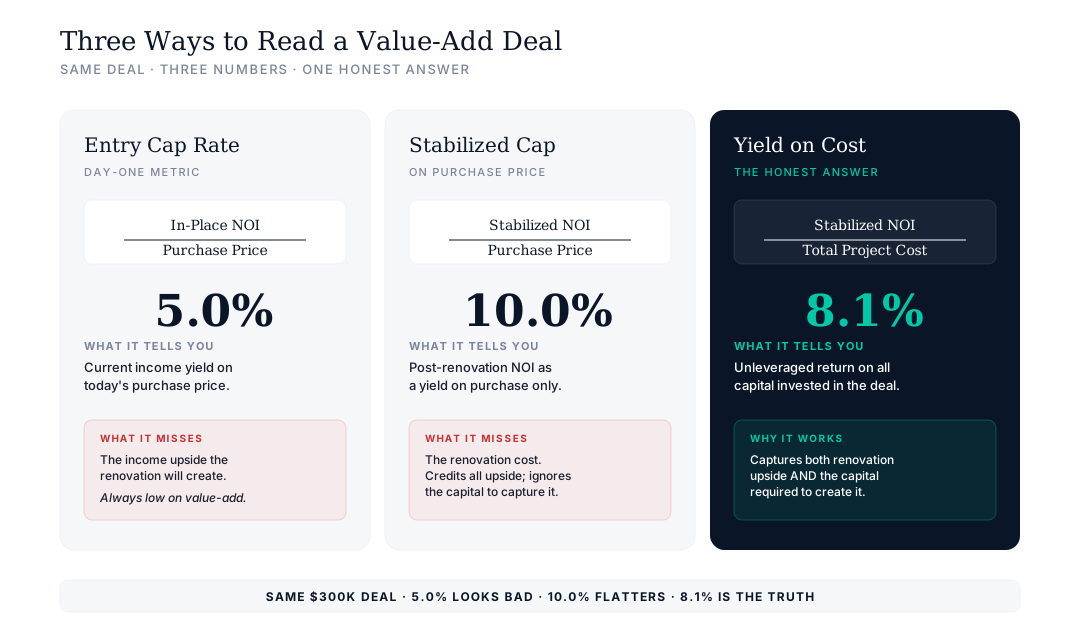
A value-add property has, conceptually, three different cap rates worth looking at.
Entry cap rate is the in-place net operating income (NOI) divided by the purchase price. For a value-add deal, the entry cap is by definition depressed. The whole reason the property is a value-add candidate is that current income is below market — rents are old, expenses are bloated, occupancy is soft. An entry cap rate of 3.5% on a property with realistic upside is not the same thing as a 3.5% cap rate on a fully stabilized asset.
Stabilized cap rate on purchase price is the projected post-renovation NOI divided by the purchase price. This number flatters the deal because it credits the investor with the income upside while ignoring the renovation cost required to capture it. A $300,000 purchase that projects to $30,000 of stabilized NOI looks like a 10% cap rate — but only if the renovation is free.
Yield on cost is the projected stabilized NOI divided by total project cost — purchase price plus closing costs, soft costs, renovation expenses, and any holding costs during the value-add period. It is the single number that captures both the income created and the capital required to create it. It is the metric institutional underwriters lead with for any deal involving capital expenditure.
What Yield on Cost Actually Measures
Yield on cost (sometimes “return on cost,” or YOC) asks one question: what unleveraged annual income does this deal produce per dollar invested, once the work is done? Structurally it is identical to cap rate — NOI in the numerator, a denominator in the bottom — but it swaps market value for all-in cost. That single substitution makes the metric honest about value-add.
The formula is straightforward:
Yield on Cost = Stabilized NOI ÷ Total Project Cost
Total project cost includes:
- Purchase price
- Closing costs (title, transfer tax, lender fees, inspection)
- Soft costs (architectural, permitting, legal)
- Hard costs (the renovation itself, including a contingency reserve)
- Holding costs during the value-add period (insurance, taxes, debt service on the acquisition loan before stabilization)
Skipping any of these line items overstates yield on cost — which is the most common mistake retail investors make when they encounter the metric for the first time.
The Development Spread
Yield on cost is useful in isolation, but it becomes powerful when compared to the market cap rate for the same asset class once stabilized. The gap between the two is called the development spread, and it is the cleanest single measure of whether a value-add deal is creating value.
Development Spread = Yield on Cost − Market Cap Rate
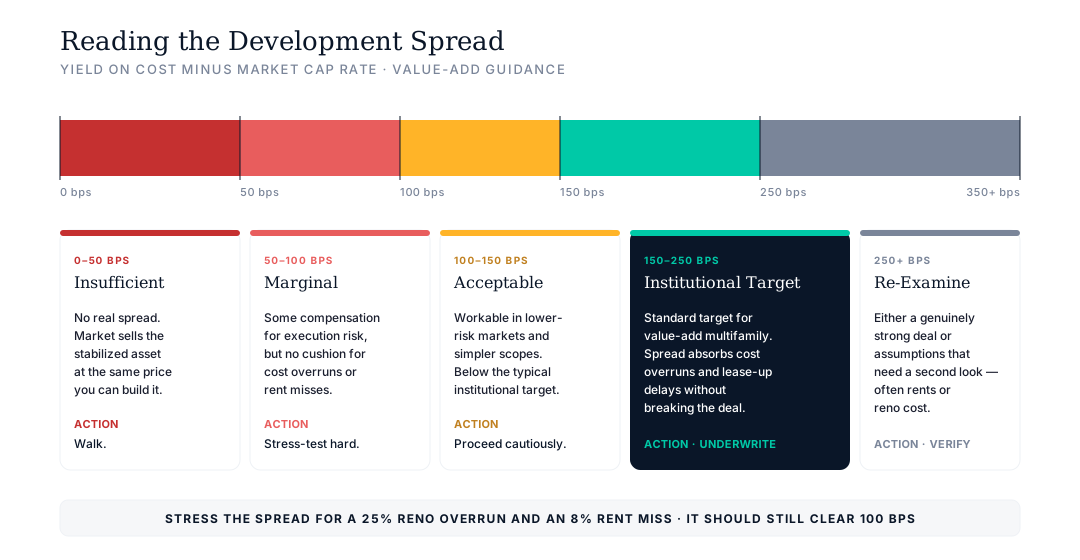
The logic is simple. If the investor can build a stabilized asset for an unleveraged 8% yield on cost, and the market is paying 6% for the same stabilized asset, they have built 200 basis points of equity into the deal. That spread is the value the renovation created. It is also the cushion that absorbs cost overruns and lease-up delays.
Institutional underwriters typically target a development spread of 150 to 250 basis points for value-add multifamily. Below 100 basis points, the spread is generally considered insufficient compensation for the construction risk, lease-up uncertainty, and cost overruns inherent in a value-add execution. Spreads above 250 basis points either indicate a genuinely strong deal — or assumptions that need a second look.
A Worked Example
Consider a Class B fourplex acquisition in a secondary market. The numbers are illustrative but realistic for the segment.
| Item | Amount |
|---|---|
| Purchase price | $300,000 |
| Closing and soft costs | $10,000 |
| Renovation budget (incl. 10% contingency) | $55,000 |
| Holding cost during 6-month renovation | $5,000 |
| Total project cost | $370,000 |
In-place NOI at acquisition is $15,000 — older below-market rents, dated finishes, soft occupancy. The renovation plan calls for unit turns, an exterior refresh, and operating-expense cleanup. After the renovation and a 90-day stabilization period, projected NOI is $30,000.
The three views of this deal:
- Entry cap rate: $15,000 ÷ $300,000 = 5.0% — looks unremarkable for the asset class.
- Stabilized cap on purchase price: $30,000 ÷ $300,000 = 10.0% — looks fantastic, but only because the renovation cost is invisible.
- Yield on cost: $30,000 ÷ $370,000 = 8.1% — the honest answer.
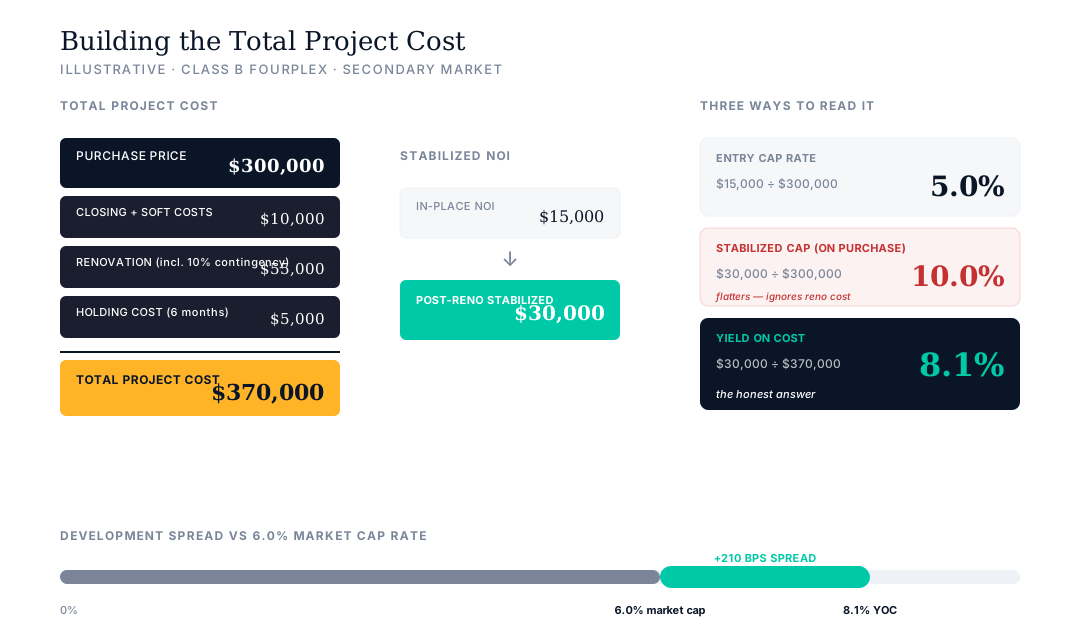
If the market cap rate for stabilized Class B fourplexes in this submarket is 6.0%, the development spread is 210 basis points. That sits comfortably in the institutional target range. The deal works.
Now run the same exercise with a renovation budget that overruns by 25%. Total project cost rises to $383,750, stabilized NOI is unchanged, yield on cost falls to 7.8%, development spread to 180 basis points. Still acceptable, but the cushion has thinned.
Run it again with rents that come in 8% below pro forma — stabilized NOI drops to $27,600. Against the original $370,000 cost, yield on cost falls to 7.5%, spread to 150 basis points. Combined with the cost overrun, the spread compresses to 120 basis points. The deal still works, but the margin for any further surprise is gone.
This is what stress-testing yield on cost looks like — and it is the work that turns a calculated metric into a useful one.
Where Retail Investors Slip
The same five mistakes recur. They share one root cause: the denominator gets too small.
- Missing line items. Closing, soft, lender, and holding costs during renovation get left out. A complete denominator is the difference between a real underwriting and a marketing pitch.
- No contingency. Renovation budgets without at least a 10–15% contingency systematically understate true cost. Overruns are not rare events; they are the base case.
- Aspirational rents. A pro forma that uses the top of the rent-comp range rather than the median produces a yield on cost the market will not deliver. Use the median, or use the lowest comp the property’s actual finish level supports.
- Wrong market cap rate. The spread calculation requires a market cap rate for the stabilized asset, not the current asset. A Class C property renovated to a Class B finish should be compared to Class B comps, not Class C.
- No time discount. A 12-month value-add timeline means the investor is not collecting stabilized NOI for a year. Yield on cost is silent on this; IRR is not. For long-duration value-add, run both.
A Checklist for Your Next Deal
When the next value-add opportunity surfaces:
- Build the full total project cost line by line, including holding costs and contingency.
- Compute stabilized NOI from rent comps and operating expense benchmarks, not from the seller’s pro forma.
- Compute yield on cost and the development spread against the market cap rate for the stabilized asset class.
- Confirm the spread is at least 150 basis points before underwriting further.
- Stress the spread for a 25% renovation overrun and an 8% rent miss. If it holds above 100 basis points in both scenarios, the deal has structural cushion.
- If yield on cost falls below the market cap rate for stabilized assets, walk. The market is selling stabilized assets cheaper than this deal can be built.
Frequently Asked Questions
What is the difference between yield on cost and cap rate?
Cap rate divides NOI by market value; yield on cost divides NOI by total project cost. For a stabilized asset purchased without improvements, the two converge. For any deal involving renovation or development, yield on cost is the more honest metric because it includes the cost of creating the stabilized income.
Is yield on cost only for big multifamily deals?
No. The metric is just as useful for a single-family BRRRR, a small multifamily light renovation, or a fourplex unit-turn project. Any deal where capital is spent to lift NOI benefits from yield on cost analysis. The framework scales down cleanly.
What development spread should I target?
For value-add deals in established markets, 150 to 250 basis points is the institutional target. Below 100 basis points typically does not compensate for execution risk. Spreads above 250 basis points either indicate a strong deal or assumptions worth re-examining — particularly stabilized rents and renovation costs.
How is yield on cost different from cash-on-cash return?
Cash-on-cash measures post-debt-service cash flow against equity invested. Yield on cost measures unleveraged NOI against total project cost. Cash-on-cash answers “what does this deal pay me each year?” Yield on cost answers “did the renovation create value?” Both are useful; they answer different questions.
Does yield on cost replace cap rate?
No. Cap rate remains the right metric for evaluating stabilized acquisitions and for benchmarking against market comps. Yield on cost is the right metric for any deal where capital expenditure changes the income stream. Use both — cap rate to value the stabilized asset, yield on cost to evaluate the path to stabilization.
AtlasTerminal computes yield on cost, stabilized cap rate, and development spread side-by-side for any value-add scenario, with built-in stress tests on renovation budget and stabilized rent. Underwrite your next value-add deal with institutional discipline.