Part of our complete framework for underwriting a rental property.
A retail investor builds a 5-year pro forma on a small multifamily acquisition. They project 3% annual rent growth, hold operating expenses near trailing-twelve, and arrive at a year-five NOI that looks reasonable. To get to a terminal value, they divide that NOI by a cap rate. The number they pick — almost always — is the going-in cap rate they bought at, sometimes nudged 25 basis points higher as a token gesture toward conservatism. The pro forma prints an attractive IRR, and the deal moves forward.
That single assumption — the exit cap rate — is doing more work than any other line in the model. NOI growth gets the bulk of underwriting attention because it feels controllable. The exit cap is set casually because it feels unknowable. The math says the casual one is the more consequential.
The Mechanics of Exit Value
A hold-period model has two paths to value creation: growing NOI over the hold, and selling at a cap rate. Terminal value (the sale price at exit) follows one equation:
Terminal Value = Year-of-Sale NOI ÷ Exit Cap Rate
This is structurally identical to entry cap rate math, just run in reverse. NOI sits in the numerator and grows with rent increases and expense discipline. The exit cap sits in the denominator and is set by the market, not by the operator.
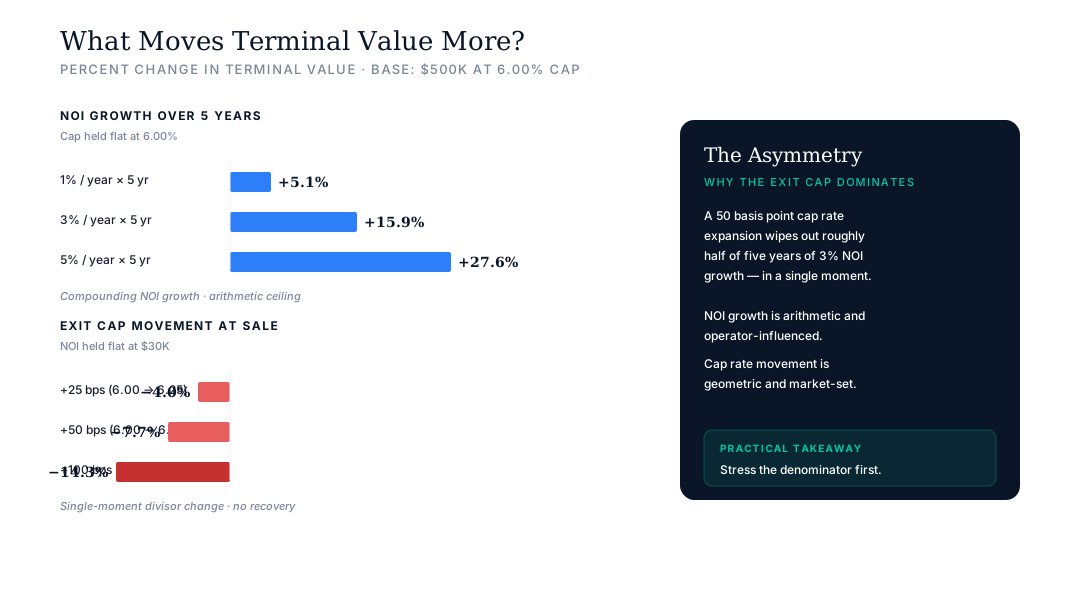
Because the cap rate is the divisor, small movements in it produce large, non-linear swings in value. A property generating $30,000 of year-five NOI sells for $500,000 at a 6.0% exit cap, $461,500 at 6.5%, and $428,500 at 7.0%. The NOI is identical in all three scenarios. The investor’s equity outcome is not.
This is the asymmetry that gets lost in retail underwriting: NOI growth compounds slowly and arithmetically — 3% per year for five years is a 16% total lift. Cap rate movement is geometric in its impact on value — 50 basis points of expansion on a 6.0% going-in cap reduces value by 7.7% in a single moment.
Why Cap Rate Movement Dominates NOI Growth
Run the comparison directly. A property bought at a 6.0% cap with $30,000 of NOI is worth $500,000 today. Hold it for five years with 3% annual NOI growth and no cap rate change, and year-five NOI of $34,800 sells at the same 6.0% cap for $580,000 — a 16% gain. Hold it five years with no NOI growth at all and let the exit cap drift to 6.75%, and the same $30,000 NOI sells for $444,400 — an 11% loss.
The same property, two opposite outcomes, driven almost entirely by the exit cap. This is why institutional underwriters spend more time defending the exit cap than the rent growth assumption. It moves the answer more.
How Institutional Underwriters Set the Exit Cap
There is a convention, and it is worth knowing because it forms the baseline against which a deal’s underwriting should be measured.
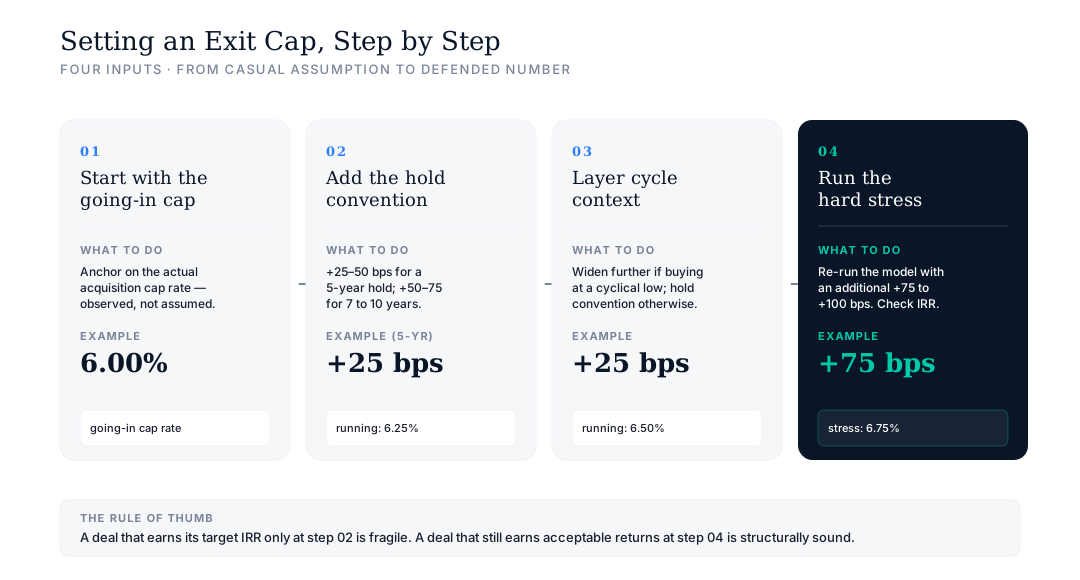
For a 5-year hold: exit cap = going-in cap + 25 to 50 basis points.
For a 7 to 10-year hold: exit cap = going-in cap + 50 to 75 basis points.
The reasoning has three components. First, an aging building physically depreciates; a five-year-older asset commands a slightly higher cap rate than a comparable newer one. Second, capital markets fluctuate; entering at a cyclical low in cap rates and assuming the next cycle low at exit is wishful underwriting. Third, the further into the future the sale, the more uncertainty, and uncertainty is priced into cap rates.
Institutional core multifamily underwriting in 2026 reflects exactly this. Average going-in cap rates for core deals sit near 4.75%, and average exit caps sit near 4.96% — a 20 basis point spread, with most underwriters widening that further for non-core assets and longer holds. Secondary-market value-add transactions price wider on both ends, often with exit caps 50 to 75 basis points above going-in.
The retail convention — using the same cap rate on both ends — has only one defense: the assumption that the market environment at sale will exactly match the market environment at purchase. That has not been true over any rolling five-year window in the last two decades.
A Worked Example
Consider a Class B fourplex acquisition. The numbers are illustrative but representative of secondary-market underwriting in 2026.
| Item | Value |
|---|---|
| Purchase price | $500,000 |
| Going-in NOI | $30,000 |
| Going-in cap rate | 6.0% |
| Hold period | 5 years |
| NOI growth assumption | 3% per year |
| Year 5 NOI | $34,800 |
| Equity invested (25% down) | $125,000 |
| Loan ($375,000 at 7.25%, 30-yr) | annual debt service ~$30,700 |
Three exit cap scenarios.
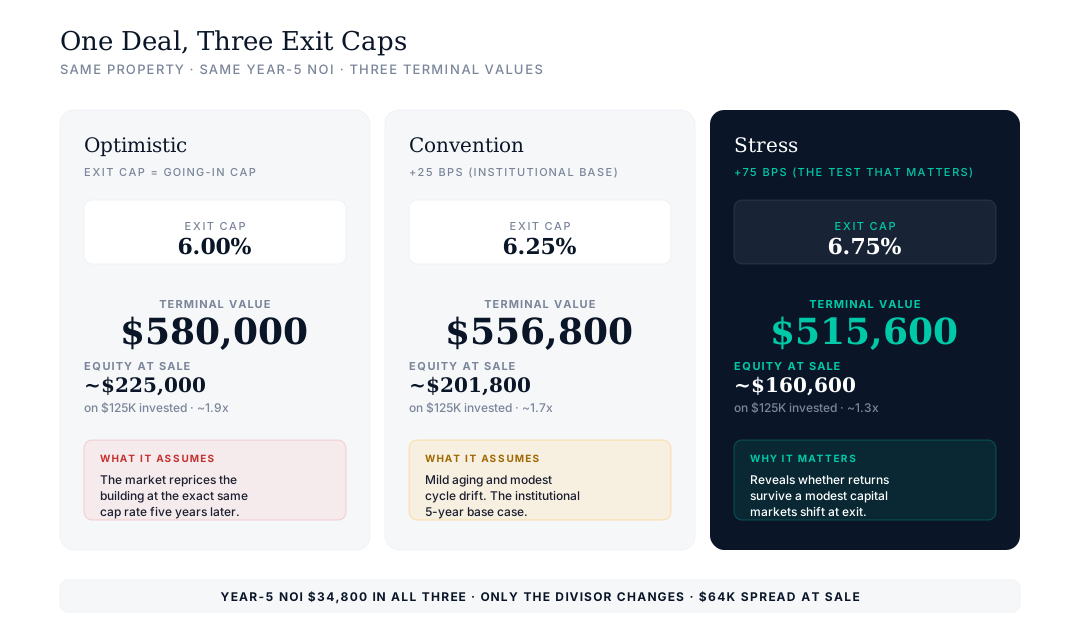
Optimistic — exit cap = going-in cap (6.00%). Terminal value = $34,800 ÷ 0.0600 = $580,000. Less the remaining loan balance (~$355,000 after five years of amortization), equity at sale ≈ $225,000. Combined with five years of operating cash flow, the deal returns roughly a 1.9x equity multiple and an IRR in the low double digits.
Convention — exit cap = going-in + 25 bps (6.25%). Terminal value = $34,800 ÷ 0.0625 = $556,800. Equity at sale ≈ $201,800. The same operating cash flow on a lower exit. Equity multiple drops to about 1.7x; IRR falls by roughly 200 basis points.
Stress — exit cap = going-in + 75 bps (6.75%). Terminal value = $34,800 ÷ 0.0675 = $515,600. Equity at sale ≈ $160,600. The deal still earns its equity back with a modest multiple, but the IRR compresses meaningfully. Most of the operator’s projected return came from terminal value, and the terminal value moved.
The NOI was identical in all three scenarios. The investor’s outcome was not. This is what the exit cap assumption does in a pro forma — and why setting it casually understates risk.
How to Stress Test the Exit Cap
The discipline is straightforward and underused. Run the model at three exit caps: the convention (going-in + 25 to 50 bps), a moderate stress (going-in + 75 bps), and a hard stress (going-in + 100 to 150 bps). For each, recompute terminal value, equity at sale, equity multiple, and IRR.
A deal that earns its target return only at the most optimistic exit cap is a deal that depends on a benign capital markets environment at exit. A deal that still produces an acceptable return at the hard stress is a deal whose returns are driven by NOI growth and amortization rather than by cap rate luck.
The right target depends on the investor’s hold strategy. A buy-and-hold operator with no fixed exit can tolerate a wider exit cap range because they can choose when to sell. A capital-constrained operator with a defined refinance or sale event in year five cannot — they need the exit cap to hold.
A Process for Your Next Deal
When the next acquisition surfaces, three rules turn the exit cap from a casual input into a deliberate one.
- Never set exit cap equal to going-in cap. Even in a flat market, the building is older and the next cycle is uncertain. Add at least 25 basis points for a 5-year hold, 50 for a 7 to 10-year hold.
- Layer cycle context onto the convention. If buying near a cyclical low in cap rates (post-rate-cut compression, supply-constrained markets), widen the exit cap further. If buying at a cyclical high (post-correction, distressed pricing), the convention is sufficient.
- Always run a +75 to +100 basis point stress. Compute the IRR and equity multiple at the stressed exit cap. If the deal fails at that level, the underwriting depends on the market giving the operator a favor at sale.
The investors who get hurt at exit are not the ones who modeled aggressive NOI growth. They are the ones who modeled defensible NOI growth and casually held the exit cap flat.
Frequently Asked Questions
What is the difference between a going-in cap rate and an exit cap rate?
The going-in cap rate is the yield at acquisition — year-one NOI divided by purchase price. The exit cap rate is the assumed yield at sale — year-of-sale NOI divided by the projected sale price. Going-in is observed; exit is assumed, which is exactly what makes it the highest-leverage assumption in the model.
Should the exit cap always be higher than the going-in cap?
In most underwriting environments, yes — for three reasons: physical depreciation, capital markets uncertainty, and the asymmetric cost of being wrong on the optimistic side. An operator can argue for a flat or compressed exit cap only in a market with strongly compressing cap rates, very short holds, and significant repositioning that moves the asset to a tighter-cap segment.
How much does a 50 basis point exit cap move actually change returns?
On a typical 5-year hold for stabilized small multifamily, 50 basis points of exit cap expansion compresses terminal value by roughly 7% to 9% depending on the going-in cap level. That value reduction lands almost entirely on equity, which is why a 50 basis point miss typically takes 150 to 250 basis points off projected IRR.
Does the exit cap matter for buy-and-hold investors who never sell?
It matters less, but it does not disappear. A refinance event uses the same cap rate logic to set property value, and that value drives loan proceeds and LTV. A buy-and-hold operator with periodic refinances is still exposed to cap rate movement at every recapitalization point.
Is there a published source for institutional exit cap conventions?
CBRE’s quarterly underwriting metrics survey reports average going-in and exit cap rates by asset class. The current spread for core multifamily sits near 20 basis points, with secondary and value-add transactions running 50 to 75 basis points wider. These are useful benchmarks, but the right exit cap for any specific deal still depends on submarket, hold period, and cycle position.
AtlasTerminal runs every acquisition at three exit cap scenarios by default — convention, stress, and hard stress — alongside the going-in metrics. Stress your next deal’s exit assumption before the model decides it for you.