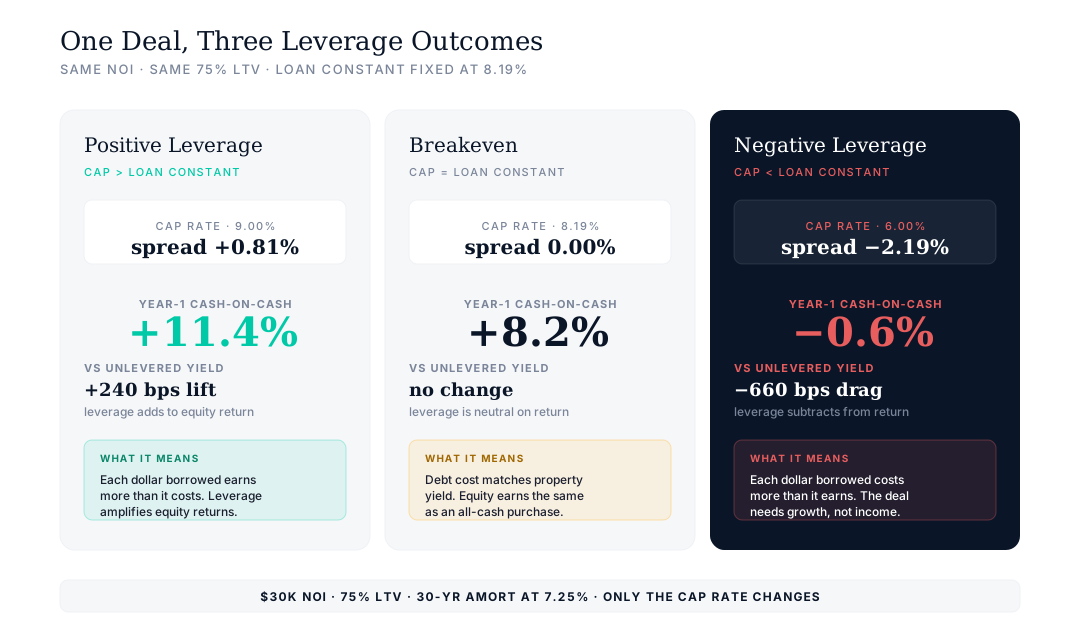
A retail investor underwrites a small multifamily acquisition at a 6.0% cap rate. The financing quote comes back at 7.25%. The investor notes the spread is unfavorable but reasons that the loan is amortizing, the cap rate is solid, and the property “still cash-flows.” The deal closes. Year-one cash-on-cash return prints at negative half a percent. Two years later, after a small vacancy and an insurance reset, the investor is funding the mortgage out of personal income.
This sequence is not unusual in 2026. It is the default outcome when the cost of borrowed capital exceeds the yield of the underlying property — a condition called negative leverage. The mechanism is straightforward, the math is unforgiving, and most retail underwriting either misses it or papers over it with rent growth assumptions that have to be perfect for the deal to work.
What Negative Leverage Actually Means
Leverage in real estate is the use of debt to amplify equity returns. When the property earns more per dollar than the debt costs per dollar, the spread accrues to the equity holder — return on equity ends up above the unlevered yield of the asset. That is positive leverage, and it is the entire reason most rental investors use a mortgage rather than paying cash.
Negative leverage is the inverse. When the cost of debt exceeds the property’s yield, each dollar of borrowing subtracts more from cash flow than it adds, and equity return falls below the unlevered yield. In the worst cases, cash-on-cash goes to zero or negative — the investor is paying out-of-pocket for the privilege of holding a property whose operations cannot cover its loan.
The threshold is a single comparison. If the property’s cap rate exceeds the cost of debt, leverage helps. If it does not, leverage hurts. Most explanations stop there, but the comparison most retail investors run — cap rate versus mortgage interest rate — is the wrong one. The right comparison is cap rate versus loan constant.
The Loan Constant Is the Real Cost of Debt
The interest rate on a loan is the cost of the money borrowed. The loan constant is the cost of the loan — interest plus principal repayment — expressed as an annual percentage of the loan balance.
Loan Constant = Annual Debt Service ÷ Loan Balance
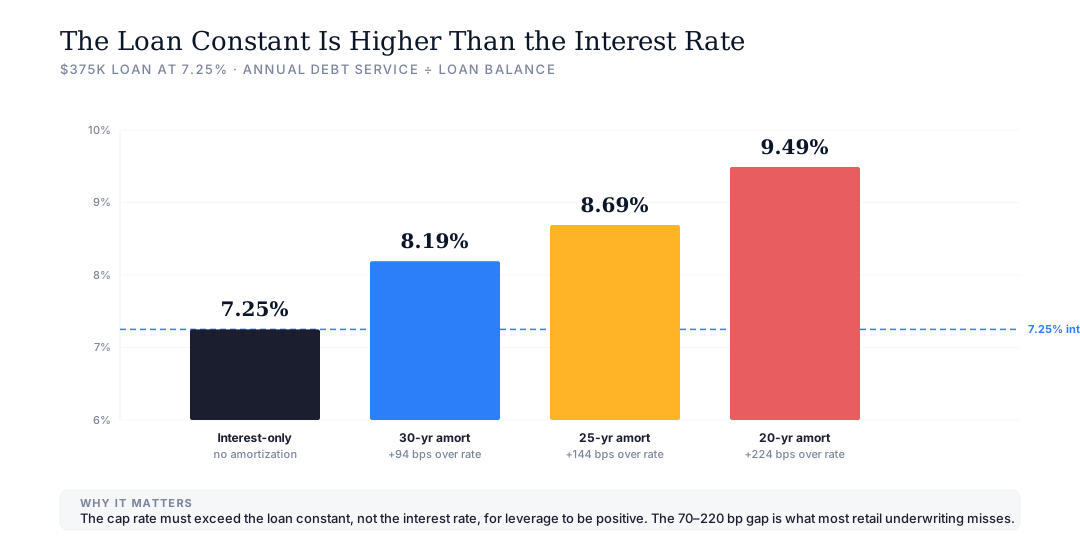
For an interest-only loan, the loan constant equals the interest rate. For an amortizing loan, the loan constant is always higher, because the payment includes principal as well as interest. The gap is a function of the amortization period: shorter amortization, larger gap.
A $375,000 loan at 7.25% on a 30-year amortization carries an annual debt service of roughly $30,700. That makes the loan constant $30,700 ÷ $375,000 = 8.19%. The interest rate is 7.25%, but the cash-flow cost of that loan is 8.19% — 94 basis points higher. On a 25-year amortization the same loan carries a constant near 8.7%. On a 20-year, it climbs above 9.5%.
This is the gap most retail investors silently misprice. They compare the 7.25% interest rate to a 6.0% cap rate, see a 125 basis point shortfall, and assume the loan is “modestly negative.” The actual shortfall against the loan constant is 219 basis points, and that is the figure that drives cash flow.
A Worked Example
Consider a Class B fourplex acquisition. The numbers are illustrative but reflect typical small-multifamily underwriting in 2026.
| Item | Value |
|---|---|
| Purchase price | $500,000 |
| Going-in NOI | $30,000 |
| Going-in cap rate | 6.0% |
| Loan amount (75% LTV) | $375,000 |
| Interest rate | 7.25% (DSCR loan, 30-yr amort) |
| Annual debt service | ~$30,700 |
| Loan constant | ~8.19% |
| Equity invested | $125,000 |
Unlevered return. Without financing, the property earns $30,000 on $500,000 — a 6.0% cash yield. That is the cap rate, and it is the ceiling on what the equity can earn in cash flow without leverage.
Levered cash flow. Subtract the $30,700 of annual debt service from the $30,000 of NOI, and the property loses $700 per year. The investor is putting cash in, not pulling it out. Cash-on-cash return on the $125,000 of equity is -0.56% — below zero.
The damage from leverage. The equity return moved from +6.0% (unlevered) to -0.56% (levered). That 656 basis point destruction is the cost of borrowing at 8.19% to fund an asset yielding 6.0%. Principal amortization gradually rebuilds some of that — the loan balance falls, equity grows by roughly $4,500 in year one — so total return on equity, including the principal paydown, is closer to +3%. But the cash component is gone.
Breakeven cap rate. The cap rate at which leverage neither helps nor hurts equals the loan constant. At 8.19%, a property generating $30,000 of NOI must cost no more than $30,000 ÷ 0.0819 = $366,300 for leverage to break even. Any price above that — any cap rate below 8.19% — is negative leverage. In 2026, with DSCR loan rates running 7.0% to 8.5% on 30-year amortizations, the breakeven cap rate for most retail borrowers sits in the high 7s to high 8s. The vast majority of cash-flowing single-family rentals and small multifamily acquisitions price below that.
When Negative Leverage Can Still Be Acceptable
Negative leverage is not automatically a deal-killer. It is a deliberate choice that has to be justified by a thesis the deal can deliver. There are three defensible cases.
Below-market rents. If in-place rents are materially below market — a tenant that has not seen an increase in years, a property mismanaged into vacancy — there is a credible path from negative leverage at acquisition to positive leverage within twelve to twenty-four months as rents normalize. The going-in cap rate is misleading because in-place NOI is depressed; the stabilized cap rate is what matters.
Value-add execution. A renovation that lifts NOI through unit upgrades, expense restructuring, or vacancy reduction can transition the deal from negative to positive leverage by stabilization. This is the yield on cost calculation — total cost basis versus stabilized NOI — and a target spread of 100 to 200 basis points over the loan constant is the discipline that distinguishes a real value-add thesis from a hope.
Expected cap rate compression at exit. If the underwriting assumes meaningful cap rate compression between acquisition and sale, equity returns can survive year-one negative leverage because the terminal value carries the deal. This is a fragile thesis — exit cap movement moves terminal value more than any other variable, and the direction is not predictable — but it is sometimes defensible in markets with strong rent growth and tight supply.
In every case, the common thread is the same: negative leverage at acquisition requires a credible mechanism for getting to positive leverage during the hold. A deal that is stuck in negative leverage from year one to exit is a deal whose returns depend on appreciation alone, and appreciation is the most volatile component of total return.
A Process for Your Next Deal
Three checks turn negative leverage from a hidden risk into a deliberate decision.
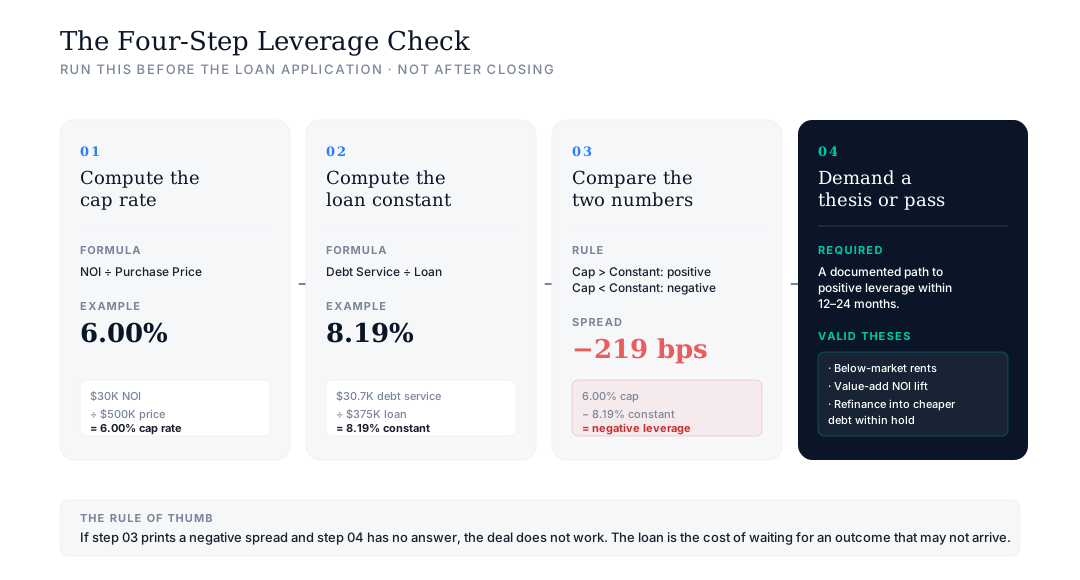
- Compute the loan constant, not the interest rate. Divide projected annual debt service by the loan balance. That is the number to compare against the cap rate. The interest rate alone systematically understates the cost of debt by 70 to 120 basis points for typical 25- to 30-year amortizations.
- Run the leverage check on day-one NOI, not pro forma. If the deal only achieves positive leverage in year three after a 15% rent lift, the underwriting is betting on execution. Acknowledge it explicitly.
- Quantify the negative-leverage drag. If the spread is negative, compute the cash-on-cash impact. A 100 basis point negative spread on a 75% LTV loan reduces cash-on-cash by roughly 3 percentage points. That is the cost the rent-growth or cap-rate thesis has to overcome.
The investors who get hurt are not the ones who knowingly accept negative leverage with a plan to exit it. They are the ones who compare a cap rate to a mortgage rate, see a manageable gap, and never realize the loan constant was the number that mattered.
Frequently Asked Questions
What is the difference between negative leverage and a negative cash flow?
Negative leverage is a structural condition — the cost of debt exceeds the property’s unlevered yield. Negative cash flow is the symptom that often results. A deal can have negative leverage and still produce slightly positive cash flow if the loan is sized small enough, but the cash-on-cash return will always be below the cap rate. Negative cash flow is the more visible problem; negative leverage is the underlying cause.
How is loan constant different from the mortgage interest rate?
The interest rate is what the lender charges on the outstanding loan balance. The loan constant is the total annual payment — interest plus principal — divided by the loan balance. For an interest-only loan, they are the same number. For an amortizing loan, the loan constant is always higher, and the gap widens as the amortization period shortens. A 30-year amortization at 7.25% has a loan constant near 8.19%; a 20-year amortization at the same rate has a loan constant above 9.5%.
Can a deal in negative leverage still be a good investment?
Yes, but only if there is a defensible thesis for transitioning to positive leverage during the hold — rent growth, value-add NOI lift, or refinance into cheaper debt. A deal that stays in negative leverage from acquisition through exit relies entirely on appreciation, which is the most volatile component of total return. The bar for accepting negative leverage at acquisition is a documented operating plan, not a hope that rates will fall.
What cap rate do I need to clear to avoid negative leverage in 2026?
It depends on the loan constant. With DSCR loan rates of 7.0% to 8.5% on 30-year amortizations, the loan constant sits roughly 70 to 120 basis points above the rate — so 7.7% to 9.7%. A property’s cap rate must exceed the loan constant for leverage to be positive. For most retail borrowers in 2026, the breakeven cap rate is in the high 7s to high 8s.
Why do institutional investors still buy deals in negative leverage?
Two reasons. They have access to cheaper debt — agency loans, life company financing, longer interest-only periods — that lowers their loan constant by 100 to 200 basis points relative to retail DSCR borrowers. And they underwrite to a multi-year stabilized return rather than year-one cash flow, so they explicitly model the transition from negative leverage at entry to positive leverage at stabilization. Retail investors borrowing at 8% loan constants without an execution plan are not running the same deal.
AtlasTerminal computes loan constant and the leverage spread alongside cap rate and DSCR on every deal we underwrite, so the financing drag is visible before the deal closes, not after. Check the leverage math on your next acquisition before the mortgage decides it for you.