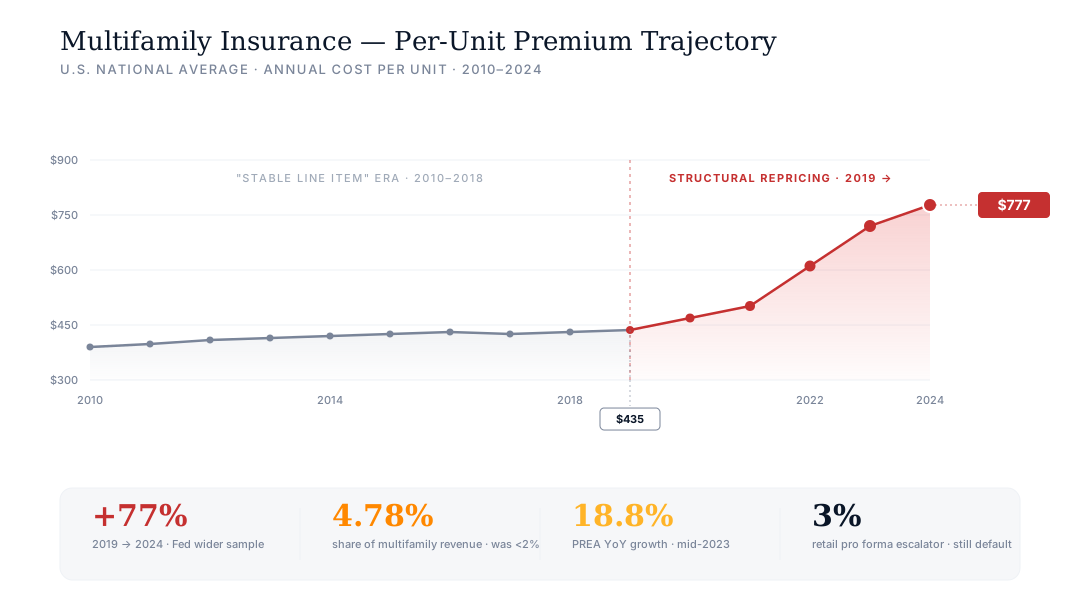
Most retail multifamily underwriting still treats insurance the way it was treated in 2018: a small, stable line item that grows roughly at general inflation. A trailing-twelve-month premium, a 3% annual escalator, and a 5% buffer on the proforma. The line item rolls forward, the NOI ties out, the cap rate looks defensible. Five years later, the actual insurance cost has doubled, the property has lost two hundred basis points of operating margin, and the exit cap rate the investor used at acquisition has been overtaken by the same expense structure that quietly compounded against it.
This is not a forecasting failure in the conventional sense. The data has been clear since 2022. National per-unit insurance costs rose 55% between 2021 and 2024, and roughly 75% over the five-year window from 2019 to 2024. Insurance as a share of multifamily revenue has moved from under 2% historically to nearly 5%. In high-risk markets, individual properties now carry insurance loads two to three times the national average. None of this is a forecast. It has already happened. The underwriting question is whether a pro forma built today reflects it — and whether the cap rate paid at acquisition is honest about what the asset actually is.
From Stable Line Item to Strategic Variable
For most of the post-GFC cycle, multifamily insurance was an unremarkable line in the operating budget. From 2010 through 2018, national average premiums per unit fluctuated between approximately $390 and $430. Year-over-year volatility was low. Underwriters could plug a number, escalate it at 3%, and not be wrong by more than a rounding error.
The structural break began in 2019 and accelerated sharply after 2022. National per-unit insurance costs reached approximately $502 in 2021, $777 in 2024, and Federal Reserve research using a broader sample puts 2024 closer to $821 — a 77% rise over five years. The per-unit dollar growth is large in isolation, but the more telling figure is insurance as a share of property revenue: it has moved from 1.95% in 2000 to 4.78% in 2024. That is not an inflationary drift. It is a structural reweighting of the operating expense stack.
Three forces are driving the repricing, and none of them mean-revert cleanly:
- Reinsurance capacity contraction. Global reinsurers repriced catastrophe exposure between 2022 and 2024 in response to a sequence of large insured-loss years. The repricing is now embedded in primary carrier rate structures.
- Climate model recalibration. Carriers updated their hurricane, wildfire, and severe convective storm models against the post-2017 loss record. The new models produce higher expected-loss assumptions, which feed directly into base rates.
- Replacement cost inflation. Construction materials and labor costs are 30–40% higher than 2019 levels, raising the insured value of every property regardless of catastrophe exposure.
Even after a hurricane-quiet 2025 and softening commercial property rates entering 2026, the structural floor sits well above pre-2020 levels. Moderation in the cycle is not the same as a reversion to the prior equilibrium.
The Mechanics: Why This Is a Cap Rate Event
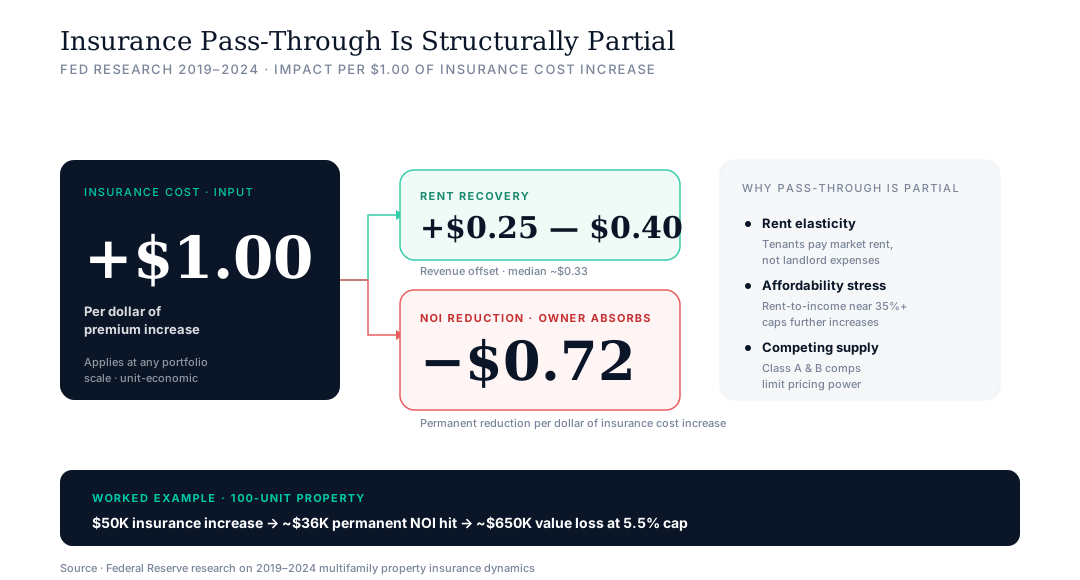
The instinctive read on a rising operating expense is that it is offset, at least partially, by rent growth. Federal Reserve analysis of the 2019–2024 multifamily data found something more uncomfortable. A one-dollar increase in property insurance costs is associated with roughly 25–40 cents of revenue increase — and approximately 72 cents of net operating income reduction. Pass-through to tenants is real but partial. The owner absorbs most of the increase.
That absorption mechanic is what converts an expense problem into a cap rate problem. Consider a hypothetical 100-unit stabilized property generating $1,800,000 in revenue with $900,000 in operating expenses, producing $900,000 of NOI. At a 5.5% cap rate, value is approximately $16.4 million. Insurance at acquisition runs $500 per unit — $50,000 annually, or 5.6% of operating expenses.
Five years later, insurance has reached $850 per unit — a 70% increase, in line with the national trajectory. The annual cost is now $85,000. Of the $35,000 increase, the owner recovers roughly $12,000 in rent (using the 35-cent-on-the-dollar pass-through midpoint). The remaining $23,000 is a permanent NOI hit.
| Metric | Year 0 | Year 5 (no rent offset) | Year 5 (35% pass-through) |
|---|---|---|---|
| Revenue | $1,800,000 | $1,800,000 | $1,812,250 |
| Insurance cost | $50,000 | $85,000 | $85,000 |
| Other operating expenses | $850,000 | $902,000 | $902,000 |
| NOI | $900,000 | $813,000 | $825,250 |
| Value at 5.5% cap | $16,364,000 | $14,782,000 | $15,005,000 |
The pass-through scenario still produces a $1.36 million value reduction — about 8.3% of acquisition value — driven by a single line item. If the buyer’s exit cap rate widened to 6.0% (a plausible outcome in a higher-rate environment), the value loss compounds to roughly $2.6 million, or 16% of acquisition value. The investor underwrote a 5.5% cap with 3% expense escalators. The asset delivered something materially worse, and the gap appeared in the line item that was treated as boring.
Geographic Repricing Is Even More Severe
The national averages understate the dispersion. Insurance repricing has been geographically concentrated, and the markets that drove the most aggressive multifamily growth in 2018–2022 are the same markets now absorbing the largest absolute and percentage increases.
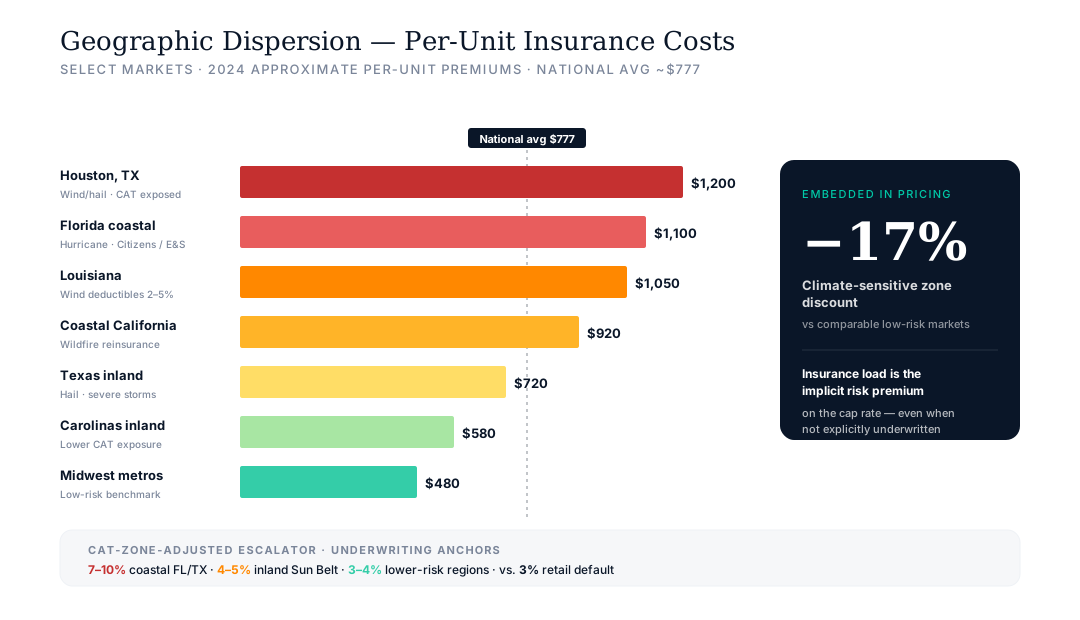
- Houston — average per-unit insurance now exceeds $1,200, more than 50% above the national average.
- Florida — the largest cumulative increases since 2019, driven by hurricane exposure and a contracting admitted carrier market that has pushed many operators into surplus lines or state-backed Citizens coverage.
- Louisiana and Texas Gulf Coast — wind and hail deductibles have climbed to 2–5% of insured value per occurrence, meaning a single named storm can produce $200,000+ of out-of-pocket loss before any insurance recovery.
- Coastal California — wildfire reinsurance pricing has compounded into double-digit annual primary rate increases, with non-renewal rates rising materially in higher-risk ZIP codes.
A separate analysis of climate-sensitive commercial markets found that property values in high-risk zones run approximately 17% below comparable assets in low-risk zones — a discount that did not exist a decade ago and is now built into transaction pricing. Insurance load is functioning as an implicit risk premium on the cap rate, even where it is not explicitly underwritten.
The discipline this requires sits at the same analytical layer as zip code analytics. Insurance pricing is not a metro phenomenon — it is a parcel-level phenomenon driven by CAT zone, distance to coast, building construction class, and roof age. A pro forma that uses a metro-average insurance assumption is using the same kind of blunt input that produces systematic underwriting errors elsewhere.
Why the Static Escalator Is the Default Mistake
The most common retail underwriting failure is not a missing data source. It is the use of an inherited assumption — a 3% annual insurance escalator — that was reasonable in 2015 and is no longer defensible. The PREA mid-2023 expense data showed multifamily insurance growing 18.8% year-over-year nationally, more than three times the rate of the next-largest expense category. Even the moderation expected in 2026 does not bring annual growth back into the 3% band.
Three corollary errors compound the headline issue:
- In-place premium versus market premium. A property’s current insurance cost reflects the policy in force, often bound 12–18 months ago. The renewal quote at acquisition can be 20–40% higher in CAT-exposed markets. Underwriting on the in-place number means modeling an expense that no longer exists.
- Deductible erosion. Even where premiums have moderated entering 2026, deductibles have continued to climb. A property with the same nominal premium as 2022 may now carry double the all-other-perils deductible and a percentage-of-value wind deductible that was not present before. This shifts loss exposure to the owner without showing in the operating budget — until the loss occurs.
- Loss-of-rents coverage compression. Loss-of-rents and business-interruption sub-limits have tightened in CAT-exposed markets. A property that loses six months of operations to a covered event may recover only a fraction of the lost income that prior policies would have covered. This is a balance-sheet exposure that the operating proforma does not capture at all.
A Disciplined Underwriting Framework
Integrating insurance repricing into acquisition analysis requires four steps that run alongside conventional underwriting.
Step one: replace the in-place premium with a current bound quote. Before signing an LOI, request a renewal indication from a broker actively writing in the submarket. Use the indicated bound premium — not the seller’s current expense — as the year-one underwriting figure. In CAT-exposed markets, the difference between in-place and bound is routinely the largest single underwriting adjustment in the model.
Step two: apply a CAT-zone-adjusted escalator. A 3% blended escalator is no longer defensible in coastal Florida, Texas Gulf, or Southern California. Use 7–10% in CAT-exposed markets, 4–5% in inland Sun Belt, and 3–4% in lower-risk regions. These are not forecasts — they are conservative anchors against the post-2019 trajectory.
Step three: stress test for a 2x insurance scenario. Recalculate NOI, DSCR, and projected debt yield under a hypothetical doubling of the insurance line over a five-year hold. If the stressed metrics fail to clear refinance thresholds — particularly the 9% projected debt yield discussed in the prior debt yield analysis — the deal carries refinance risk that is not visible in the base case.
Step four: reprice the cap rate. If the property sits in a CAT-exposed market, add 25–50 basis points to the assumed exit cap rate to reflect the climate risk premium that is now embedded in transaction pricing for those zones. This is not a punitive adjustment — it is an alignment with how institutional buyers are pricing the same assets.
The Strategic Implication
Insurance repricing has compressed multifamily NOI in a way that conventional underwriting does not capture, and the compression is largest in exactly the markets that produced the strongest absolute returns in the prior cycle. Investors who underwrite a Texas Gulf or Florida coastal acquisition today using the operating expense ratios that worked in 2019 are systematically overstating the asset’s stabilized economics — typically by 50–150 basis points of NOI margin.
The corrective discipline is not exotic. It is current data on bound premiums, honest escalators that match the post-2019 trajectory, and a willingness to stress test the line item that has produced more NOI volatility than any other since 2020. The investors who have integrated this into their acquisition workflow are not buying fewer deals. They are paying different prices for them, and they are exiting properties whose financing math still works rather than properties whose insurance bill broke the model.
What was an operating expense in 2018 is a cap rate variable in 2026. Underwriting it as anything else is paying for an asset the seller still owns and inheriting the one the market has already repriced.
Frequently Asked Questions
How much have multifamily insurance premiums actually risen?
National per-unit costs rose from approximately $502 in 2021 to $777 in 2024 — a 55% increase. Federal Reserve research using a broader property sample puts the increase at roughly 75% over the 2019–2024 window. By 2024, insurance accounted for nearly 5% of multifamily revenue, compared to under 2% historically. Increases have been heaviest in coastal and Gulf markets.
Why do owners absorb most of the insurance increase rather than passing it to tenants?
Federal Reserve analysis of 2019–2024 data found that a one-dollar insurance cost increase produces only 25–40 cents of revenue increase, with about 72 cents of net operating income reduction borne by the owner. Rental markets have meaningful price elasticity — particularly in markets with rising vacancy or affordability constraints — and tenants do not pay rent as a function of the landlord’s expense structure. Insurance pass-through is real but structurally partial.
Are insurance costs falling in 2026?
Commercial property insurance rates moderated entering 2026 after a hurricane-quiet 2025, with some indicators suggesting modest declines. However, this represents a softening from extreme highs, not a return to pre-2020 pricing. Deductibles have continued to climb even as premiums have moderated, shifting exposure to owners. The structural drivers — reinsurance capacity, climate model recalibration, and replacement cost inflation — remain in place.
How should I model insurance for an acquisition in a CAT-exposed market?
Replace the seller’s in-place premium with a current bound quote from an active broker in the submarket — these often differ by 20–40%. Apply a 7–10% annual escalator rather than the 3% historical default. Stress test NOI under a 2x insurance scenario over a five-year hold and check whether refinance metrics, particularly debt yield, still clear lender thresholds. If they do not, the cap rate must absorb the difference.
What is the relationship between insurance repricing and cap rates?
Higher insurance costs reduce NOI, which reduces value at any given cap rate. Separately, climate-exposed markets have seen transaction prices reset to reflect a 15–20% discount versus comparable lower-risk markets — meaning the cap rate paid at acquisition has effectively widened. Underwriting a CAT-exposed asset at the same exit cap rate as a comparable inland asset systematically overstates value at exit.
Does this analysis apply to single-family rentals and small multifamily?
The dynamics apply, though the magnitudes differ. Smaller residential investment property owners are typically in admitted homeowner-style policies, where rate increases have been more uniform and pass-through to rents is somewhat higher in single-family rental contexts. The framework — current bound quotes, CAT-zone escalators, stress testing — is the same. The dollar impact per door is generally smaller, but it represents a larger share of NOI for properties with thin margins.
AtlasTerminal incorporates current market insurance benchmarks, CAT-zone-adjusted expense escalators, and stress-tested NOI projections into single-asset underwriting — bringing the discipline that institutional acquisition teams apply to the line item retail proformas most often understate. Reprice your underwriting before the renewal quote does it for you.