Part of our complete framework for underwriting a rental property.
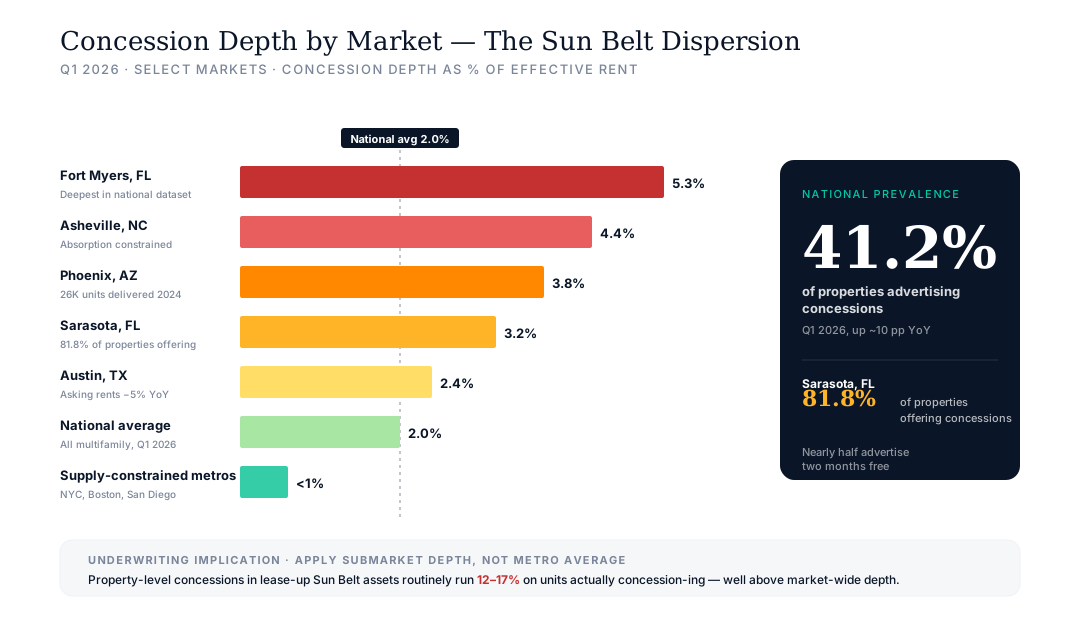
A multifamily pro forma built on advertised asking rents has been an acceptable approximation for most of the past decade. Vacancy and bad debt absorbed the small gap between what was posted and what was actually collected, and concessions, where they existed, were a feature of stressed lease-ups rather than stabilized operations. That approximation has stopped working. Roughly 41% of U.S. multifamily properties now advertise concessions, with deep clusters across the Sun Belt — Sarasota at 82% prevalence, Phoenix at 3.8% depth, Fort Myers at 5.3%. Investors underwriting acquisitions in those markets at asking rent are starting from a number the operator does not actually collect.
The mechanical issue is small in any single month and large over a hold period. A single month of free rent on a twelve-month lease is an 8.3% reduction in effective rent. Two months free — a concession structure now common in lease-up properties across Sun Belt submarkets that absorbed the 2023–2024 delivery wave — is 16.7%. A pro forma that treats asking rent as collected revenue and applies a 5% vacancy adjustment is silently overstating Year One revenue by hundreds of basis points before any operational underperformance.
This is not a forecasting problem. It is a measurement problem. The data has been visible since mid-2024, and by Q1 2026 concession prevalence has risen another ten percentage points year-over-year. The underwriting question is whether the pro forma reflects the rent the asset can actually collect, or the rent posted on the listing sites.
A Supply Wave the Sun Belt Has Not Yet Absorbed
The current concession cycle is a direct function of supply. The U.S. multifamily market delivered approximately 592,000 units in 2024 — the largest single-year total since 1974. More than half of that volume landed in Sun Belt metros: Dallas–Fort Worth at roughly 35,400 units, Phoenix at 26,000, Austin and Houston each at 25,000 to 30,000, Atlanta near 24,000, Charlotte 17,000, Raleigh–Durham 15,600.
National absorption was the second-highest of the century at approximately 555,000 units — a strong number in isolation, but still net negative versus delivery volume in the markets that carried most of the supply. The 2025 calendar moderated to roughly 430,000 deliveries, and 2026 steps down further in supply-heavy metros: Austin deliveries down approximately 47%, Phoenix down approximately 40% on top of an 18% 2025 decline, Denver supply cut by more than half. Markets including Orlando, Miami, and Nashville will still add 4–5% to stock through 2026–2027.
The composition matters for underwriting. The supply pipeline is decelerating, but the inventory already delivered remains in lease-up or recently stabilized. A property that opened in mid-2024 may not reach steady-state occupancy until late 2026 or 2027, and the rent roll signed during that window carries embedded concessions that re-price the asset’s economics for the duration of those leases — and for the comps used to write the next leases. Each new lease at a $1,650 effective on a $1,800 asking is a data point that anchors the submarket’s renewal rent and the next year’s pro forma.
The Asking-to-Effective Math
The mechanical conversion from asking to effective rent is the same one underwriters use for office and industrial leases with free-rent periods, but it is largely absent from retail multifamily pro formas. The formula:
Effective rent = (Asking rent × Lease months − Concession value) / Lease months
For a single-asset acquisition, the more useful framing is the percentage gap that different concession structures produce:
| Concession structure | Effective rent gap |
|---|---|
| 2 weeks free on 12-month lease | 4.2% |
| 1 month free on 12-month lease | 8.3% |
| 6 weeks free on 12-month lease | 12.5% |
| 2 months free on 12-month lease | 16.7% |
| $1,000 lease signing credit on $1,800 rent, 12-month | 4.6% |
| 1 month free on 15-month lease | 6.7% |
Two structural points run through these numbers. First, the gap is significantly larger than the headline concession-depth metric reported by data providers like CoStar and RealPage, which expresses concessions as a percentage of asking rent averaged across the entire stock — including units with no concession at all. A market reported at 3.8% concession depth may include individual lease-up properties offering 12–16% on the units actually concession-ing. Underwriting an acquisition of one of those properties requires the property-level gap, not the market average.
Second, the concession does not disappear at renewal in the way the marketing structure implies. Renewal rent is set against the tenant’s expectations, which were formed by the concession-adjusted rent they paid at move-in. Operators report a renewal stickiness effect — new asking rents at renewal that materially exceed the effective rent the tenant paid in Year One produce churn, and the cost of re-leasing in a soft market often justifies holding renewal rent close to the effective rent rather than reverting to gross asking. The concession compresses the entire stabilized rent trajectory, not just the move-in month.
Where the Gap Is Widest
The dispersion across Sun Belt submarkets is meaningful for acquisition pricing. Q1 2026 data shows national concession prevalence at 41.2% of properties — up nearly ten percentage points year-over-year — with depth at approximately 2.0% of effective rent. The dispersion sits inside that national average.
- Sarasota, FL — 81.8% concession prevalence; 3.2% effective rent gap; nearly half of advertising properties offering two months free.
- Fort Myers, FL — 5.3% effective rent gap, the deepest reading in the national dataset.
- Asheville, NC — 4.4% effective rent gap, driven by a smaller absolute supply wave but absorption constrained by population growth deceleration.
- Phoenix — 3.8% depth and 2.3% effective rent gap; one of the largest Sun Belt delivery markets in 2024.
- Austin — 2.4% effective rent gap, against a backdrop of −4.8% to −5.2% year-over-year asking rent declines.
In each of these markets, the headline cap rate paid on a 2026 acquisition reflects a price the buyer is paying against a trailing twelve-month NOI that already incorporates the concession structure. The question for the buyer is what NOI projects forward — and whether concessions sunset in line with the supply pipeline deceleration, or persist as a structural feature of the rent roll for the duration of leases signed in 2025 and 2026.
Why Concessions Do Not Cleanly Sunset
The intuitive reading is that as the supply pipeline contracts — Austin down 47%, Phoenix down 40%, Denver down more than half — concessions will compress mechanically, and effective rents will converge back to asking. The mechanics are more layered.
Three forces resist clean reversion:
-
The signed rent roll is locked. Leases signed in late 2024 through 2026 with two-month concessions carry through the lease term. A property acquired in mid-2026 with a typical 12-month lease structure will not see those leases fully roll until mid-to-late 2027, by which point a portion will renew. Even if the submarket clears its supply overhang in 2026, the rent roll the buyer inherits reflects the concession environment that existed when each lease was signed.
-
The comp set anchors on net effective. Operators set new asking rents using competitor effective rents, not competitor asking rents. A market that has spent eighteen months at 4% concession depth establishes a net effective benchmark that is harder to dislodge than a posted asking number. The first operator to drop concessions and hold asking rent loses traffic to the comp.
-
Concessions migrate from move-in to renewal. As lease-up concessions roll off, operators in oversupplied submarkets often shift to renewal credits or rent-freeze offers to maintain occupancy against newly-stabilized competitors. The line item moves from “lease-up concessions” to “renewal concessions,” but the effective rent compression remains.
The result is that even in submarkets where 2026 delivery contractions are dramatic, the rent roll inherited at acquisition contains embedded concession economics that take eighteen to thirty-six months to work through. Underwriting that assumes a return to asking-rent revenue within twelve months of acquisition is making an assumption the supply data does not support.
A Worked Example
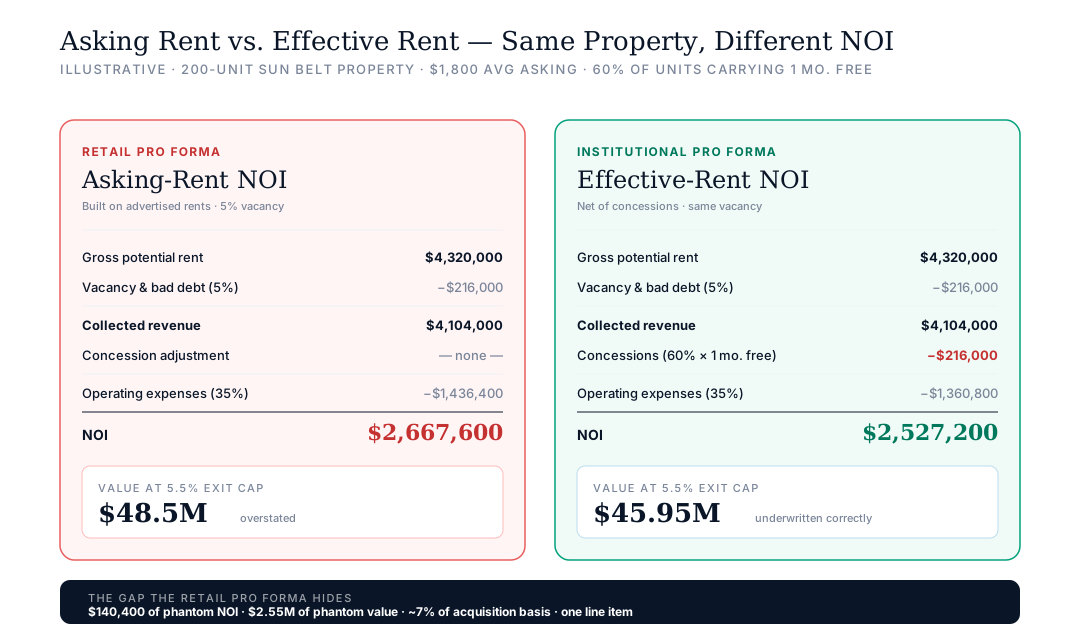
Consider a hypothetical 200-unit Sun Belt property with asking rents averaging $1,800 per unit, acquired in mid-2026. The trailing-twelve-month rent roll shows 60% of units carrying one month of concession on twelve-month leases — consistent with the property’s lease-up vintage. The remaining 40% are renewals at asking, executed before the concession cycle deepened.
At full asking rent, gross potential income is $4,320,000. A 5% vacancy adjustment produces gross collected revenue of $4,104,000. This is the number a retail pro forma typically carries to NOI.
The effective-rent adjustment is concentrated in the 60% of units carrying one month of free rent. Each of those 120 units gives back $1,800 over twelve months, or $150 per month per unit — $216,000 in aggregate annually. Subtracting this from the vacancy-adjusted figure produces effective collected revenue of $3,888,000.
The gap is $216,000, or 5.3% of vacancy-adjusted revenue. At a 35% operating expense ratio and a 5.5% exit cap rate, that revenue gap flows roughly one-for-one into NOI ($140,400) and implies $2.55 million of value at exit cap — approximately 7% of acquisition value. The investor whose pro forma used asking rent rather than effective rent has overstated the asset’s stabilized economics by exactly that amount.
The error compounds in markets where concessions are deeper. A Sarasota or Fort Myers property at 5% effective rent gap on the entire rent roll produces a 7–10% revenue gap to the asking-rent pro forma. Across the same exit cap rate, the implied value miss is in the $4–6 million range on a $30 million acquisition.
A Disciplined Underwriting Framework
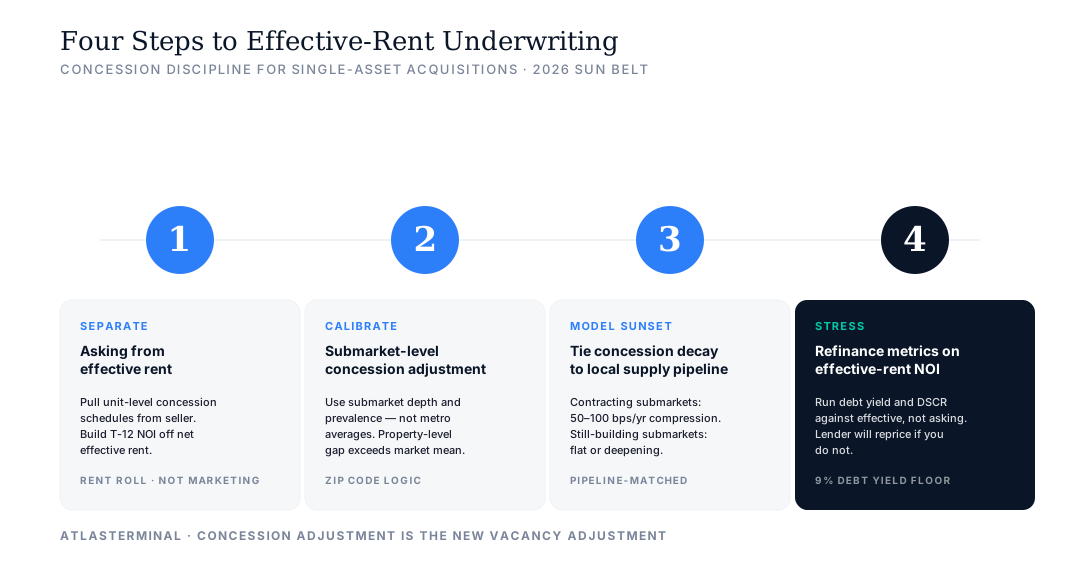
Integrating concession discipline into single-asset underwriting runs in four steps that sit alongside the rest of the analytical stack.
Step one: separate gross asking rent from collected effective rent in the rent roll. Request the rental concession schedule and the actual unit-level effective rents from the seller. Build the trailing-twelve-month NOI off effective rent, not advertised rent. If the seller cannot or will not produce the schedule, treat asking rent as an overstatement and apply a submarket concession adjustment from third-party data.
Step two: apply a submarket-specific concession adjustment to Year One revenue projections. Use submarket-level concession depth and prevalence — not metro averages. The framework here is the same logic that drives zip-code-level analytics: metro data conceals the submarket dispersion that matters at the property level.
Step three: model concession sunset against the local supply pipeline. In submarkets with steep 2026–2027 supply contractions (Austin, Phoenix, Denver in particular), an assumption that concessions compress 50–100 basis points per year is defensible. In submarkets still adding 4–5% to stock through 2027 (Orlando, Nashville, Miami), an assumption that concessions remain stable or deepen is more honest. Do not apply a single national rent-growth assumption across submarkets with different supply curves.
Step four: stress test refinance metrics on effective-rent NOI. The debt yield and DSCR framework discussed in the prior debt yield analysis should be run against effective-rent NOI, not asking-rent NOI. An acquisition that passes a 9% projected debt yield on asking rent and fails it on effective rent is an acquisition the lender will reprice at refinance.
The Strategic Implication
The current Sun Belt acquisition environment contains two distinct populations of opportunities: properties priced on asking-rent economics that overstate forward NOI, and properties priced on effective-rent economics with embedded concession leases that will work through the rent roll over the next eighteen to thirty-six months. Distinguishing between them is the analytical task that defines underwriting discipline in 2026.
The discipline is not exotic. It is the same conversion that office and industrial underwriters have applied to free-rent structures for decades, applied to a multifamily asset class where concessions were until recently rare enough to be ignored without consequence. The data has shifted. The framework has not.
Investors who treat asking rent as revenue in 2026 Sun Belt acquisitions are repeating the same category of error retail underwriting made with insurance escalators in 2022 and with refinance debt yield in 2023: relying on a default assumption from a market environment that no longer exists. Concession adjustment is the new vacancy adjustment. The properties whose forward NOI matches the pro forma will be the ones underwritten that way.
Frequently Asked Questions
What is the difference between asking rent and effective rent?
Asking rent is the advertised monthly rent before any incentives or concessions. Effective rent is the actual rent collected after spreading concessions — typically free months of rent or signing credits — across the lease term. For a 12-month lease at $1,800 with one month free, asking rent is $1,800 and effective rent is $1,650, an 8.3% gap. Operating NOI, lender underwriting, and exit valuations are calculated against effective rent.
How common are multifamily concessions in 2026?
Roughly 41% of U.S. multifamily properties advertised concessions in Q1 2026, up nearly ten percentage points from 2025. National concession depth measured against effective rent was approximately 2.0%. Sun Belt markets sit materially above the national average, with Sarasota showing 81.8% concession prevalence and several Florida and Arizona submarkets at 4–5% depth or higher at the individual property level.
Why is the Sun Belt seeing larger concessions than other regions?
The Sun Belt absorbed more than half of the 592,000 units delivered nationally in 2024 — the largest annual delivery volume since 1974 — concentrated in markets including Dallas–Fort Worth, Phoenix, Austin, Atlanta, and Charlotte. Even with the second-highest absorption of the century in 2024, the supply overhang in those metros pushed asking rents down and concessions up. Austin and Phoenix posted negative year-over-year rent growth through 2025 and into early 2026.
Will concessions disappear as supply contracts in 2026 and 2027?
The supply pipeline is contracting sharply in Austin, Phoenix, Denver, and other Sun Belt metros, which should compress concessions over time. The reversion is not clean. Existing leases signed with concessions carry through their terms, the comp set anchors on net effective rather than asking rent, and operators tend to shift lease-up concessions to renewal credits to maintain occupancy. A reasonable assumption for stabilized assets in contracting submarkets is 50–100 basis points of concession compression per year — not an immediate return to asking-rent revenue.
How should I adjust my pro forma to reflect concessions?
Build Year One revenue off effective rent, not asking rent, using the seller’s unit-level concession schedule where available. Apply a submarket-specific concession adjustment to forward years calibrated to the local supply pipeline. Stress test refinance metrics — particularly debt yield — against effective-rent NOI. Treat concession depth as a separate variable from vacancy, not a subset of it: vacancy measures unrented units, while concessions measure rented units producing less than asking rent.
Do concessions also affect single-family rentals and small multifamily?
The pattern is most visible in larger multifamily assets in supply-heavy Sun Belt metros, where institutional operators face direct competition from newly-delivered Class A inventory. Single-family rentals and small multifamily (5–50 units) in the same submarkets feel the effect indirectly — through compressed asking-rent growth and longer days-on-market — rather than through formal concession structures. The framework of separating asking from effective and modeling the gap still applies; the manifestation is qualitative rather than line-itemized on the rent roll.
AtlasTerminal integrates submarket-level concession data, effective-rent normalization, and supply-pipeline-adjusted NOI projections into single-asset underwriting — bringing institutional discipline to the line that retail pro formas most often skip. Run your next acquisition through effective-rent math before the rent roll does it for you.