Part of our complete guide to DSCR and debt coverage.
A retail investor walks out of a lender call with a quote — 1.25 debt service coverage ratio (DSCR), 30-year amortization, 7.25% rate — and reads the number as a safety stamp. The bank ran the math, the deal cleared the minimum, the loan funds. From that point on, the assumption is that the property is “covering its debt.” It is, on paper, at one moment in time, under one set of inputs.
That is the gap the rest of this post is about. DSCR is a useful metric. It is also the most commonly misread one in retail underwriting. The number a lender quotes is the floor required to fund the loan. The number that determines whether the deal survives a rate reset, a vacancy spike, or an insurance jump is a different number — one most investors never compute.
The Number, in Plain Terms
DSCR is a single ratio: net operating income divided by annual debt service.
DSCR = NOI ÷ Annual Debt Service
NOI is gross rental income minus operating expenses — taxes, insurance, repairs and maintenance, management, utilities the owner pays, and a reserve allowance — but before mortgage payments. Annual debt service is twelve months of principal and interest. A property generating $30,000 of NOI against $24,000 of annual debt service has a DSCR of 1.25, meaning NOI is 125% of what the loan demands.
The intuition matters more than the formula. A 1.0 DSCR means the property pays the mortgage with nothing left over. A 1.25 means there is a 25% cushion in NOI — or, read the other way, NOI can fall by 20% before coverage breaks. (The asymmetry is the math: at a 1.25 starting ratio, a 20% NOI decline takes coverage to 1.0, not zero.) A 1.40 means NOI can fall by roughly 29% before the property cannot service debt from operations.
This translation from ratio to margin is the part most retail investors skip. They remember the lender said 1.25 and stop there. The more useful framing is: at 1.25, the property tolerates about a fifth of an NOI hit before something has to come out of the operator’s pocket.
The Lender’s DSCR Is Not Your DSCR
The DSCR a bank computes for underwriting is built from program assumptions, not from the investor’s actual operating plan. Three things almost always diverge.
Income. Most DSCR loan programs underwrite to either market rent (an appraiser’s opinion of fair-market rent for the unit) or in-place rent, whichever is lower, and frequently apply a haircut on top — 3% or 5% vacancy and credit loss is standard, regardless of the property’s actual history. An investor projecting their own income often uses their realized rent roll with no haircut.
Expenses. Lender models apply a programmatic operating-expense ratio — often 25% to 35% of effective gross income for small multifamily, sometimes higher. That ratio may not match the property’s real trailing expenses, particularly if insurance has repriced or property taxes have reassessed. The lender’s expense line is a benchmark, not the truth.
Debt service. This is the one place the lender’s number is exact — for the loan being underwritten today. It does not reflect future rate adjustments on an ARM, the rate environment at refinance, or any change in amortization.
The practical takeaway: an investor should always compute a second DSCR alongside the lender’s number, using their own income assumption, their own expense load, and the same debt service. The two will rarely match. If the investor’s DSCR is meaningfully tighter than the lender’s, the deal has less day-one cushion than the loan documents suggest.
What “Cushion” Actually Means
A DSCR of 1.25 is not just a number. It is a specific tolerance for NOI deterioration before the operator has to subsidize the mortgage out of personal cash flow.
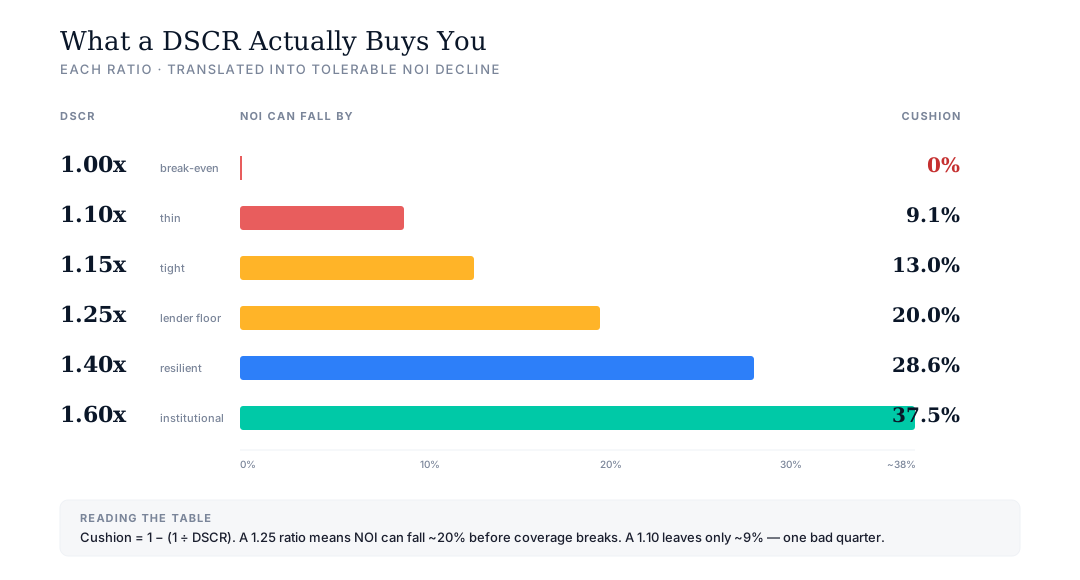
This is the part of the picture rate sheets do not put in front of investors. A 1.15 DSCR — common for retail deals that “just penciled” — leaves only about a 13% margin. A single quarter of unexpected vacancy at one unit in a fourplex is often enough to consume it. A 1.40 DSCR, by contrast, can absorb a meaningful vacancy event and a moderate expense surprise in the same year without dipping below break-even.
The right way to set a personal DSCR target is to back into it from the worst realistic NOI scenario, not the lender’s floor. If a market’s historical vacancy spikes to 8% in a downturn, and the deal’s day-one DSCR is 1.10, the math has already lost.
Stress-Testing the Three Pressure Points
Three variables move DSCR meaningfully over a holding period. Stressing each in isolation, then together, is the work that turns DSCR from a closing number into a risk metric.
Rate. For floating-rate or short-fixed loans, the rate at maturity is the dominant DSCR risk. A 150 basis point rate move adds roughly $4,500 to $6,000 of annual debt service per $300,000 of loan balance, depending on amortization. That cost lands entirely on the denominator of DSCR — NOI does not move, but coverage falls. Lenders themselves now stress underwriting at 50 to 100 basis points above current rates as a matter of policy; an investor should stress at least that much, and more for short-duration debt.
Vacancy. Most pro formas assume 5% economic vacancy. Realistic stress is the historical peak vacancy in the submarket, not the average. Sun Belt markets that ran 4% vacancy in 2022 ran 10% to 12% in 2024–2025; a deal that assumed 5% and got 10% lost half its assumed economic cushion.
Operating expenses. Insurance has repriced 30% to 100% in several U.S. markets since 2023. Property taxes reassess on sale in many jurisdictions. Repairs and management costs inflate. Holding expenses flat at the seller’s trailing-twelve number is the most common pro forma error in retail underwriting.
The discipline is to run each shock individually, then combine the two most plausible into a stacked stress. A deal that holds DSCR above 1.10 under a stacked stress has structural resilience. A deal that drops below 1.0 in any single-variable stress has hidden fragility regardless of what the closing DSCR reads.
A Worked Example
Consider a small multifamily acquisition. The numbers are illustrative but realistic for a Class B fourplex in a secondary U.S. market.
| Line | Year 1 |
|---|---|
| Gross rent | $48,000 |
| Less: vacancy and credit loss (5%) | ($2,400) |
| Effective gross income | $45,600 |
| Operating expenses (34% of EGI) | ($15,600) |
| Net operating income | $30,000 |
| Annual debt service ($300K loan at 7.25%, 30-yr) | ($24,540) |
| DSCR | 1.22x |
At closing, the deal clears the lender’s 1.20x program minimum with 2 basis points to spare. The investor reads “DSCR 1.22” and assumes the property is covering.
Now stress the three pressure points, one at a time.
Rate shock. This is a 7/1 ARM; at year seven, the rate resets to 8.75%. Annual debt service rises to roughly $28,300. NOI unchanged. DSCR falls to 1.06x. The deal still pays the mortgage, but barely, and any second shock takes it negative.
Vacancy shock. A regional softening pushes vacancy from 5% to 10%. Effective gross income falls to $43,200; operating expenses (mostly fixed) hold near $15,600; NOI drops to $27,600. At the original 7.25% rate, DSCR falls to 1.12x.
Expense shock. Insurance reprices 40% (an additional $1,800 annually) and property taxes reassess at sale (another $1,200). Operating expenses rise to $18,600; NOI falls to $27,000. DSCR falls to 1.10x.
Stacked stress. A rate reset to 8.75% plus a vacancy uptick to 8% plus a $2,400 expense surprise. NOI lands near $26,000; debt service near $28,300. DSCR falls to 0.92x. The property no longer covers its mortgage from operations. The operator has to subsidize debt service out of pocket — or sell, often into a soft market.
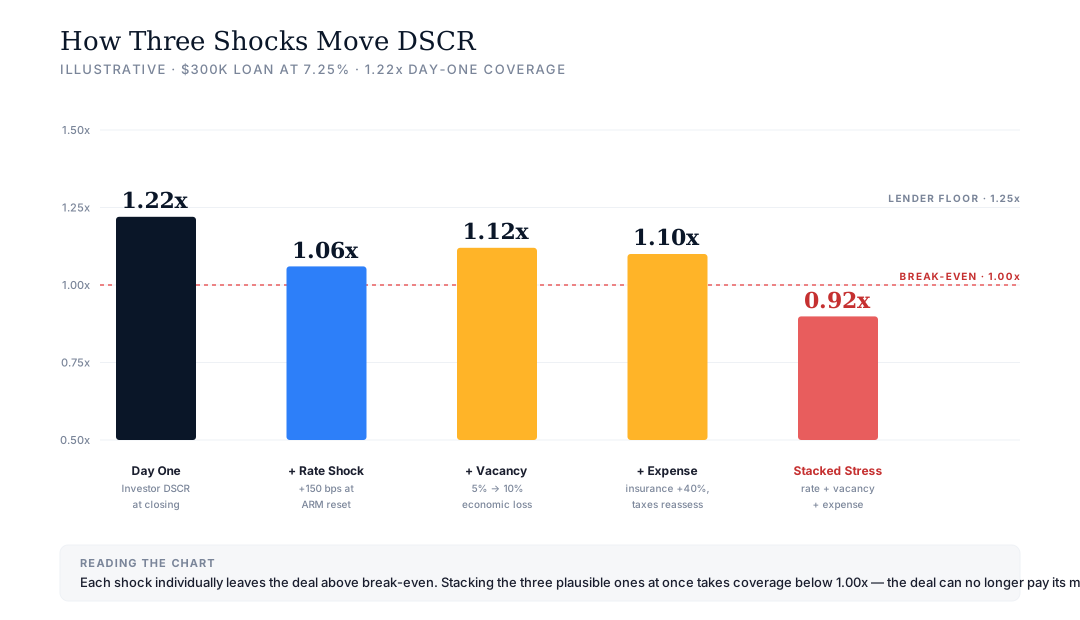
A 1.22 closing DSCR did not predict this outcome. A stress test did. The deal is not necessarily un-doable — the operator might still take it with more equity down, a longer fixed-rate, or a lower price — but the decision is now informed.
A Process for Your Next Deal
When the next acquisition surfaces, compute three DSCRs before making an offer.
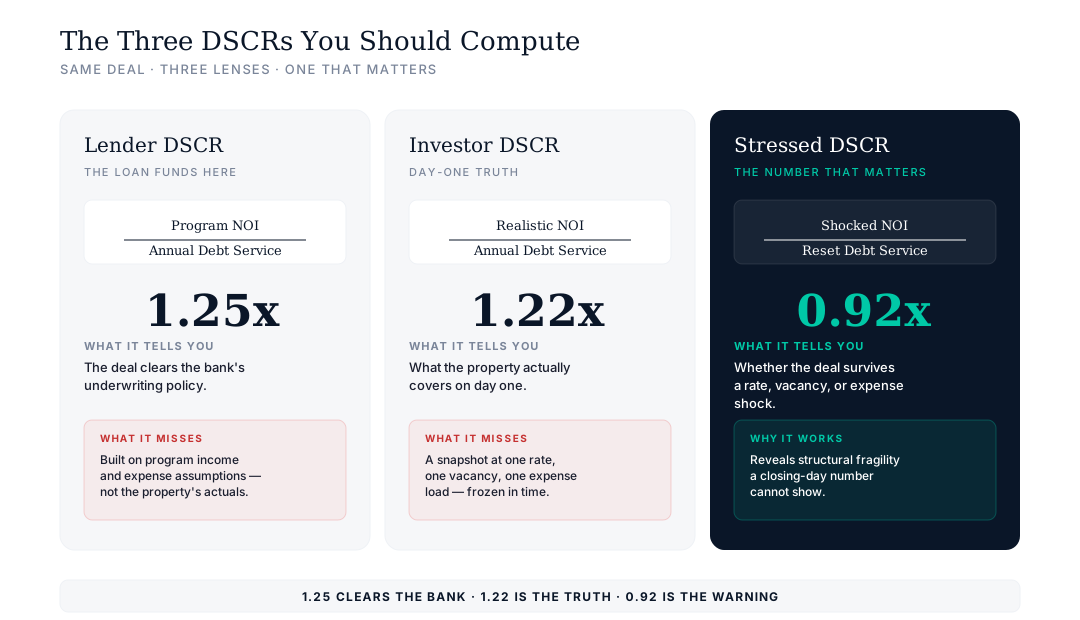
- Lender DSCR — the number the bank will quote. Useful for confirming the loan funds and for negotiating terms. Not useful for risk.
- Investor DSCR — the same formula with the operator’s realistic income assumption (in-place rent, no aspirational lifts), full trailing expenses (re-quoted for current insurance and taxes), and the actual debt service. This is the day-one truth of the deal.
- Stressed DSCR — the investor DSCR re-run under a rate shock (+150 to +200 basis points if the loan is short-duration), a vacancy shock (to the submarket’s historical peak), and an expense shock (10% to 20% above trailing). Run each individually, then stack the two most plausible.
Three targets, calibrated for retail underwriting in 2026: lender DSCR ≥ 1.25, investor DSCR ≥ 1.20, stressed DSCR ≥ 1.05 under a stacked scenario. Deals that pass the first two but fail the third are the ones that close in good markets and break in bad ones. Deals that pass all three have structural resilience.
Frequently Asked Questions
What is a good DSCR for a rental property?
For long-term fixed-rate loans on stabilized small multifamily, 1.25x is the typical lender minimum and a reasonable floor for the investor’s own DSCR. For shorter-duration or floating-rate debt, 1.35x to 1.40x at closing is more appropriate because the cushion will be tested at the next rate reset.
Why does the lender’s DSCR differ from mine?
The lender computes DSCR with program-mandated assumptions about income, vacancy, and expenses — often more conservative on income and less conservative on expenses than the investor’s actual operating numbers. The lender’s number is calibrated to underwriting policy, not to the property’s specific operating reality.
How is DSCR different from cash-on-cash return?
DSCR measures the property’s ability to service its debt from NOI before any equity return; it is a credit metric. Cash-on-cash return measures the after-debt-service cash flow against the equity invested; it is a return metric. A deal can have a strong DSCR and a weak cash-on-cash, or vice versa.
Should I stress DSCR even on a 30-year fixed-rate loan?
Yes. Rate risk is the most dramatic stress but not the only one. Vacancy and operating expenses move on any property regardless of debt structure. A 30-year fixed eliminates the rate variable but leaves vacancy and expense shocks fully in play, and those alone can compress DSCR by 20 to 30 basis points in a bad year.
Is debt yield the same thing as DSCR?
No. Debt yield divides NOI by the loan balance, which strips out rate and amortization entirely. DSCR includes them. Debt yield is the better metric for cross-comparing leverage exposure across deals with different loan terms. DSCR is the better metric for asking “can this specific loan be paid from this specific property’s income?”
AtlasTerminal computes lender DSCR, investor DSCR, and stressed DSCR side-by-side for any acquisition, with built-in rate, vacancy, and expense shocks. Stress test your next deal before the closing table sets the assumptions for you.