Part of our complete guide to DSCR and debt coverage.
Most retail real estate underwriting stops at three numbers: cap rate at acquisition, cash-on-cash return at stabilization, and debt service coverage ratio at the modeled interest rate. Each is useful. None of them tells the investor whether the property can be refinanced when the loan term ends. In a market where origination rates were 3.5% and prevailing rates are 7%, that distinction has stopped being theoretical. It is the central underwriting question for any acquisition financed today.
The metric that answers it is debt yield. It is the primary screen used by CMBS conduits, agency lenders, and life insurance companies to size refinance proceeds. It is independent of interest rate, loan term, and amortization schedule. And in 2025 it cleanly separated the loans that refinanced from the ones that did not — paid-off loans averaged debt yields of 13–14%, while loans that failed to refinance averaged closer to 9%. Retail investors who underwrite acquisitions without modeling debt yield at exit are taking refinance risk they have not measured.
What Debt Yield Actually Measures
Debt yield is calculated as net operating income divided by total loan amount, expressed as a percentage. A property generating $100,000 of NOI with a $1,250,000 loan has a debt yield of 8%. The metric answers a specific question: if the lender had to take back the property and operate it directly, what unlevered return would the loan balance produce?
That framing is why lenders care about it. Cap rate is a market valuation construct that moves with interest rates and investor sentiment. DSCR depends on the interest rate and amortization schedule used at underwriting, both of which can be temporarily flattering. Loan-to-value depends on appraised value, which is itself a function of cap rates that may not hold. Debt yield strips out all three. It collapses the underwriting question to its rate-independent core: does the property generate enough income to support the loan size on a pure cash basis?
That property — independence from interest rate and valuation — is exactly why debt yield has become the dominant refinance constraint in 2026. Lenders cannot trust today’s cap rates to hold through a loan term. They cannot trust today’s interest rates to persist. They can verify NOI, and they can require that NOI be large relative to loan balance. The minimum debt yield is the lender’s hedge against everything else moving against them.
Debt Yield Versus DSCR
DSCR — debt service coverage ratio — is the more familiar metric. It divides NOI by annual debt service. A 1.25x DSCR means NOI covers debt service with 25% headroom. Retail investors typically size loans to a DSCR floor and stop there.
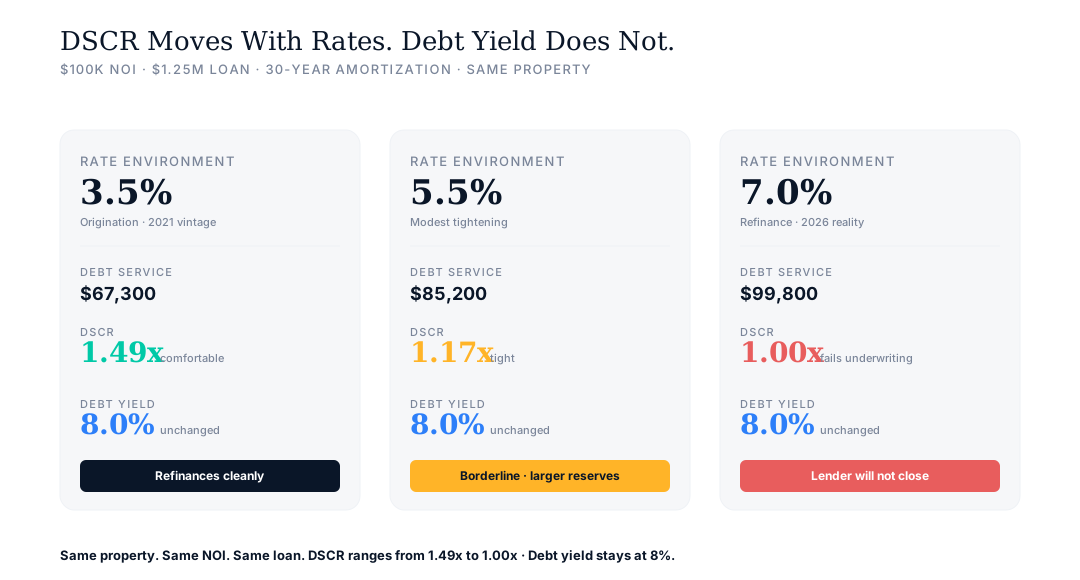
The problem is that DSCR is rate-sensitive in a way that masks risk. The same property with the same NOI produces dramatically different DSCRs depending on the interest rate assumption:
| NOI | Loan Amount | Rate | Amortization | Annual Debt Service | DSCR | Debt Yield |
|---|---|---|---|---|---|---|
| $100,000 | $1,250,000 | 3.5% | 30-year | $67,300 | 1.49x | 8.0% |
| $100,000 | $1,250,000 | 5.5% | 30-year | $85,200 | 1.17x | 8.0% |
| $100,000 | $1,250,000 | 7.0% | 30-year | $99,800 | 1.00x | 8.0% |
The property is the same. The loan is the same. DSCR ranges from “comfortably refinanceable” to “lender will not close” depending entirely on the rate used. Debt yield does not move. That is the point. An investor underwriting an acquisition at 5.5% who assumes their refinance will clear DSCR underwriting at the same rate is making an assumption the lender will not.
The 2026 Refinance Wall in Numbers
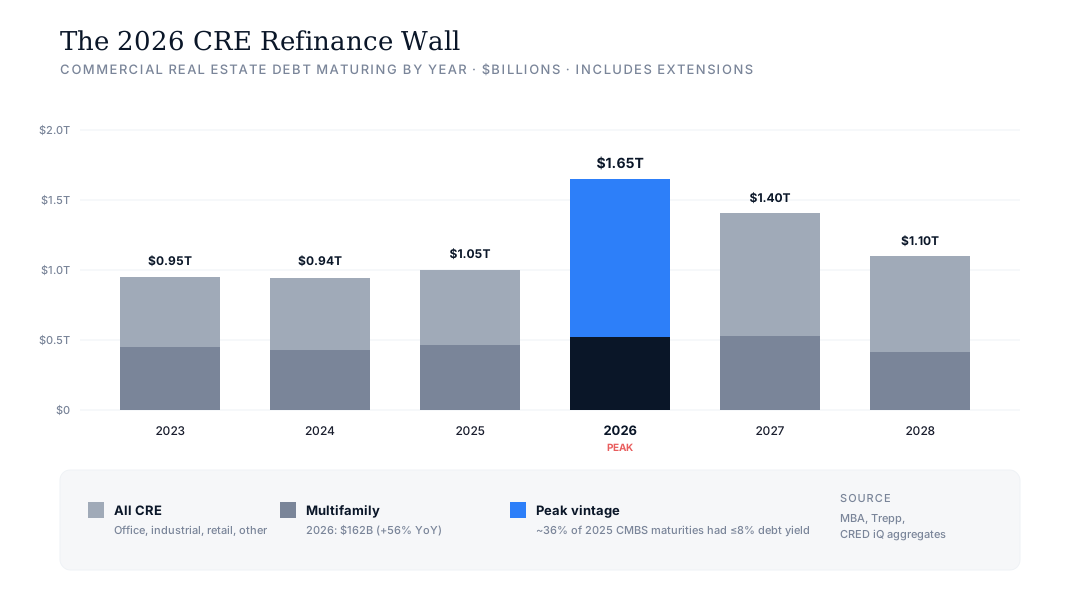
The reason debt yield has moved from an obscure CMBS metric to a deciding factor in retail underwriting is the scale of debt now hitting maturity. Roughly $1.5–$1.8 trillion of commercial real estate debt is maturing in 2026, the largest single-year refinance volume on record. Multifamily-specific maturities are jumping from approximately $104 billion in 2025 to $162 billion in 2026 — a 56% increase — and remain elevated at $168 billion in 2027.
The composition of that maturity wall matters more than the headline figure. A disproportionate share originated in 2020–2022, when ten-year Treasury yields ran between 0.7% and 1.5% and stabilized multifamily traded at 4–5% cap rates. Origination underwriting on those loans used DSCR coverage at interest rates between 3% and 4%, and frequently sized loans to a debt yield of 8–9%. Five years later, prevailing refinance rates are roughly double the origination rates, and cap rates have widened by 100–200 basis points.
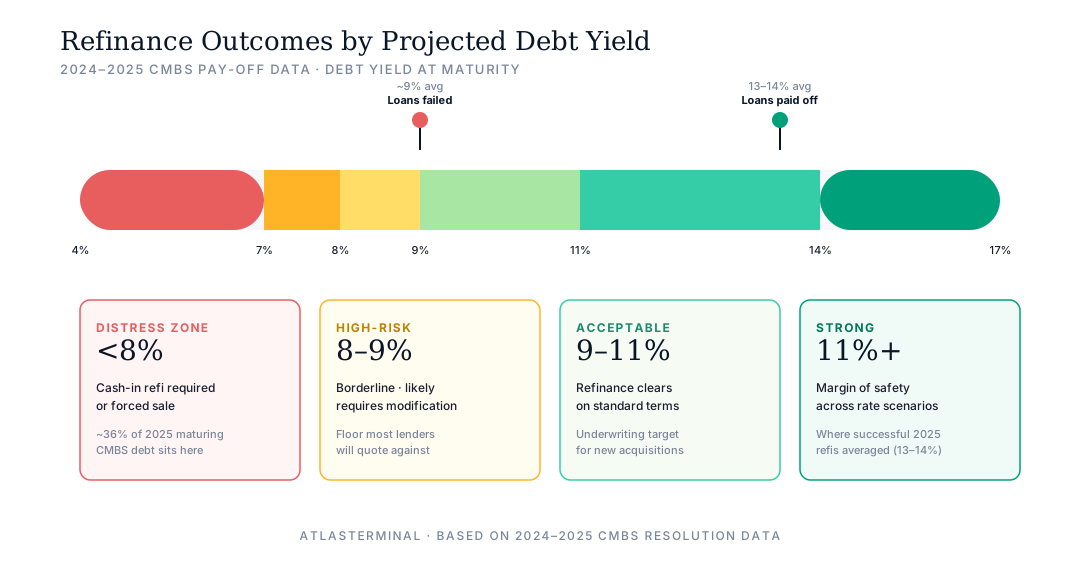
The result is a population of loans where the original underwriting metrics no longer support refinancing. A property bought at a 4.5% cap rate in 2021 with a 75% LTV loan now needs to demonstrate debt yield against an unchanged loan balance — and may have seen NOI rise modestly while values fell. In 2025, roughly 36% of hard CMBS maturities — about $27 billion — carried debt yields of 8% or less, the threshold most lenders identify as the high-risk refinancing zone. These are not loans that need a small extension. They are loans that need either cash-in refinances, capital partners, or sale.
What “Extend and Pretend” Has Done
Through 2024 and 2025, lenders absorbed the early waves of maturity stress by granting short-term extensions — the “extend and pretend” pattern that has dominated CRE workouts since 2023. The result was not resolution but deferral. Many of those extended loans are now stacked into 2026 alongside the natural maturity calendar, compounding the volume the market must clear.
In Q3 2025, total distressed CRE volume reached $126.6 billion, with multifamily accounting for $22.8 billion. Rolling 12-month troubled apartment sales reached $13.8 billion by mid-2025. These figures reflect the leading edge of the maturity wall, not the peak. For investors evaluating acquisitions in 2026, the implication is straightforward: a meaningful share of the inventory that will trade in the next 18 months will trade because the seller could not refinance, not because the seller chose to sell.
The 8% Threshold and What It Means at the Property Level
The clearest data signal from the 2024–2025 refinance cycle is the spread between debt yields on loans that refinanced successfully and loans that did not. Loans that paid off at maturity carried average debt yields between 13% and 14%. Loans that failed to refinance — those requiring modification, extension, or workout — clustered around 9%. The 8% threshold is the practical floor below which most institutional lenders will not size new debt without significant cash-in.
For a retail investor underwriting an acquisition today, this is the number that should anchor the analysis. Not the in-place cap rate. Not the proforma cap rate at year three. The debt yield at the loan balance the investor expects to be refinancing — five or seven or ten years from today, against an NOI the investor can defensibly project.
The construction is simple. Assume the loan balance at refinance (original principal minus scheduled amortization, or original principal for interest-only loans). Project NOI at exit using assumptions the investor can defend with submarket data. Divide. If the result is below 9%, the property is being underwritten with refinance risk that the current lending market has explicitly priced as elevated. If it is below 8%, the investor is underwriting a position that, on current evidence, has roughly even odds of refinancing on standard terms.
This calculation is not a substitute for DSCR sizing at acquisition. It is a constraint that runs alongside it. An investor who passes DSCR but fails projected debt yield at refinance is buying a property whose financing will work today and may not work tomorrow.
A Worked Example: The 2021 Vintage Refinance
Consider a hypothetical $1.0 million stabilized fourplex acquired in mid-2021. NOI at acquisition was $50,000. The acquisition was financed at 75% LTV — a $750,000 loan — at a fixed rate of 3.75% on a five-year term with thirty-year amortization. Cap rate at acquisition was 5.0%.
The original underwriting metrics looked solid: DSCR of 1.20x, debt yield of 6.7% on the original loan. Even by 2021 standards, the debt yield was thin — but rates were low enough that DSCR cleared lender requirements, and the metric was not generally treated as binding.
Fast-forward to mid-2026. The loan is maturing. NOI has grown modestly to $58,000 — 16% over five years, roughly in line with submarket rent trajectories adjusted for expense inflation. Cap rates in the submarket have widened from 5.0% to 6.5%. Prevailing refinance rates are approximately 7.0% on a five-year fixed term.
The principal balance at maturity, after five years of amortization, is approximately $678,000. Debt yield on that balance at current NOI is 8.6% — within range of the high-risk zone but above the strict 8% floor. DSCR at the prevailing rate of 7.0% and thirty-year amortization on $678,000 is approximately 1.07x, which most lenders will not accept. Property value at the new cap rate is approximately $892,000 — meaning the loan is at 76% LTV against a value that has fallen below the acquisition price.
The investor’s options narrow to: a cash-in refinance reducing the loan balance to roughly $580,000 (bringing DSCR above 1.20x), a sale at a price below acquisition, or a short-term extension on unfavorable terms. None of these were visible in the original 2021 underwriting, which used DSCR alone.
A debt yield discipline applied at acquisition would have flagged this risk. Underwriting to a 9% projected debt yield at exit, against modest NOI growth assumptions, would have required either a larger equity check, a lower purchase price, or a different deal. The investor in that scenario would have either passed or entered the position with a margin of safety against exactly the refinance environment that has now materialized.
Applying Debt Yield Discipline to Current Underwriting
The practical framework for incorporating debt yield into acquisition analysis runs in four steps.
Step one: model NOI at the loan maturity date. Use submarket rent growth assumptions grounded in zip-code-level data, not metro averages, and apply expense growth assumptions that include realistic insurance and tax escalators. The forecast does not need to be precise — it needs to be defensible at the low end.
Step two: project the loan balance at maturity. For fixed-rate amortizing loans, this is a straightforward calculation. For interest-only or floating-rate loans, the balance at maturity equals the origination balance, which is generally a less favorable starting point.
Step three: calculate projected debt yield as NOI-at-maturity divided by loan-balance-at-maturity. Compare against a 9% floor for institutional-quality assets in primary markets and 10% for secondary markets or higher-risk asset classes.
Step four: stress test the NOI assumption. Reduce projected NOI by 10% and recalculate. If the stressed debt yield falls below 8%, the deal carries refinance risk that should be priced into either the purchase price or the required equity return.
This framework does not require proprietary data or institutional tooling. It requires disciplined application of public-market refinance benchmarks to the investor’s own pro forma. The institutional advantage is not in access — it is in the habit of asking the question.
The Strategic Implication
The 2026 refinance wall is producing two distinct populations of properties on the market: forced sellers whose properties are priced by the constraints of their existing capital stack, and discretionary sellers whose properties are priced on operating fundamentals. Both populations exist in every submarket. Distinguishing between them is the analytical task that defines opportunity in the current cycle.
For retail investors, the implication is operational. Underwriting that integrates debt yield discipline at acquisition will both screen out deals where the financing will not work in five years and identify deals where motivated sellers are pricing in their own refinance failure. The metric is not new. It has been the dominant CMBS sizing constraint for two decades. What is new is the market environment that has made it the deciding factor in whether retail acquisitions made today will be refinanceable when their term ends.
Investors who limit their analysis to cap rate, cash-on-cash, and DSCR are not necessarily underwriting incorrectly. They are underwriting incompletely. In a refinance environment where 36% of maturing CMBS debt sits in the high-risk zone, the debt yield calculation is the difference between buying a property and buying a refinance problem.
Frequently Asked Questions
What is debt yield in commercial real estate?
Debt yield is a property’s net operating income divided by the total loan amount, expressed as a percentage. It measures the unlevered return a lender would earn if forced to take ownership of the property at the current loan balance. Unlike DSCR or LTV, it is independent of interest rate and appraised value, which is why lenders use it as the primary refinance sizing constraint.
Why does debt yield matter more than DSCR for refinance risk?
DSCR depends on the interest rate used at underwriting. The same property and loan amount can produce a DSCR of 1.50x at one rate and 1.00x at another. When refinancing, the lender uses the prevailing rate — not the rate the borrower used at acquisition. Debt yield does not move with rates, so it remains a stable measure of whether a loan size is supportable across rate environments.
What is a safe debt yield threshold?
Most institutional CMBS lenders require a minimum debt yield of 9–10% for stabilized assets in primary markets, with 8% as the practical floor for highest-quality properties. Recent refinance outcome data shows loans paying off on time averaged 13–14% debt yields, while loans failing to refinance averaged near 9%. Underwriting acquisitions to a projected 9% debt yield at exit provides meaningful margin against refinance failure.
How does the 2026 maturity wall affect retail investors?
Approximately $1.5–$1.8 trillion of commercial real estate debt matures in 2026, with multifamily maturities increasing 56% over 2025 levels. A substantial share originated at low interest rates and faces refinancing in a much higher-rate environment. Retail investors should expect elevated transaction volume from forced sellers, opportunities to acquire from motivated counterparties, and tighter lender underwriting that will require stronger debt yield metrics on new acquisitions.
How do I calculate debt yield at refinance for an acquisition I am evaluating?
Project NOI to the loan maturity date using defensible rent and expense growth assumptions. Calculate the projected loan balance at maturity, accounting for any scheduled amortization. Divide projected NOI by projected loan balance. If the result falls below 9%, the acquisition carries elevated refinance risk that should be reflected in the price paid or the required return.
AtlasTerminal integrates submarket-level NOI projections, expense escalator modeling, and debt yield stress testing into a single workflow — bringing institutional refinance discipline to single-asset acquisition analysis. Stress-test your next acquisition before the financing has to work.